
Actors Nakajima Mihoemon II as Fujiwara no Shihei, Ichikawa Ebizô III as Matsuo-maru, Ichikawa Yaozô II as Sakura-maru, and Ichimura Uzaemon IX as Umeo-maru in “Sugawara’s Secrets of Calligraphy” (“Sugawara denju tenarai kagami”)
- Date:
- About 1776
- Medium:
- Color woodblock prints; hosoban triptych
- Source:
- Art Institute of Chicago
Description
Katsukawa Shunsho assembles a four-figure composition from Sugawara Denju Tenarai Kagami ("Sugawara's Secrets of Calligraphy"), one of the three pillars of the kabuki history-play canon. The print shows Nakajima Mihoemon II as the villain Fujiwara no Shihei flanked by the three triplet brothers whose fate the play hinges on: Ichikawa Ebizo III as Matsuo-maru, Ichikawa Yaozo II as Sakura-maru, and Ichimura Uzaemon IX as Umeo-maru. The triplets, each named after a tree (pine, cherry, plum), are bound by competing loyalties: one serves Shihei, the others serve his enemy Sugawara, and the play follows their wrenching attempts to reconcile family bonds with feudal duty. Shunsho composes the four figures across the sheet in a roughly symmetrical arrangement, costumes color-coded by tree affiliation, faces individuated enough that Edo collectors could identify each player at a glance. The Katsukawa school's reform of Edo ukiyo-e yakusha-e is on full display here: a controlled palette, clear silhouettes, a disciplined printed outline, and a likeness specific to each named actor rather than the generic stage type that had characterized earlier Torii-school work. The Art Institute of Chicago preserves this impression, which functions as both a souvenir of a specific Sugawara production and as a primary document of one of Shunsho's most ambitious multi-figure designs. The print survives among the strongest demonstrations of the Katsukawa workshop's capacity to translate complex ensemble scenes into the language of single-sheet kabuki imagery.
More Prints by Katsukawa Shunshō

The Actor Arashi Sangoro II as Sakura-maru in the Play Sugawara Denju Tenarai Kagami, Performed at the Ichimura Theater in the First Month, 1772
c. 1772
Color woodblock print; hosoban; right sheet of a multisheet print

The Actor Nakamura Tomijuro I as the female fox from Mt. Ubagadake in the play "Chigo Torii Tobiiri Kitsune," performed at the Ichimura Theater in the eleventh month, 1777
c. 1777
Color woodblock print; one sheet of hosoban tetraptych

The Warrior Ômori Hikoshichi Carrying a Demon on His Back
About 1772
Color woodblock print; chûban

The Actor Segawa Tomisaburo I as the Heron Maiden (Sagi Musume)
c. 1774
Color woodblock print; hosoban
More Mount Fuji Prints
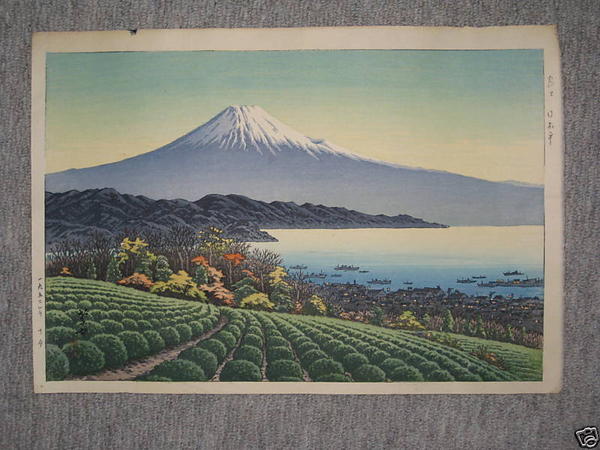
Fuji from tea farm
Woodblock print

Akasaka, Fujikawa, Okazaki, Chiryu, and Narumi, from the series "Famous Places on the Fifty-three Stations of the Tokaido, Five Stations (Tokaido gojusan eki goshuku meisho)"
c. 1830/35
Color woodblock print; oban
![Mount Fuji on a Moonlit Night, Kawai Bridge (Tsukiyo no Fuji [Kawaibashi]), from the series "Selection of Views of the Tokaido (Tokaido fukei senshu)" by Kawase Hasui](https://www.artic.edu/iiif/2/d0960668-1e73-339a-b182-fb995a54bff0/full/843,/0/default.jpg)
Mount Fuji on a Moonlit Night, Kawai Bridge (Tsukiyo no Fuji [Kawaibashi]), from the series "Selection of Views of the Tokaido (Tokaido fukei senshu)"
1947
Color woodblock print; oban

Mt. Fuji in Rain (Ame no Fuji)
n.d.
Color woodblock print
Featured in Collections
Curated cross-cuts that include this print.
Frequently Asked Questions
Actors Nakajima Mihoemon II as Fujiwara no Shihei, Ichikawa Ebizô III as Matsuo-maru, Ichikawa Yaozô II as Sakura-maru, and Ichimura Uzaemon IX as Umeo-maru in “Sugawara’s Secrets of Calligraphy” (“Sugawara denju tenarai kagami”) was created by Katsukawa Shunshō (勝川春章) in About 1776.
Actors Nakajima Mihoemon II as Fujiwara no Shihei, Ichikawa Ebizô III as Matsuo-maru, Ichikawa Yaozô II as Sakura-maru, and Ichimura Uzaemon IX as Umeo-maru in “Sugawara’s Secrets of Calligraphy” (“Sugawara denju tenarai kagami”) depicts mount fuji.