
The Actor Ichikawa Monnosuke II as the Renegade Monk Zenjibo Disguised as Dainichibo in the Play Edo no Fuji Wakayagi Soga, Performed at the Nakamura Theater in the First Month, 1789
- Date:
- c. 1789
- Medium:
- Color woodblock print; hosoban
- Source:
- Art Institute of Chicago
Description
This print by Katsukawa Shunsho records Ichikawa Monnosuke II in the part of the renegade monk Zenjibo, disguised as Dainichibo, in Edo no Fuji Wakayagi Soga, mounted at the Nakamura Theater in the first month of 1789. The first-month kaomise productions were the heart of the Edo theatre calendar, presenting the company's contracted players in newly composed Soga-themed dramas, and the role of a corrupted cleric in disguise gave Monnosuke an opportunity for a layered performance of false piety. Shunsho's yakusha-e captures this duality without resorting to the violent contortion of later Edo ukiyo-e portraiture. As founder of the Katsukawa school, he had by the late 1780s established the conventions that virtually all single-actor printmaking would follow until the brief eruption of Sharaku in 1794. The narrow hosoban format frames the body almost full-length, kosode and surplice rendered with clear contour and unmodulated colour, while subtle expressive notes are concentrated in the face and hands. This impression is held in the Clarence Buckingham Collection at the Art Institute of Chicago, where it joins a substantial body of Shunsho and Katsukawa school yakusha-e that documents the casts and repertoire of the three licensed Edo theatres during the An'ei and Tenmei eras. Such prints functioned both as souvenirs for theatre-goers and as portable advertising for the actors themselves, intertwining the worlds of commercial printmaking and stage celebrity that defined late eighteenth-century Edo popular culture.
More Prints by Katsukawa Shunshō

The Actor Arashi Sangoro II as Sakura-maru in the Play Sugawara Denju Tenarai Kagami, Performed at the Ichimura Theater in the First Month, 1772
c. 1772
Color woodblock print; hosoban; right sheet of a multisheet print

The Actor Nakamura Tomijuro I as the female fox from Mt. Ubagadake in the play "Chigo Torii Tobiiri Kitsune," performed at the Ichimura Theater in the eleventh month, 1777
c. 1777
Color woodblock print; one sheet of hosoban tetraptych

The Warrior Ômori Hikoshichi Carrying a Demon on His Back
About 1772
Color woodblock print; chûban

The Actor Segawa Tomisaburo I as the Heron Maiden (Sagi Musume)
c. 1774
Color woodblock print; hosoban
More Mount Fuji Prints
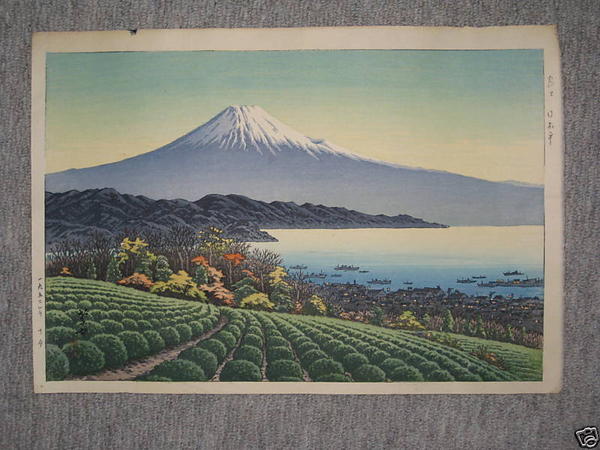
Fuji from tea farm
Woodblock print

Akasaka, Fujikawa, Okazaki, Chiryu, and Narumi, from the series "Famous Places on the Fifty-three Stations of the Tokaido, Five Stations (Tokaido gojusan eki goshuku meisho)"
c. 1830/35
Color woodblock print; oban
![Mount Fuji on a Moonlit Night, Kawai Bridge (Tsukiyo no Fuji [Kawaibashi]), from the series "Selection of Views of the Tokaido (Tokaido fukei senshu)" by Kawase Hasui](https://www.artic.edu/iiif/2/d0960668-1e73-339a-b182-fb995a54bff0/full/843,/0/default.jpg)
Mount Fuji on a Moonlit Night, Kawai Bridge (Tsukiyo no Fuji [Kawaibashi]), from the series "Selection of Views of the Tokaido (Tokaido fukei senshu)"
1947
Color woodblock print; oban

Mt. Fuji in Rain (Ame no Fuji)
n.d.
Color woodblock print
Featured in Collections
Curated cross-cuts that include this print.
Frequently Asked Questions
The Actor Ichikawa Monnosuke II as the Renegade Monk Zenjibo Disguised as Dainichibo in the Play Edo no Fuji Wakayagi Soga, Performed at the Nakamura Theater in the First Month, 1789 was created by Katsukawa Shunshō (勝川春章) in c. 1789.
The Actor Ichikawa Monnosuke II as the Renegade Monk Zenjibo Disguised as Dainichibo in the Play Edo no Fuji Wakayagi Soga, Performed at the Nakamura Theater in the First Month, 1789 depicts mount fuji.