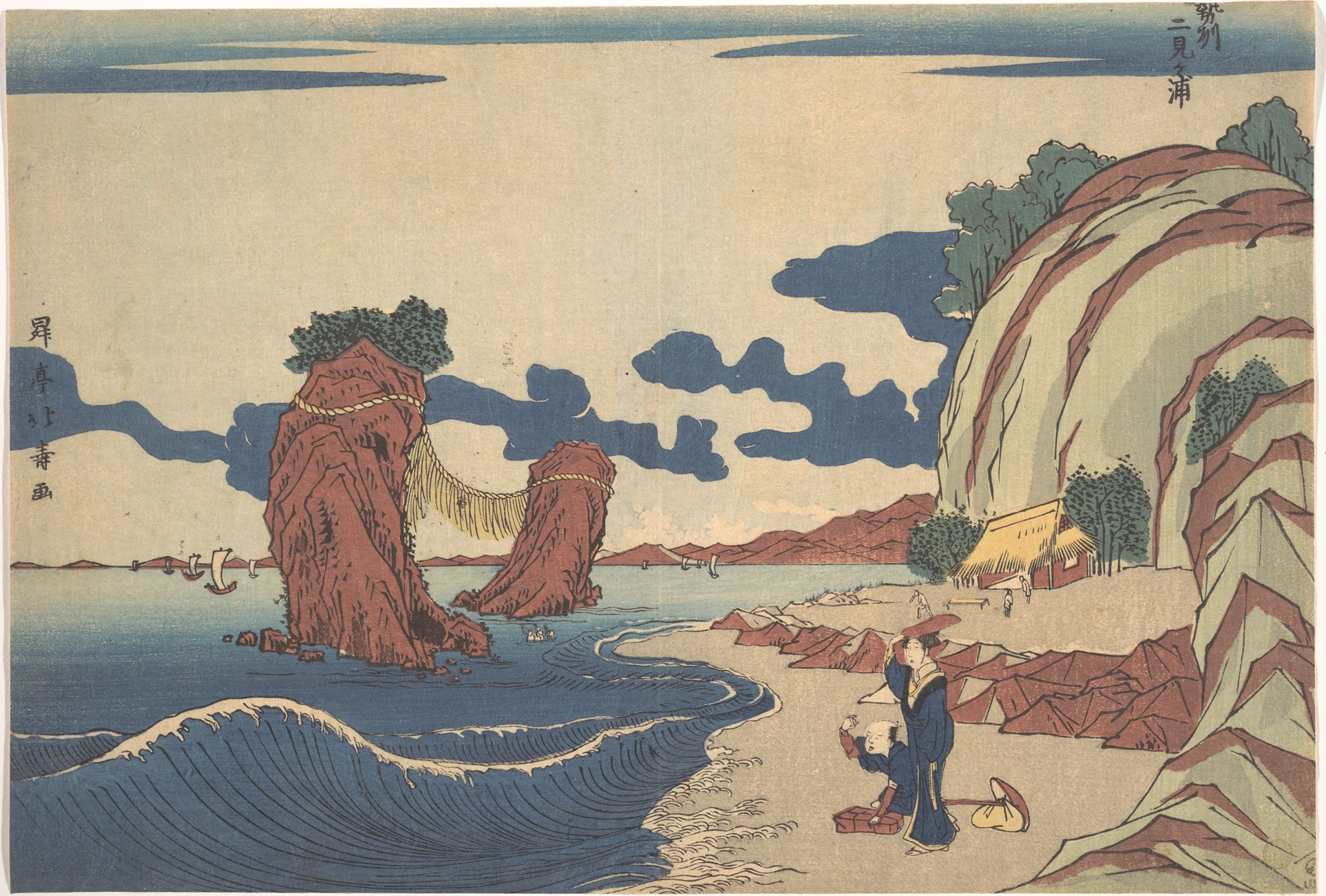
View of Futami Beach at Ise
- Date:
- ca. 1810–1820
- Medium:
- Woodblock print; ink and color on paper
- Source:
- Metropolitan Museum of Art
Description
This woodblock print in ink and color on paper, dated to circa 1810-1820 and held by the Metropolitan Museum of Art, depicts the celebrated Futami Beach at Ise on the Pacific coast south of Edo. Futami no Ura is famous for the meoto iwa, the wedded rocks, two outcroppings just offshore connected by a sacred shimenawa rope and venerated as a manifestation of the male and female creator deities Izanagi and Izanami. The site was a major pilgrimage destination, particularly for travelers visiting the nearby Ise Grand Shrine, and its iconic seascape became a stock subject of Edo period landscape prints. Hokuju treats the view with his characteristic perspective scheme and graded blue palette, the two rocks rising from the bay as compositional anchors with the sun (or moon) hanging in the sky above them. The atmosphere is rendered with the cool, almost crystalline clarity that distinguishes his mature work, and the figures of pilgrims and travelers on the beach are scaled to emphasize the vastness of the seascape. The print is one of the early treatments of a subject that Hiroshige and other later designers would return to repeatedly, and Hokuju's version helps establish the visual conventions of the Futami view.
More Prints by Katsushika Hokuju


Frequently Asked Questions
View of Futami Beach at Ise was created by Katsushika Hokuju (葛飾北寿) in ca. 1810–1820.