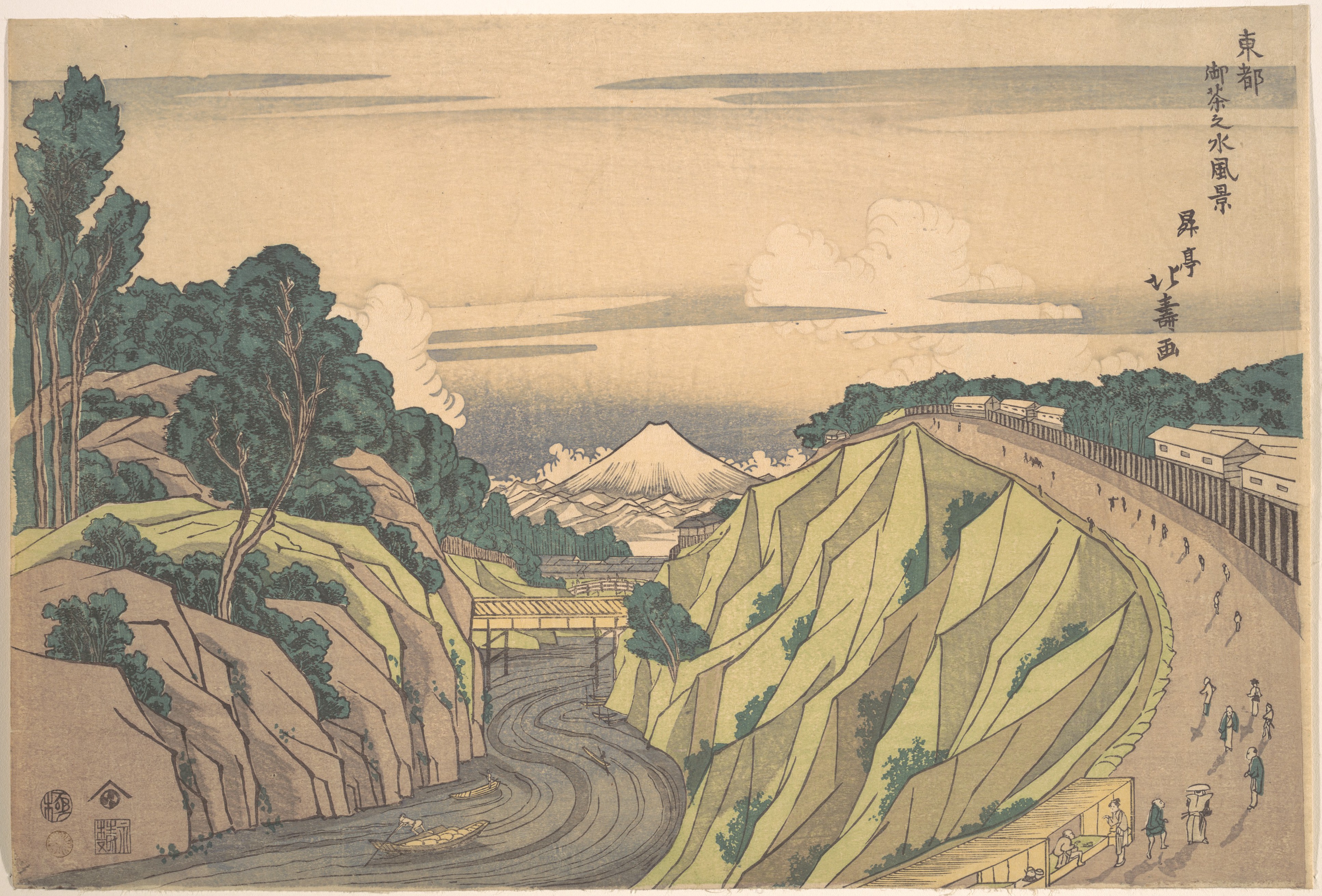
View of Ochanomizu in the Eastern Capital
- Date:
- ca. 1810–1820
- Medium:
- Woodblock print; ink and color on paper
- Source:
- Metropolitan Museum of Art
Description
This woodblock print in ink and color on paper, dated to circa 1810-1820 and held by the Metropolitan Museum of Art, depicts Ochanomizu, the dramatic gorge cut through central Edo by the Kanda River. The name Ochanomizu, literally water for tea, refers to a spring whose water was reportedly used to prepare tea for the shogun. The gorge was a notable feat of early Edo civil engineering, deepened by the shogunate to provide flood control and a defensive line, and its steep wooded banks and arching bridges made it a celebrated meisho (famous place) within the city. Hokuju shows the river with the curving cliffs of the gorge rising on either side, a bridge spanning the channel in the middle distance, and figures of travelers and washerwomen at the water's edge. The composition deploys his signature perspective and graded blue water effects, and the verdant treatment of the wooded banks introduces green into a palette he otherwise dominated by cool blues. The Ochanomizu view became a staple subject of Edo landscape prints, treated repeatedly by Hokusai and Hiroshige in subsequent decades, and Hokuju's version stands as an important early formulation of the iconography.
More Prints by Katsushika Hokuju


Frequently Asked Questions
View of Ochanomizu in the Eastern Capital was created by Katsushika Hokuju (葛飾北寿) in ca. 1810–1820.