
Hanging up dyed cloth
- Date:
- c. 1805
- Medium:
- Color woodblock print; nagaban, surimono
- Source:
- Art Institute of Chicago
Description
Hanging up Dyed Cloth is an early ukiyo-e print by Katsushika Hokusai dated around 1800, preserved in the Art Institute of Chicago. The design depicts the everyday spectacle of long lengths of newly dyed fabric being stretched and hung out to dry, a familiar sight along the rivers and dyers' yards of Edo. Towering vertical bolts of cloth, often patterned with crests, stripes, or freehand designs, dominate the composition, while figures of dyers and onlookers cluster at their bases. The result is a striking visual rhythm of soaring textile columns punctuated by sky and small human silhouettes, an arrangement that anticipates the strong vertical landscapes Hokusai would later perfect. As an Edo ukiyo-e print, the design celebrates the labor and design economy of textile production in a city that consumed an enormous quantity of dyed cotton and silk. Hokusai treats the dyer's yard as a kind of open-air gallery in which patterns, family crests, and seasonal motifs become genuinely public art, displayed to the city before being cut and sewn into kimonos. The print also rewards attention as a study of color and registration; the careful printing of multicolor patterns on the hanging fabrics is itself a demonstration of woodblock skill. By transforming a humble industrial scene into an image of restrained grandeur, Hokusai affirms the close kinship between ukiyo-e print culture and the broader visual life of Edo.
More Prints by Katsushika Hokusai

The Fishermen of Katase Hauling in Their Nets: The Purple Shell (Murasakigai)
1821
Color woodblock print with metallic pigments; surimono shikishiban

Burdock Root (Kurama gobo), from the series "A Selection of Horses (Uma-zukushi)"
1822
Color woodblock print; shikishiban, surimono

Horse Shells (Umagai), from the series "A Selection of Horses (Uma-zukushi)"
1822
Color woodblock print; shikishiban, surimono

Orange Orchids, from an untitled series of flowers
c. 1832
Color woodblock print; oban
More Landscapes Prints

Lake Kugushi in Wakasa Province (Wakasa Kugushiko), from the series Souvenirs of Travel I (Tabi miyage dai isshu)"
Wakasa Kugushiko
1920
Color woodblock print; oban
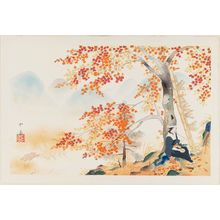
Autumn Maple Leaves at Takao, from the album Eight Views of Kyoto (Kyôto hakkei)
Woodblock print

The Beach at Kaiganji in Sanuki Province (Sanuki Kaiganji no hama), from the series "Collection of Views of Japan II, Kansai Edition (Nihon fukei shu II Kansai hen)"
1934
Color woodblock print; oban

Tea Kettle, section of a sheet from the series "Mirror of Stone Rubbings of Views of the Provinces" (Kohon meihitsu ishizuri kagami)
n.d.
Woodblock print; ishizuri-e, section of harimaze sheet
Featured in Collections
Curated cross-cuts that include this print.
Frequently Asked Questions
Hanging up dyed cloth was created by Katsushika Hokusai (葛飾北斎) in c. 1805.
Hanging up dyed cloth depicts landscapes.