
Nihonbashi Bridge in Edo
- Date:
- 1830–33
- Medium:
- Woodblock print (nishiki-e), ink and color on paper
- Source:
- Art Institute of Chicago
Description
In Nihonbashi Bridge in Edo, dated about 1830 and part of his Thirty-six Views of Mount Fuji series, Katsushika Hokusai turns to the symbolic heart of the shogunal capital. The Nihonbashi was the zero milestone from which all distances on Japan's highways were measured, and Hokusai packs its planked span with porters, merchants, samurai, and townspeople streaming in both directions. Beyond the bridge, the white walls and tiled rooftops of the warehouse district line the canal, and the dome of Edo Castle rises in the middle distance, while Mount Fuji floats like a pale blue specter on the horizon. The print uses sharp orthogonals and tightly stacked architectural geometry to create one of the most striking demonstrations of perspective in any Edo ukiyo-e print of the period. Hokusai exploits this technique to compress the city into a single legible vista, allowing the viewer to read the social and economic engine of Edo at a glance: commerce on the bridge, storage along the canal, governance in the castle, and the sacred mountain presiding above it all. The Art Institute of Chicago impression preserves the cool blues that anchor the design and the meticulous block carving that records every roof tile and figure. As a ukiyo-e print, it shows Hokusai near the height of his powers, fusing topographical reportage with the contemplative framing of Fuji that gives the series its spiritual coherence. Collectors prize Nihonbashi Bridge in Edo as both a portrait of the city Hokusai knew intimately and as a textbook example of how Japanese woodblock landscape absorbed and transformed Western pictorial space.
More Prints by Katsushika Hokusai
Hokusai manga (Hokusai Sketchbooks)
19th century
Woodblock-printed book; ink and light color on paper
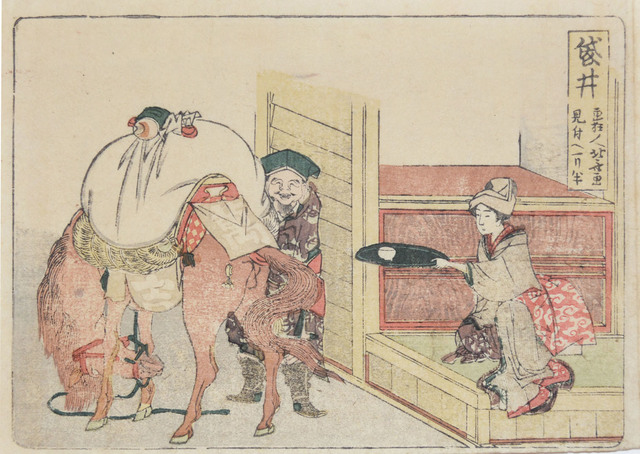
Fukuroi
1804
Japanese woodblock print

The Fishermen of Katase Hauling in Their Nets: The Purple Shell (Murasakigai)
1821
Color woodblock print with metallic pigments; surimono shikishiban

Burdock Root (Kurama gobo), from the series "A Selection of Horses (Uma-zukushi)"
1822
Color woodblock print; shikishiban, surimono
More Landscapes Prints

Lake Kugushi in Wakasa Province (Wakasa Kugushiko), from the series Souvenirs of Travel I (Tabi miyage dai isshu)"
Wakasa Kugushiko
1920
Color woodblock print; oban
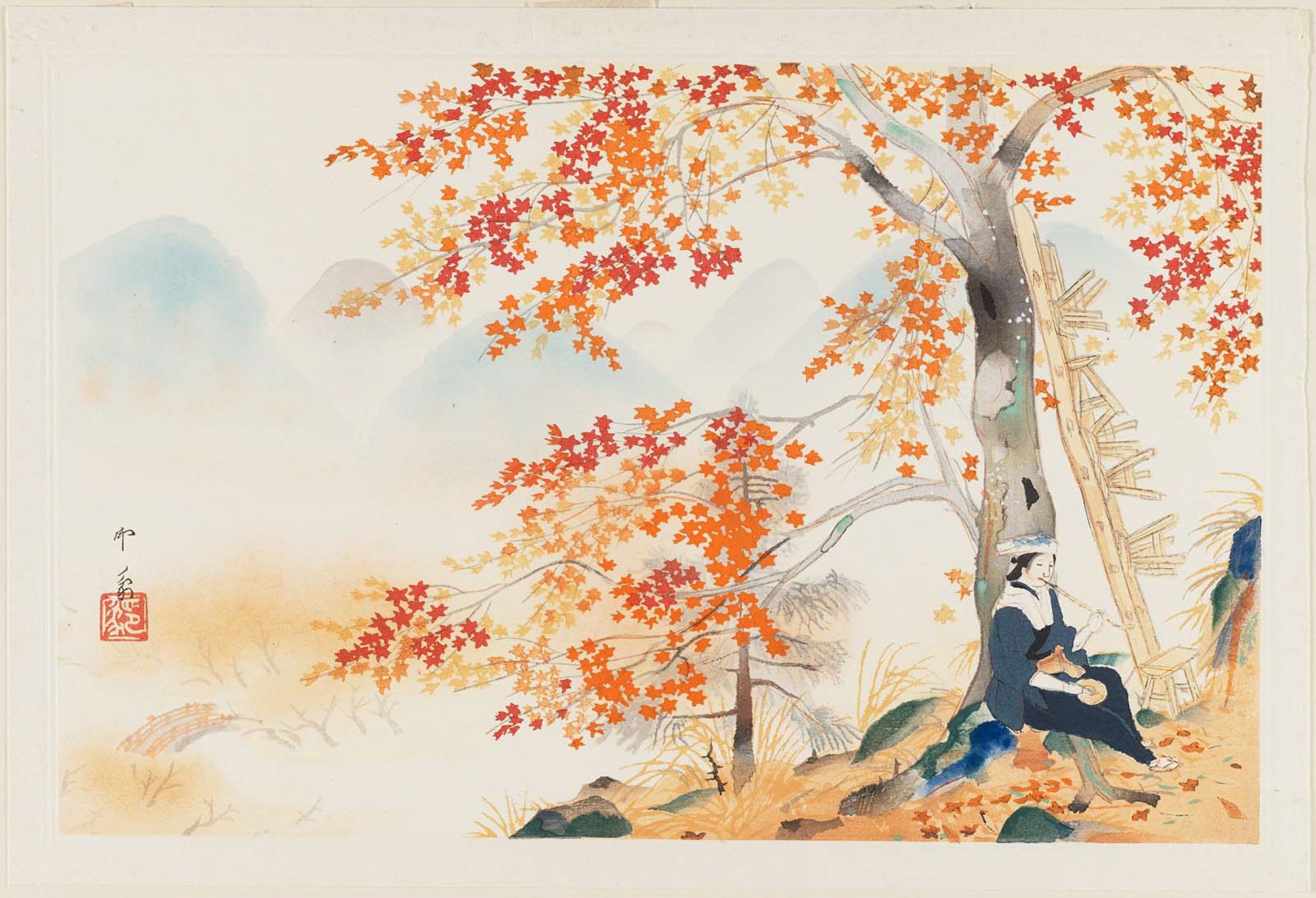
Autumn Maple Leaves at Takao, from the album Eight Views of Kyoto (Kyôto hakkei)
Woodblock print

The Beach at Kaiganji in Sanuki Province (Sanuki Kaiganji no hama), from the series "Collection of Views of Japan II, Kansai Edition (Nihon fukei shu II Kansai hen)"
1934
Color woodblock print; oban

Tea Kettle, section of a sheet from the series "Mirror of Stone Rubbings of Views of the Provinces" (Kohon meihitsu ishizuri kagami)
n.d.
Woodblock print; ishizuri-e, section of harimaze sheet
Featured in Collections
Curated cross-cuts that include this print.
Frequently Asked Questions
Nihonbashi Bridge in Edo was created by Katsushika Hokusai (葛飾北斎) in 1830–33.
Nihonbashi Bridge in Edo depicts landscapes and bridges.