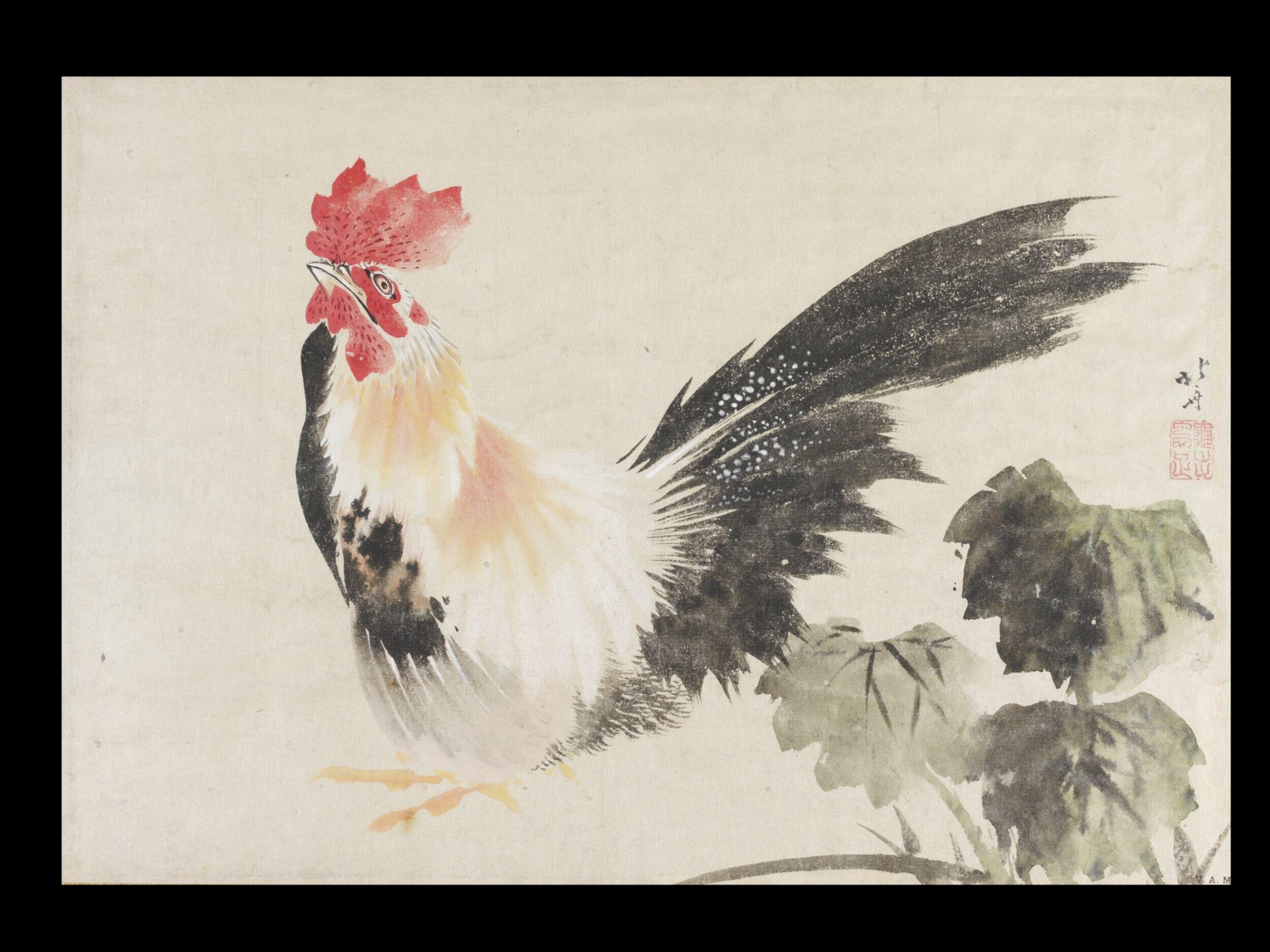
Rooster
- Date:
- ca. 1808-1809
- Medium:
- Source:
- Victoria and Albert Museum
Description
Made in 1808, this print depicts a rooster as drawn by Katsushika Hokusai with the close observational rigor that distinguishes his bird-and-flower works. The bird is shown in profile, weight balanced on one leg as the other lifts and the head turns slightly to engage the viewer. Hokusai pays particular attention to the structure of the rooster's tail, where each feather is articulated, and to the play of light over its breast and comb. As an Edo ukiyo-e print, the sheet sits within the long-standing kacho-ga tradition, but Hokusai brings to it a draftsman's interest in posture and balance that lifts the image beyond decorative formula. The composition leaves much of the surrounding space empty, recalling the conventions of monochrome Chinese painting in which a single creature carries the weight of the whole image. Roosters held a particular cultural place in Japan as messengers of dawn, as auspicious New Year's symbols, and as fixtures of Shinto shrines, where they wandered freely. Hokusai's rooster is neither emblem nor ornament but a portrait of the bird as a living creature with its own dignity and self-possession. The Victoria and Albert Museum preserves the print within its Hokusai collection. The sheet belongs to a productive moment in his middle career, when he was supplying picture books, single-sheet prints, and design manuals at a remarkable rate. The Rooster, with its precision of line and confident use of negative space, is a small reminder that Hokusai's reputation as a master of landscape rests on a much wider foundation of disciplined nature observation. The print rewards repeated looking, both as a portrait and as a study in compositional restraint.
More Prints by Katsushika Hokusai
Hokusai manga (Hokusai Sketchbooks)
19th century
Woodblock-printed book; ink and light color on paper
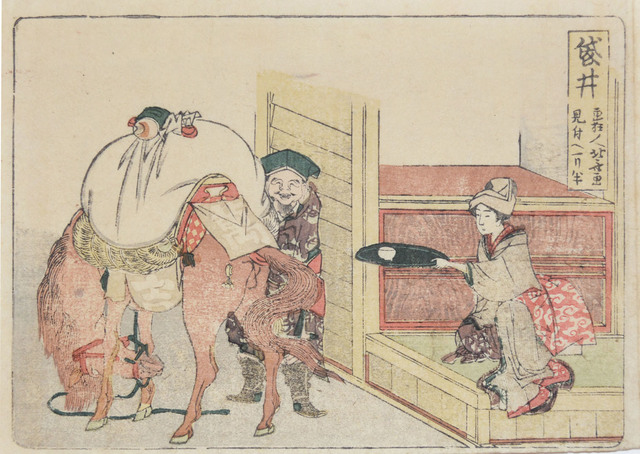
Fukuroi
1804
Japanese woodblock print

The Fishermen of Katase Hauling in Their Nets: The Purple Shell (Murasakigai)
1821
Color woodblock print with metallic pigments; surimono shikishiban

Burdock Root (Kurama gobo), from the series "A Selection of Horses (Uma-zukushi)"
1822
Color woodblock print; shikishiban, surimono
More Landscapes Prints

Lake Kugushi in Wakasa Province (Wakasa Kugushiko), from the series Souvenirs of Travel I (Tabi miyage dai isshu)"
Wakasa Kugushiko
1920
Color woodblock print; oban
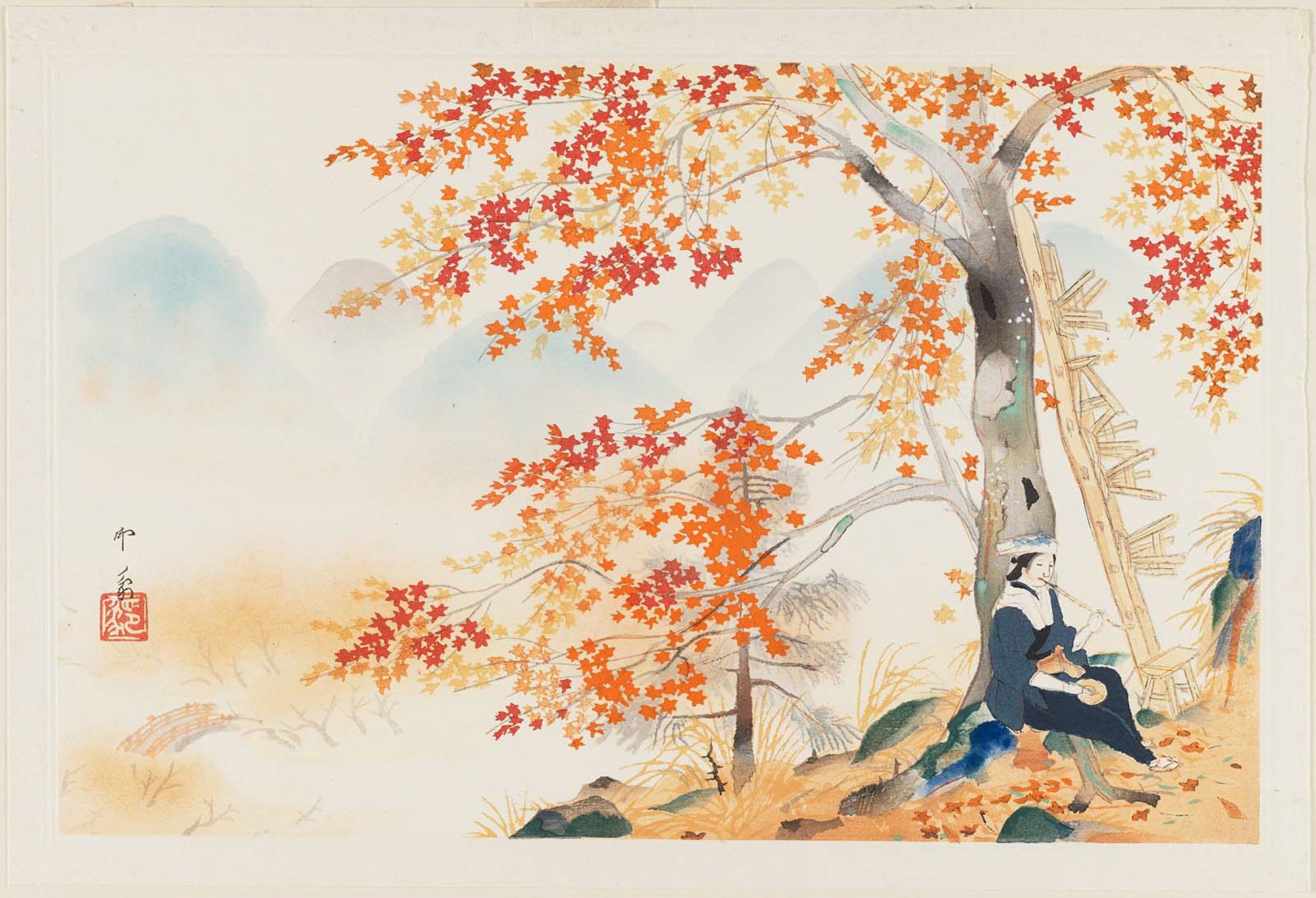
Autumn Maple Leaves at Takao, from the album Eight Views of Kyoto (Kyôto hakkei)
Woodblock print

The Beach at Kaiganji in Sanuki Province (Sanuki Kaiganji no hama), from the series "Collection of Views of Japan II, Kansai Edition (Nihon fukei shu II Kansai hen)"
1934
Color woodblock print; oban

Tea Kettle, section of a sheet from the series "Mirror of Stone Rubbings of Views of the Provinces" (Kohon meihitsu ishizuri kagami)
n.d.
Woodblock print; ishizuri-e, section of harimaze sheet
Featured in Collections
Curated cross-cuts that include this print.
Frequently Asked Questions
Rooster was created by Katsushika Hokusai (葛飾北斎) in ca. 1808-1809.
Rooster depicts landscapes.