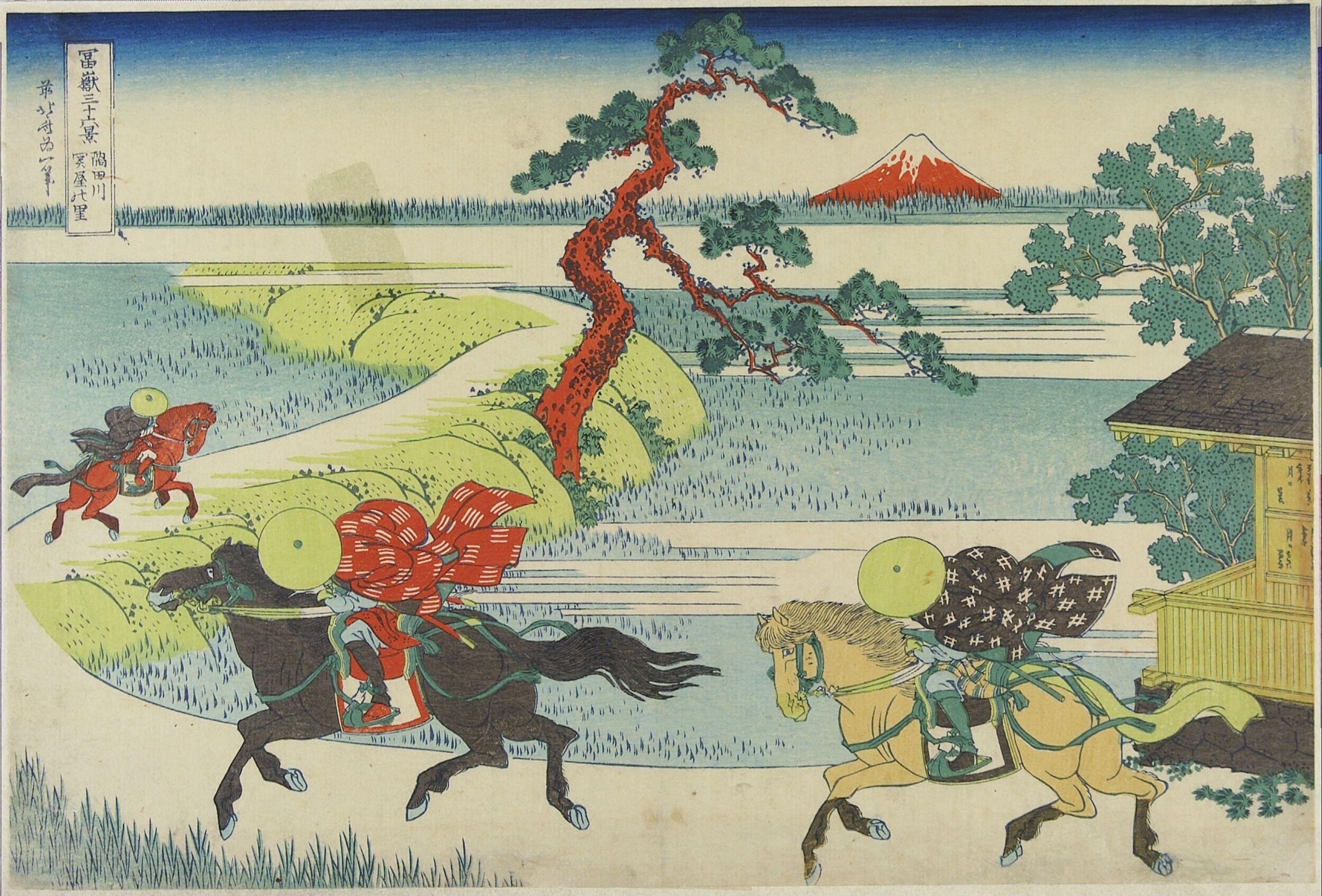
Sekiya Village on the Sumida River (Sumida gawa Sekiya no sato)
- Date:
- ca. 1831
- Medium:
- Source:
- Victoria and Albert Museum
Description
Sekiya Village on the Sumida River (Sumida gawa Sekiya no sato) is a celebrated landscape ukiyo-e print by Katsushika Hokusai, dated to 1831 and held in the collection of the Victoria and Albert Museum in London. The design belongs to the Thirty-six Views of Mount Fuji series, the body of work that secured Hokusai's reputation as Edo ukiyo-e's foremost landscape designer and reshaped the entire genre of meisho-e, or pictures of famous places.
In this composition, three travelers ride at a rapid clip along the elevated embankment that follows the curve of the Sumida River north of Edo. The horses' flying legs and the streaming sleeves of the riders introduce a sense of urgent motion that contrasts pointedly with the serene cone of Mount Fuji rising in the distance across the river plain. Hokusai exploits the diagonal sweep of the dyke to organize the entire pictorial field, drawing the eye from the busy figural group at right toward the still, snow-capped mountain at left.
The color palette demonstrates the printmaker's confident handling of imported Prussian blue, the synthetic pigment whose arrival from Europe in the late 1820s gave Edo ukiyo-e designers a stable, vibrant blue suitable for skies, water, and atmospheric gradation. Soft bokashi shading along the horizon and across the river surface gives this ukiyo-e print its distinctive sense of light and distance.
Sekiya was a real riverbank settlement on the route between Edo and the northern provinces, and Hokusai's choice to depict it reflects the series's interest in everyday vantage points from which ordinary travelers and laborers might glimpse the sacred mountain. The print thus operates simultaneously as topographical record, devotional image, and dynamic figure study, encapsulating the formal ambitions that distinguish Hokusai's mature landscape work.
More Prints by Katsushika Hokusai

The Fishermen of Katase Hauling in Their Nets: The Purple Shell (Murasakigai)
1821
Color woodblock print with metallic pigments; surimono shikishiban

Burdock Root (Kurama gobo), from the series "A Selection of Horses (Uma-zukushi)"
1822
Color woodblock print; shikishiban, surimono

Horse Shells (Umagai), from the series "A Selection of Horses (Uma-zukushi)"
1822
Color woodblock print; shikishiban, surimono

Orange Orchids, from an untitled series of flowers
c. 1832
Color woodblock print; oban
More Landscapes Prints

Lake Kugushi in Wakasa Province (Wakasa Kugushiko), from the series Souvenirs of Travel I (Tabi miyage dai isshu)"
Wakasa Kugushiko
1920
Color woodblock print; oban
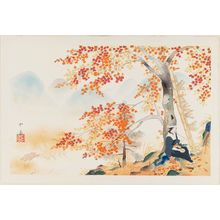
Autumn Maple Leaves at Takao, from the album Eight Views of Kyoto (Kyôto hakkei)
Woodblock print

The Beach at Kaiganji in Sanuki Province (Sanuki Kaiganji no hama), from the series "Collection of Views of Japan II, Kansai Edition (Nihon fukei shu II Kansai hen)"
1934
Color woodblock print; oban

Tea Kettle, section of a sheet from the series "Mirror of Stone Rubbings of Views of the Provinces" (Kohon meihitsu ishizuri kagami)
n.d.
Woodblock print; ishizuri-e, section of harimaze sheet
Featured in Collections
Curated cross-cuts that include this print.
Frequently Asked Questions
Sekiya Village on the Sumida River (Sumida gawa Sekiya no sato) was created by Katsushika Hokusai (葛飾北斎) in ca. 1831.
Sekiya Village on the Sumida River (Sumida gawa Sekiya no sato) depicts landscapes.