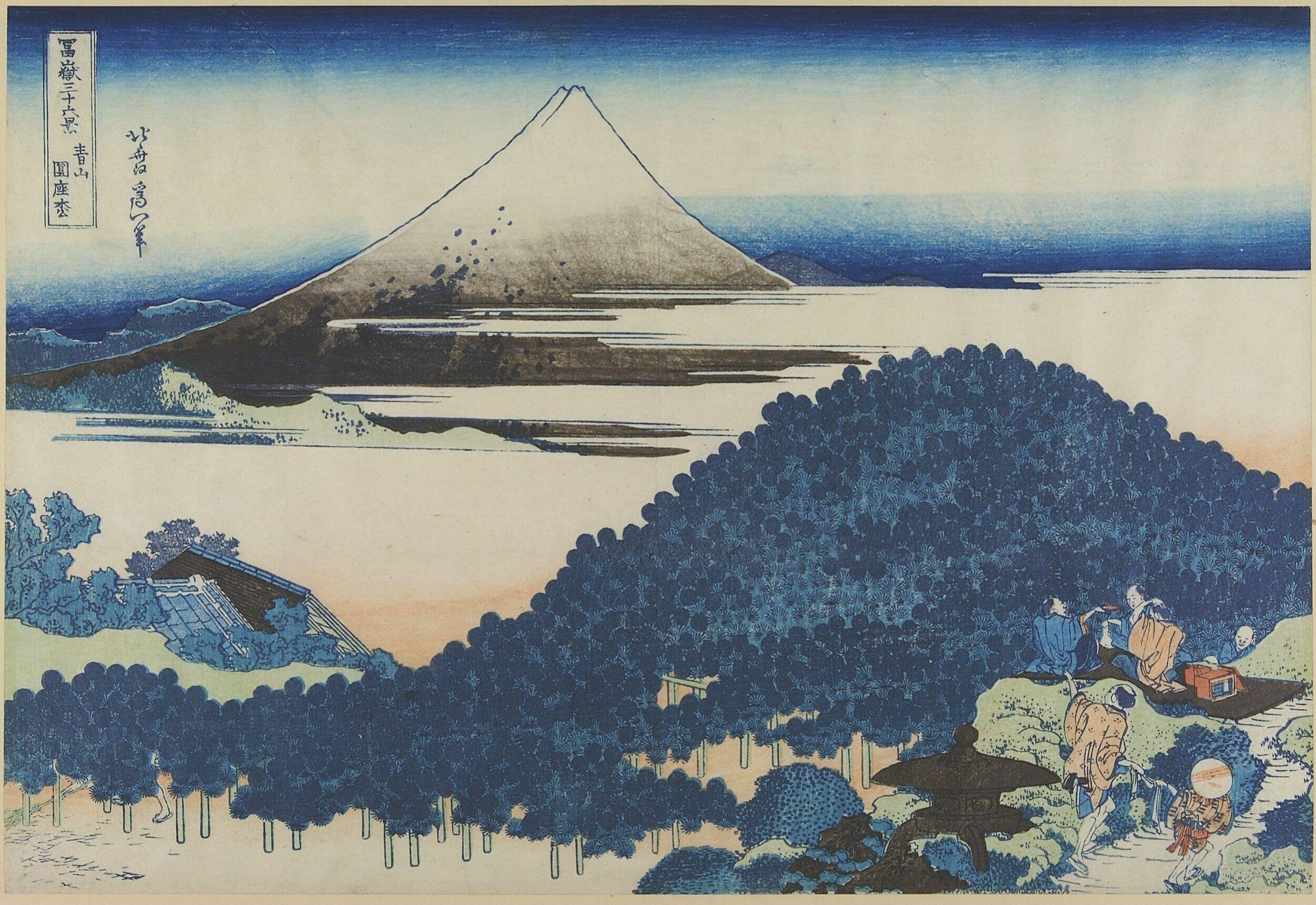
The Cushion Pine at Aoyama (Aoyama Enza-no-matsu)
- Date:
- ca. 1830-31
- Medium:
- Source:
- Victoria and Albert Museum
Description
The Cushion Pine at Aoyama (Aoyama Enza-no-matsu) belongs to Katsushika Hokusai's series Thirty-Six Views of Mount Fuji (Fugaku sanjurokkei), produced from around 1830. Aoyama, then a semi-rural district on the southwestern edge of Edo, was known for an unusually shaped pine whose lower branches had grown into a flat, circular form, giving rise to the nickname "cushion pine." Hokusai uses this curious local landmark as a frame: townspeople and travelers gather under the pine's broad disk of foliage in the foreground, while Mount Fuji rises beyond in a soft pale cone against the sky. The design demonstrates one of Hokusai's most characteristic strategies in the Fuji series, taking an unrelated subject - in this case a famous tree - and using its silhouette to play against the symmetrical mountain in the distance. The Victoria and Albert Museum holds an impression of this Edo ukiyo-e print, recording a key example of how the artist combined the conventions of meisho (famous-place) imagery with his own structural inventions. As a Mount Fuji subject, the Cushion Pine print also speaks to the way Hokusai treated the mountain as an everyday companion to ordinary Edoites, rather than a remote spiritual icon. By placing the pine and its visitors at the heart of the design, he reminds the viewer that the experience of Fuji was as much about social ritual and local landmarks as about the volcano itself.
More Prints by Katsushika Hokusai
Hokusai manga (Hokusai Sketchbooks)
19th century
Woodblock-printed book; ink and light color on paper
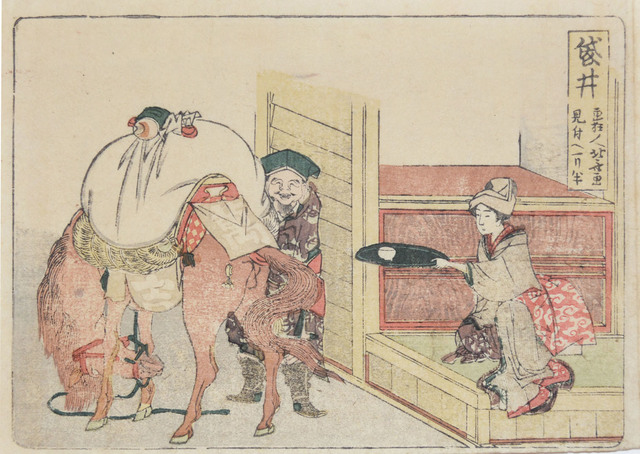
Fukuroi
1804
Japanese woodblock print

The Fishermen of Katase Hauling in Their Nets: The Purple Shell (Murasakigai)
1821
Color woodblock print with metallic pigments; surimono shikishiban

Burdock Root (Kurama gobo), from the series "A Selection of Horses (Uma-zukushi)"
1822
Color woodblock print; shikishiban, surimono
More Landscapes Prints

Lake Kugushi in Wakasa Province (Wakasa Kugushiko), from the series Souvenirs of Travel I (Tabi miyage dai isshu)"
Wakasa Kugushiko
1920
Color woodblock print; oban
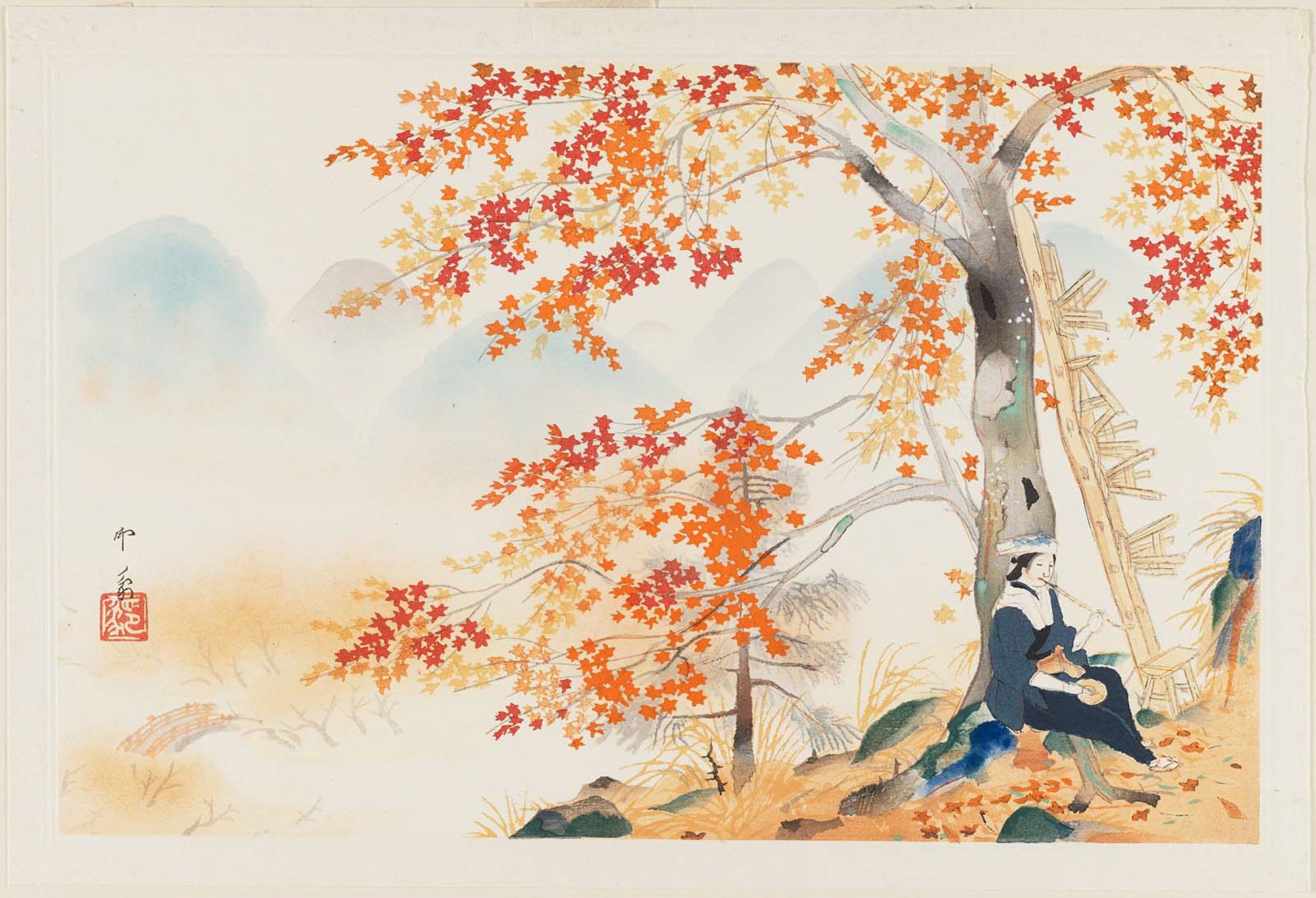
Autumn Maple Leaves at Takao, from the album Eight Views of Kyoto (Kyôto hakkei)
Woodblock print

The Beach at Kaiganji in Sanuki Province (Sanuki Kaiganji no hama), from the series "Collection of Views of Japan II, Kansai Edition (Nihon fukei shu II Kansai hen)"
1934
Color woodblock print; oban

Tea Kettle, section of a sheet from the series "Mirror of Stone Rubbings of Views of the Provinces" (Kohon meihitsu ishizuri kagami)
n.d.
Woodblock print; ishizuri-e, section of harimaze sheet
Featured in Collections
Curated cross-cuts that include this print.
Frequently Asked Questions
The Cushion Pine at Aoyama (Aoyama Enza-no-matsu) was created by Katsushika Hokusai (葛飾北斎) in ca. 1830-31.
The Cushion Pine at Aoyama (Aoyama Enza-no-matsu) depicts landscapes.