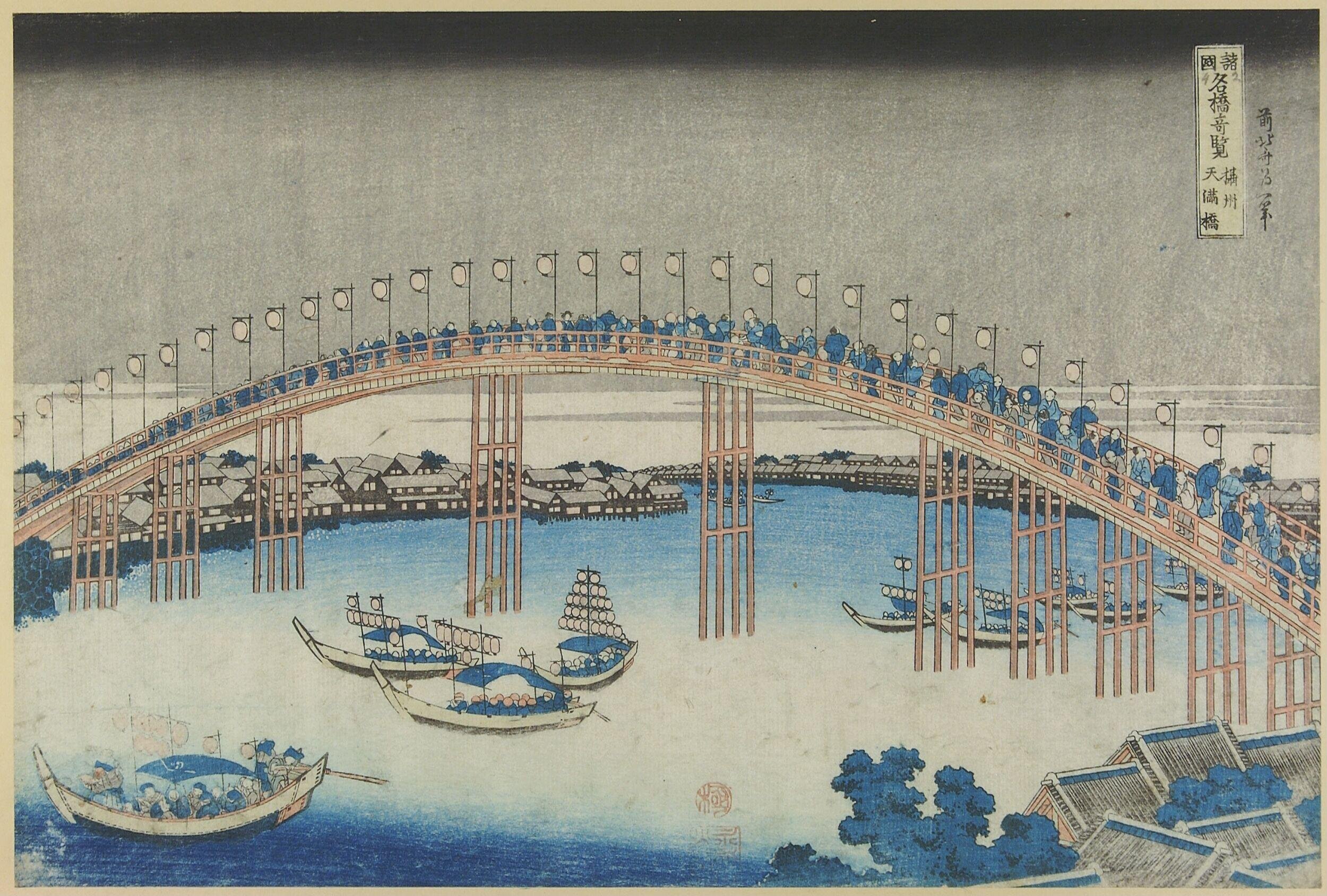
The Tenma Bridge in Settsu Province (Sesshū Tenmabashi)
- Date:
- ca. 1834
- Medium:
- Source:
- Victoria and Albert Museum
Description
The Tenma Bridge in Settsu Province (Sesshū Tenmabashi) is a landscape ukiyo-e print designed by Katsushika Hokusai around 1834 and held in the Victoria and Albert Museum. The sheet belongs to the series Remarkable Views of Bridges in Various Provinces (Shokoku meikyō kiran), one of the great late-career landscape projects in which Hokusai turned the Edo ukiyo-e tradition toward subjects almost no earlier designer had attempted in print form.
The Tenma Bridge spanned the Ōkawa River in Osaka and was renowned for its commanding length and the lively traffic of merchants, porters, palanquin bearers, and pilgrims who crossed it on their way to and from Osaka's commercial center. Hokusai exploits this human variety by lining the deck of the bridge with a dense procession of small figures, each posed and dressed with sufficient specificity to suggest a particular trade or errand. Beneath them, the river is alive with boats, while the far bank rises to a tracery of rooftops and trees.
Formally, the composition demonstrates Hokusai's mature command of architectural perspective and aerial recession. The bridge sweeps in a long diagonal across the picture plane, its dark timber piers planted firmly into the print's vertical structure while the horizontal of the river surface anchors the design from edge to edge. Prussian blue dominates the water and sky, layered with delicate bokashi gradations to suggest haze and depth.
As a ukiyo-e print, Sesshū Tenmabashi marks Hokusai's project of mapping the engineering achievements of Edo-period Japan and inserting them, alongside Mount Fuji and the great waterfalls, into the canon of subjects fit for landscape design. Katsushika Hokusai treats the bridge as both topographical fact and pictorial structure.
More Prints by Katsushika Hokusai
Hokusai manga (Hokusai Sketchbooks)
19th century
Woodblock-printed book; ink and light color on paper
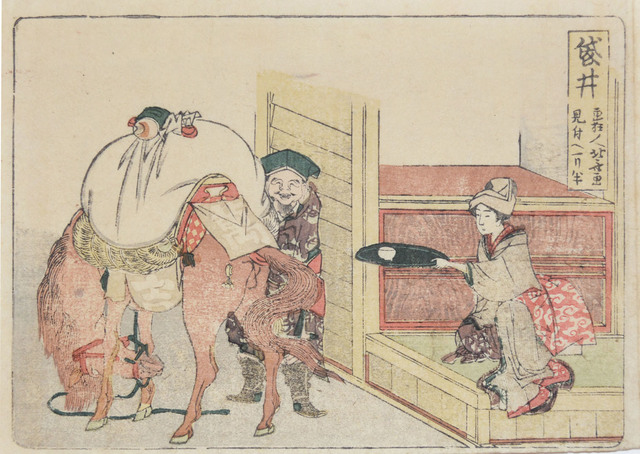
Fukuroi
1804
Japanese woodblock print

The Fishermen of Katase Hauling in Their Nets: The Purple Shell (Murasakigai)
1821
Color woodblock print with metallic pigments; surimono shikishiban

Burdock Root (Kurama gobo), from the series "A Selection of Horses (Uma-zukushi)"
1822
Color woodblock print; shikishiban, surimono
More Landscapes Prints

Lake Kugushi in Wakasa Province (Wakasa Kugushiko), from the series Souvenirs of Travel I (Tabi miyage dai isshu)"
Wakasa Kugushiko
1920
Color woodblock print; oban
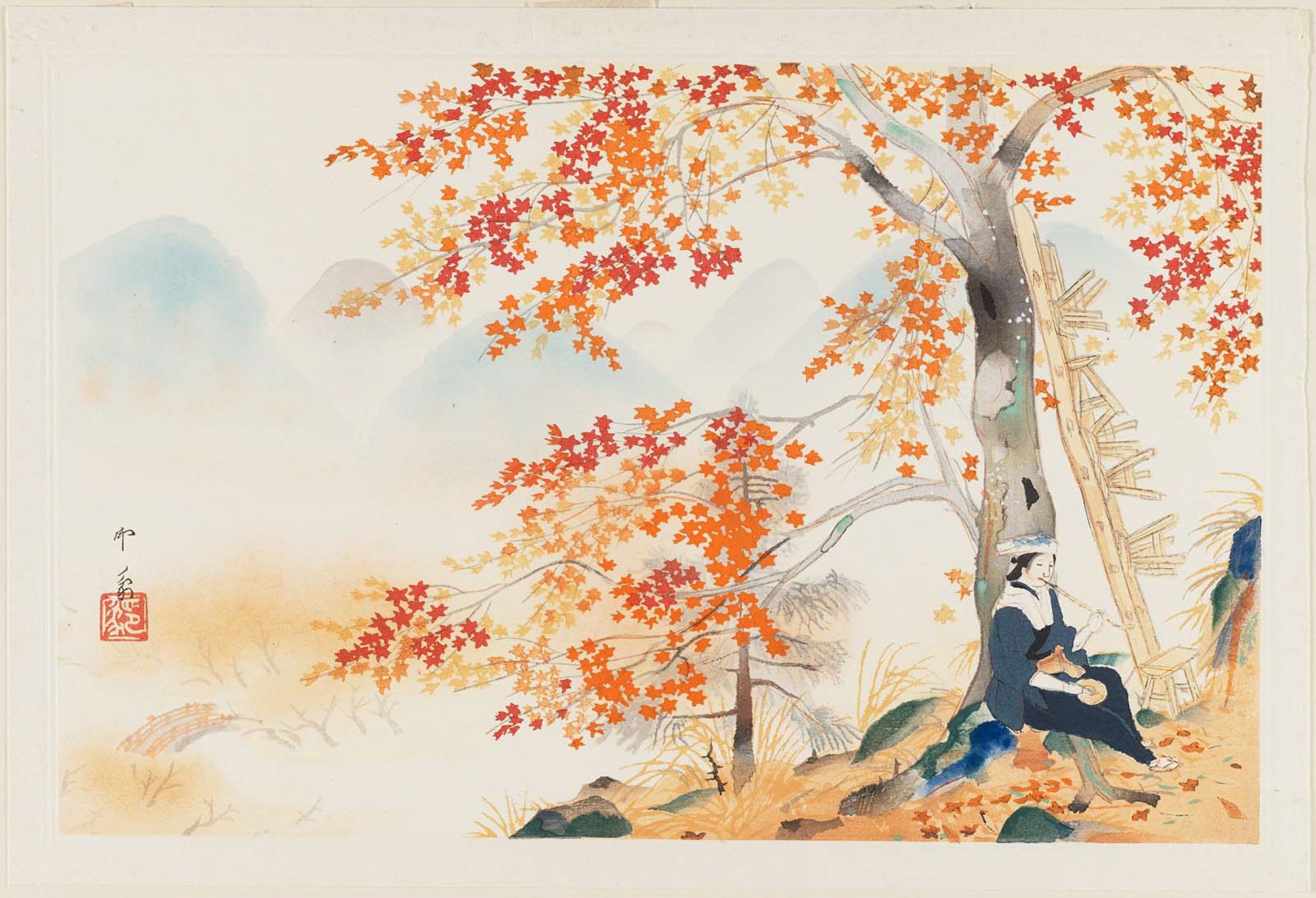
Autumn Maple Leaves at Takao, from the album Eight Views of Kyoto (Kyôto hakkei)
Woodblock print

The Beach at Kaiganji in Sanuki Province (Sanuki Kaiganji no hama), from the series "Collection of Views of Japan II, Kansai Edition (Nihon fukei shu II Kansai hen)"
1934
Color woodblock print; oban

Tea Kettle, section of a sheet from the series "Mirror of Stone Rubbings of Views of the Provinces" (Kohon meihitsu ishizuri kagami)
n.d.
Woodblock print; ishizuri-e, section of harimaze sheet
Featured in Collections
Curated cross-cuts that include this print.
Frequently Asked Questions
The Tenma Bridge in Settsu Province (Sesshū Tenmabashi) was created by Katsushika Hokusai (葛飾北斎) in ca. 1834.
The Tenma Bridge in Settsu Province (Sesshū Tenmabashi) depicts landscapes and bridges.