
AMEAGARI (After Rain)
- Medium:
- Woodblock print
- Source:
- Watanabe Print
- Image courtesy of
- Watanabe Print
Description
After-rain subjects are a staple of Japanese landscape print tradition, prized for the particular quality of reflected light, wet surfaces, and refreshed air they allow an artist to explore. Nishijima's print almost certainly depicts a historic street or architectural scene — stone-paved lanes, wooden machiya facades, a garden wall — in the immediate aftermath of rainfall, when puddles mirror sky and eaves still drip. The compositional interest would center on surface reflections: the wet cobblestones or packed earth of a Kyoto lane picking up the gray-silver of an overcast sky and the dark vertical rhythms of wooden buildings. The palette would be characteristically restrained — deep grays, soft blacks, the blue-white of reflected sky, with perhaps a single warm note from a paper lantern or moss-covered stone. Technically, the challenge lies in distinguishing wet surface texture from dry through precise ink gradation, a task well suited to the multiple printing passes available in sosaku-hanga practice.
More Prints by Katsuyuki Nishijima
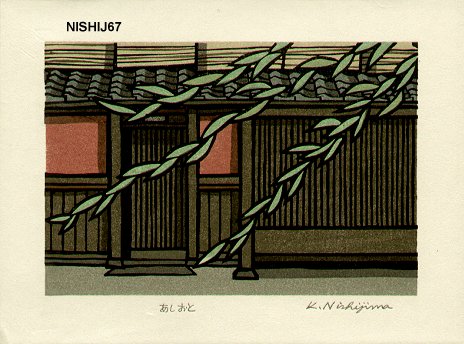

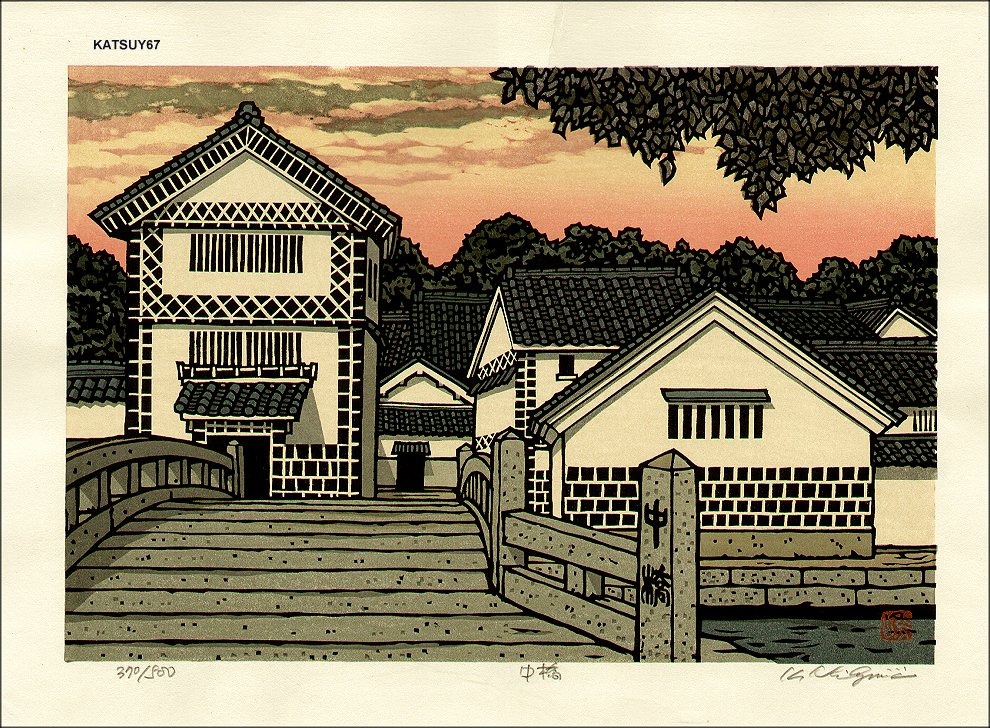
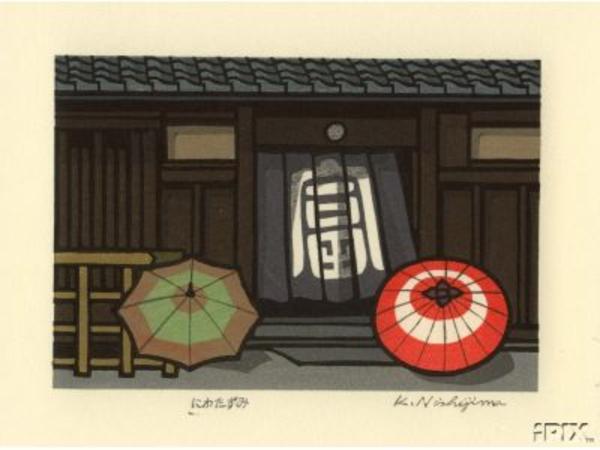
More Rain Prints

Rain Shower at Shо̄no, from the series Fifty-three Stations of the Tо̄kaidо̄ (Tо̄kaidо̄ gojusan tsugi)
1962
Woodblock print, ink and color on paper

Shōno: Driving Rain (Shōno hakuu), from the series Fifty-three Stations of the Tōkaidō (Tōkaidō gojūsan tsugi no uchi), also known as the First Tōkaidō or Great Tōkaidō
c. 1833-36
Woodblock print (nishiki-e); ink and color on paper

Omiya in Rain (Ame no Omiya)
Ame no Omiya
1930
Color woodblock print; oban

Evening Shower at Teradomari (Teradomari no yau), from the series "Souvenirs of Travel, Second Series (Tabi miyage dai nishu)"
Teradomari no yau
1921
Color woodblock print; oban
Frequently Asked Questions
AMEAGARI (After Rain) was created by Katsuyuki Nishijima (西島勝之).
AMEAGARI (After Rain) depicts rain.