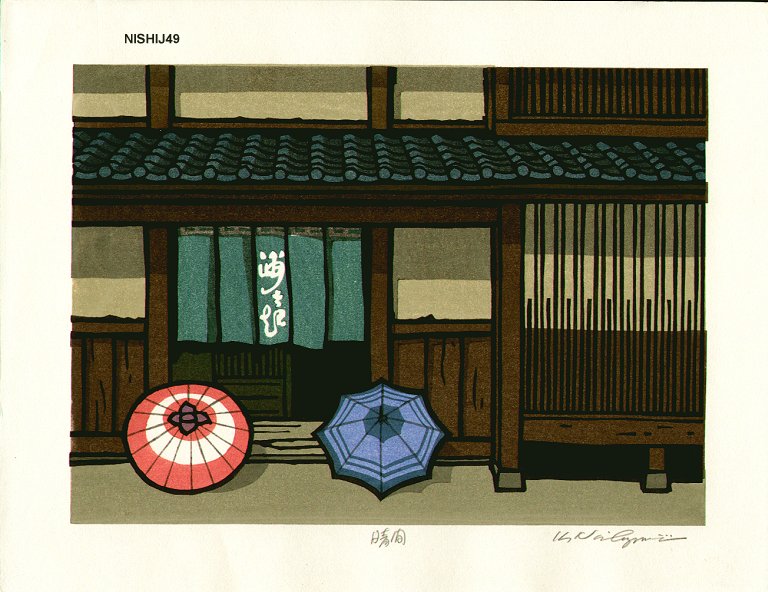
HAREMA (lull in the rain)
- Medium:
- Woodblock print
- Source:
- Watanabe Print
- Image courtesy of
- Watanabe Print
Description
Harema (晴れ間) denotes the interval of clearing that appears between periods of rain — a moment of light breaking through overcast skies — and is a subject with deep associations in Japanese poetry and visual art, particularly in the context of the rainy season or spring showers. Nishijima's print of this theme would likely depict a Kyoto lane or rural streetscape at the precise moment when the rain pauses: wet stone pavement reflecting pale light, the dark wood of machiya facades still damp, and the sky transitioning from gray to luminous white or pale blue at the horizon. Technically, the rendering of wet surfaces in woodblock printing requires careful management of tonal values — the increased reflectivity of stone and wood after rain is conveyed through lighter color application or the strategic use of the paper's own white. Puddles, dripping eaves, and the empty quiet of a street where pedestrians have retreated would all contribute to the print's atmospheric specificity. The composition likely emphasizes horizontal ground plane and the play of reflected light.
More Prints by Katsuyuki Nishijima

More Rain Prints

Rain Shower at Shо̄no, from the series Fifty-three Stations of the Tо̄kaidо̄ (Tо̄kaidо̄ gojusan tsugi)
1962
Woodblock print, ink and color on paper

Shōno: Driving Rain (Shōno hakuu), from the series Fifty-three Stations of the Tōkaidō (Tōkaidō gojūsan tsugi no uchi), also known as the First Tōkaidō or Great Tōkaidō
c. 1833-36
Woodblock print (nishiki-e); ink and color on paper

Omiya in Rain (Ame no Omiya)
Ame no Omiya
1930
Color woodblock print; oban

Evening Shower at Teradomari (Teradomari no yau), from the series "Souvenirs of Travel, Second Series (Tabi miyage dai nishu)"
Teradomari no yau
1921
Color woodblock print; oban
Frequently Asked Questions
HAREMA (lull in the rain) was created by Katsuyuki Nishijima (西島勝之).
HAREMA (lull in the rain) depicts rain.