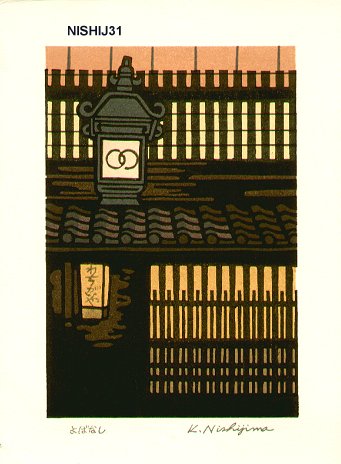
YOBANASHI (Story at night)
Description
"Yobanashi" — stories told at night, or nighttime conversation — suggests an interior scene glimpsed from outside, or the quality of a night when lights in houses invite the imagination to supply the conversations happening within. Nishijima's night scenes rarely depict explicit human activity, but the presence of interior light transforms his architectural subjects into containers of implied life: the darkness outside makes the warmth within legible, the blank facades of daytime streetscapes becoming animated by the specific illumination of inhabited interiors.
More Prints by Katsuyuki Nishijima

More Night Scenes Prints
Evening in East Africa
Woodblock print

Evening Shower at Teradomari (Teradomari no yau), from the series "Souvenirs of Travel, Second Series (Tabi miyage dai nishu)"
Teradomari no yau
1921
Color woodblock print; oban
![Mount Fuji on a Moonlit Night, Kawai Bridge (Tsukiyo no Fuji [Kawaibashi]), from the series "Selection of Views of the Tokaido (Tokaido fukei senshu)" by Kawase Hasui](https://www.artic.edu/iiif/2/d0960668-1e73-339a-b182-fb995a54bff0/full/843,/0/default.jpg)
Mount Fuji on a Moonlit Night, Kawai Bridge (Tsukiyo no Fuji [Kawaibashi]), from the series "Selection of Views of the Tokaido (Tokaido fukei senshu)"
1947
Color woodblock print; oban

Evening Moon at Nakanoshima, Sapporo (Sapporo Nakanoshima no yuzuki), from the series "Collection of Views of Japan, Eastern Japan Edition (Nihon fukei shu higashi Nihon hen)"
March 1933
Color woodblock print; oban
Frequently Asked Questions
YOBANASHI (Story at night) was created by Katsuyuki Nishijima (西島勝之).
YOBANASHI (Story at night) depicts night scenes.