
Forest
- Medium:
- Mokuhanga (Japanese woodblock)
- Image courtesy of
- Saru Gallery
Description
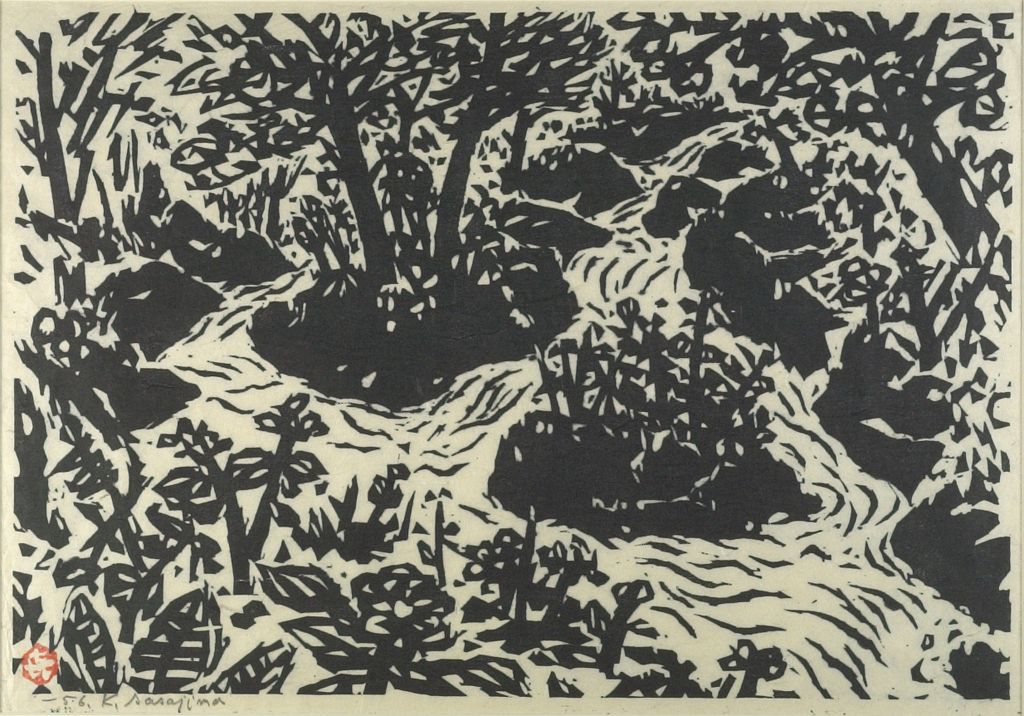
A departure from Sasajima's central preoccupation with Buddhist architecture, Forest turns to the wooded landscapes that surround the mountain temples and rural shrines he documented elsewhere. The print likely depicts a stand of trees rendered in his characteristic dense black sumi, with trunks and canopy reduced to broad, gouge-carved silhouettes against the bare washi. Sasajima's landscape work shares the structural austerity of his temple subjects: the same flat planes, the same emphasis on visible carving marks, the same refusal of atmospheric softening. Rather than the seasonal lyricism typical of mid-twentieth-century shin-hanga landscapes, Sasajima's forests read as architectural studies of trees, treated as columns and vaults of an organic temple. The work belongs to the sosaku-hanga tradition of artist-printed mokuhanga, with every block designed, carved, and pulled by Sasajima himself in keeping with the principle Onchi Koshiro had impressed on him in the late 1930s.
More Prints by Kihei Sasajima


More Trees Prints


Featured in Collections
Curated cross-cuts that include this print.
Frequently Asked Questions
Forest was created by Kihei Sasajima (笹島喜平).
Forest depicts trees.