Courtesan Fujie of the Nakamajiya (Nakamajiya uchi Fujie), from the series
- Date:
- 19th century
- Medium:
- Ukiyo-e woodblock print in "ōban" format; ink and color on paper, with printed signature reading "Utamaro hitsu"
- Source:
- Harvard Art Museums
Description
Preserved in the Harvard Art Museums, this print depicting Courtesan Fujie of the Nakamajiya (Nakamajiya uchi Fujie), from an unidentified series, is part of Kitagawa Utamaro's broader project of portrait portraits of named Yoshiwara women. The Nakamajiya was one of many brothel houses whose courtesans formed a quasi-celebrity culture in late Edo, and series identifying women by both house and personal name allowed buyers of ukiyo-e to assemble portraits of their favored figures. The composition is a near-frame okubi-e or chuban portrait whose vertical orientation foregrounds the courtesan's idealized oval face. Utamaro's recognizable design conventions all appear: an elongated neck rising from layered collars, slightly elongated proportions in the cheek and jaw, fine hatched strokes for the temples and side hair, and broad confident contours for kimono and obi. Behind the figure, the background is typically pared down so that the textiles' patterns can speak in concert with the carefully arranged hair ornaments. As an example of Utamaro's bijin-ga at its mature stage, the Harvard impression demonstrates the visual codes by which Edo viewers identified and admired a courtesan such as Fujie, including the specific brothel cartouche that named her place within the Yoshiwara's hierarchy. Even when shorn of its full series title, the print remains valuable both as a portrait of a particular working woman and as a study in how ukiyo-e produced and distributed the celebrity image in late-eighteenth-century Edo.
More Prints by Kitagawa Utamaro
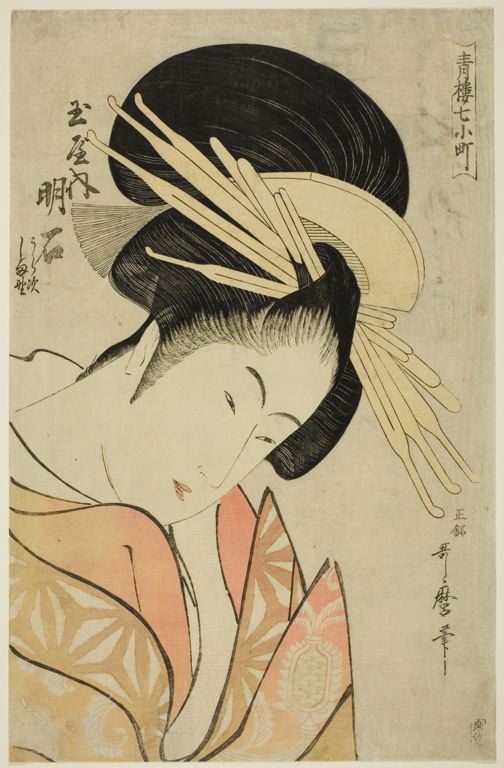
Akashi of the Tamaya, from the series Seven Komachis of Yoshiwara (Seiro nana Komachi) (Tamaya uchi Akashi, Uraji, Shimano)
Woodblock print
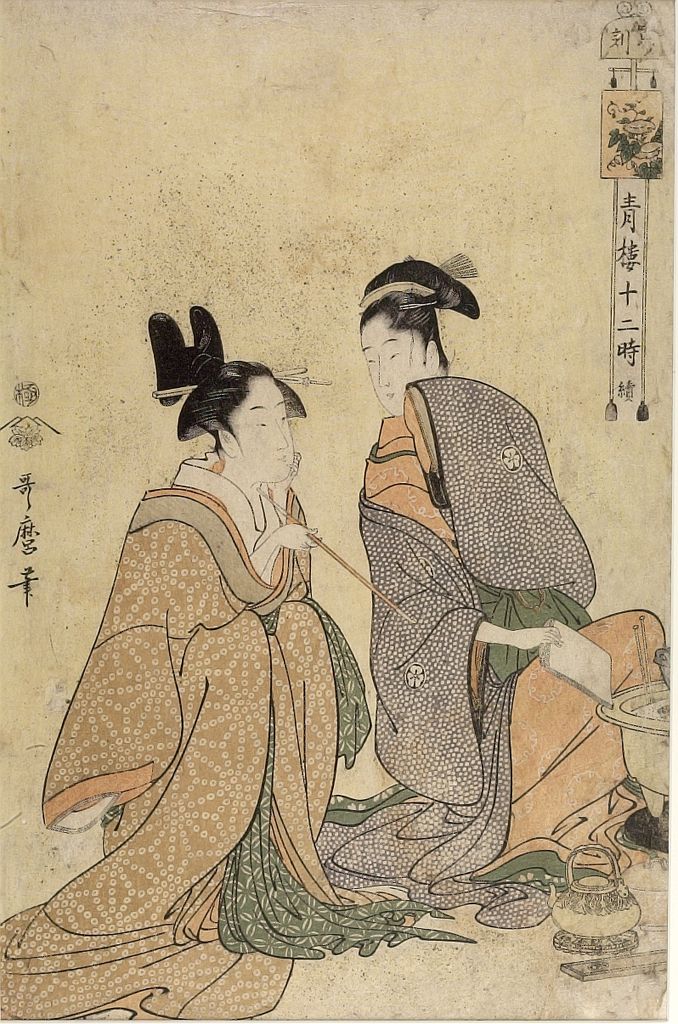
Hour of the Tiger (Tora no koku = 4 AM) from the series Twelve Hours in Yoshiwara (Seirô jûni toki tsuzuki), Late Edo period, circa 1794
Woodblock print
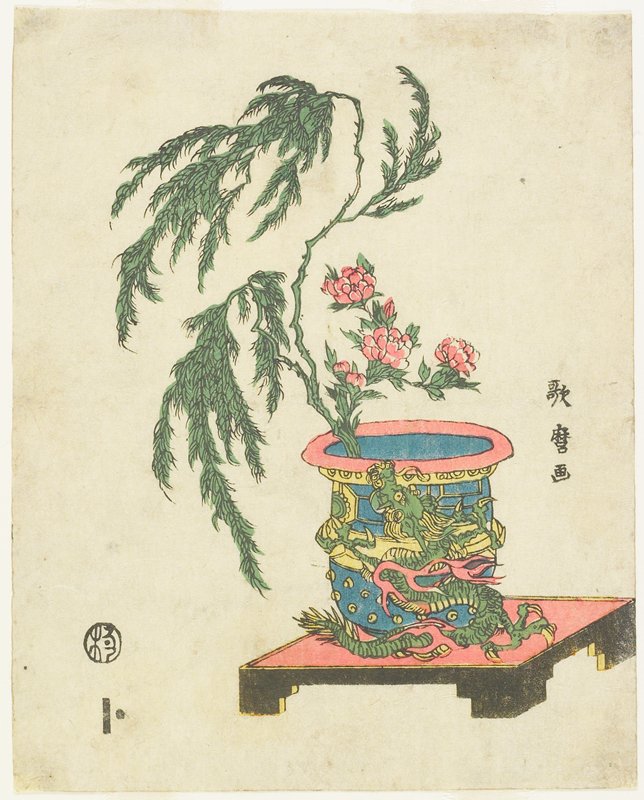
Ikebana arrangement of Peony and Willow in Dragon Pot
1781–1806
Woodblock print (nishiki-e), ink and color on paper
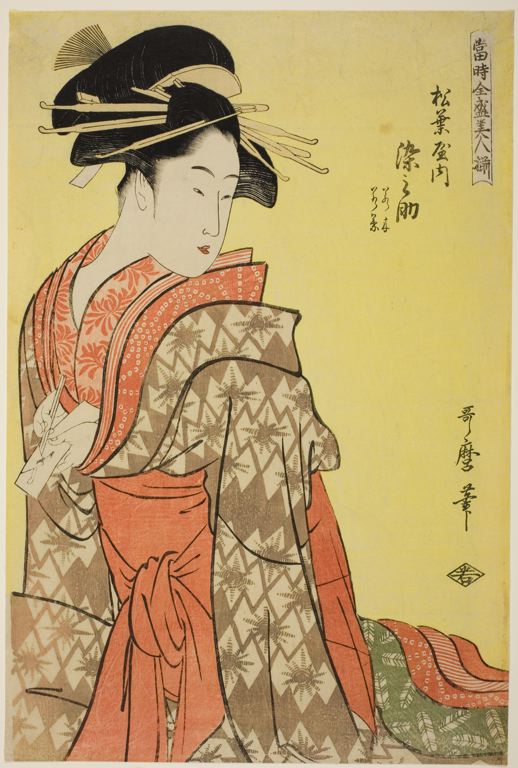
The Greatest Beauties of Our Time (Toji zensei bijin zoroe): Somenosuke of the Matsubaya with Attendants Wakagi and Wakaba
Woodblock print
More Mount Fuji Prints
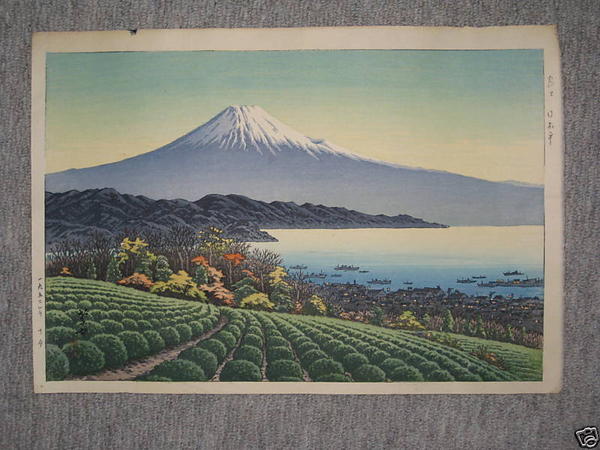
Fuji from tea farm
Woodblock print

Akasaka, Fujikawa, Okazaki, Chiryu, and Narumi, from the series "Famous Places on the Fifty-three Stations of the Tokaido, Five Stations (Tokaido gojusan eki goshuku meisho)"
c. 1830/35
Color woodblock print; oban
![Mount Fuji on a Moonlit Night, Kawai Bridge (Tsukiyo no Fuji [Kawaibashi]), from the series "Selection of Views of the Tokaido (Tokaido fukei senshu)" by Kawase Hasui](https://www.artic.edu/iiif/2/d0960668-1e73-339a-b182-fb995a54bff0/full/843,/0/default.jpg)
Mount Fuji on a Moonlit Night, Kawai Bridge (Tsukiyo no Fuji [Kawaibashi]), from the series "Selection of Views of the Tokaido (Tokaido fukei senshu)"
1947
Color woodblock print; oban

Mt. Fuji in Rain (Ame no Fuji)
n.d.
Color woodblock print
Featured in Collections
Curated cross-cuts that include this print.
Frequently Asked Questions
Courtesan Fujie of the Nakamajiya (Nakamajiya uchi Fujie), from the series was created by Kitagawa Utamaro (喜多川歌麿) in 19th century.
Courtesan Fujie of the Nakamajiya (Nakamajiya uchi Fujie), from the series depicts mount fuji.