Geisha
- Medium:
- Ukiyo-e/Woodblock print
- Image courtesy of
- Artsy
Description
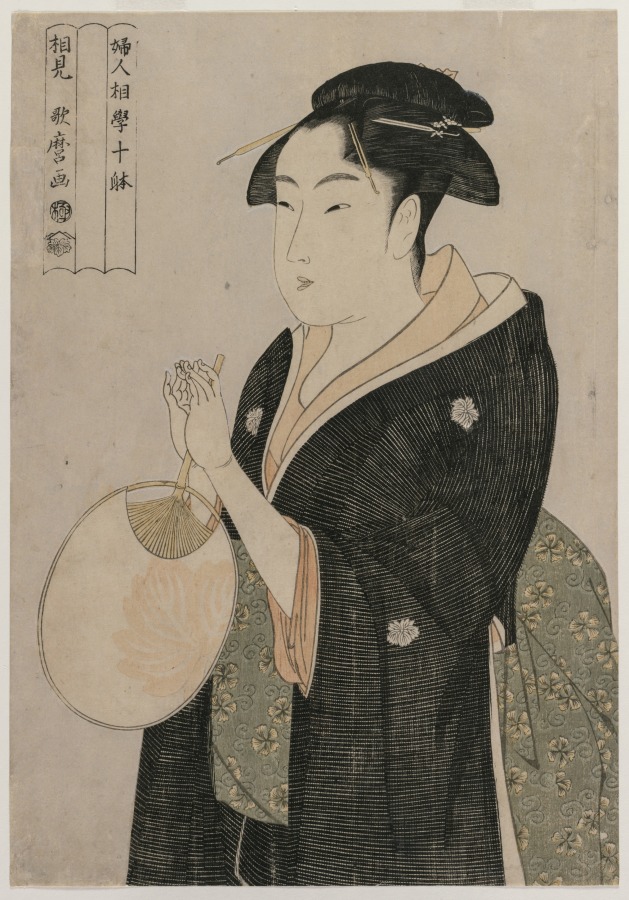
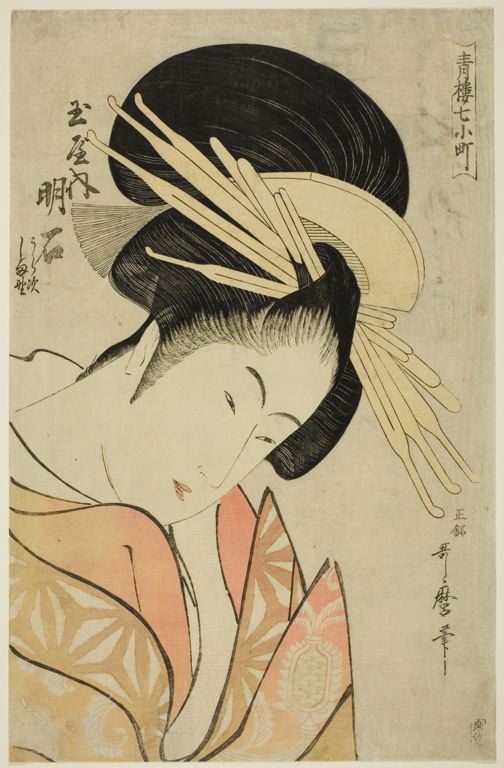
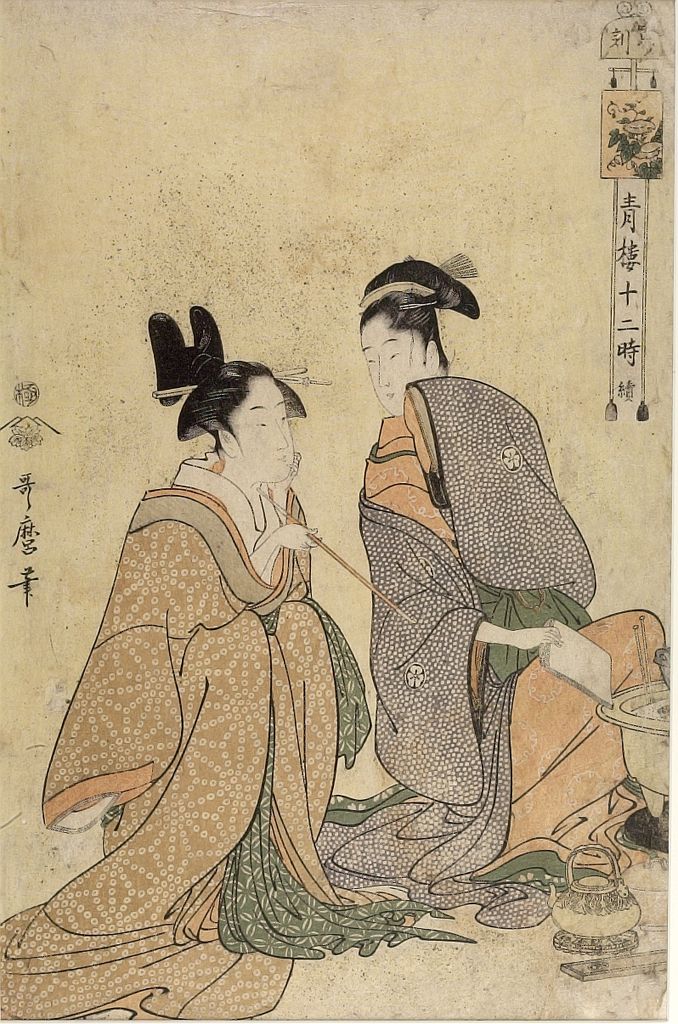
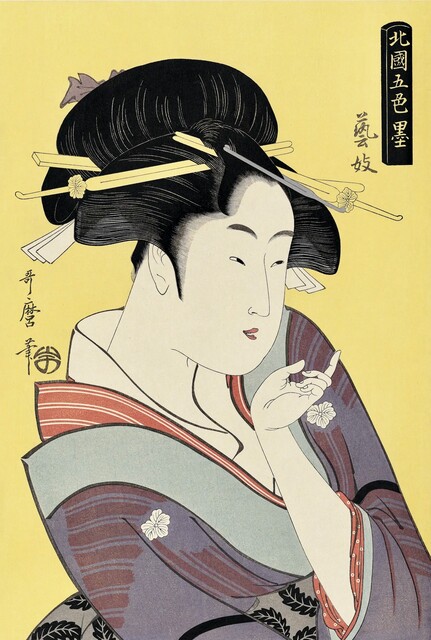
Geisha, an undated [ukiyo-e](/glossary/ukiyo-e) print by Kitagawa Utamaro listed in the Artsy reference database (https://www.artsy.net/artwork/kitagawa-utamaro-geisha), presents a single-figure [bijin-ga](/glossary/bijin-ga) portrait of one of the professional female entertainers who, by the late eighteenth century, had emerged as a distinct cultural category within the Edo licensed quarters and adjoining machi districts. Utamaro spent the bulk of his career working for the publisher Tsutaya Juzaburo, whose Yoshiwara-adjacent shop in Edo's Tori-Abura-cho dominated the bijin-ga market between the early 1780s and Tsutaya's death in 1797, and his typological portraits of Yoshiwara courtesans, teahouse beauties, and geisha together defined the visual vocabulary of late-Edo feminine celebrity. The geisha as a print subject is distinguished from the higher-ranking oiran courtesan by costume restraint, by a more disciplined arrangement of hair and ornament, and by the prominence of musical instruments such as the shamisen, which signal her professional standing as a performer rather than as a commercial sexual partner. Utamaro's hand operates in this idiom through a refined keyblock line that articulates the slow curve of the neck, the angle of the head, and the layered architecture of collar and hair, with patterned robes carrying the bulk of decorative interest against a quiet ground. The half-length okubi-e composition for which the artist became famous concentrates attention on the face, where his most distinctive contribution to ukiyo-e bijin-ga lay: a capacity to differentiate one woman from another through subtle modulations of physiognomy and gaze, rather than through generic type. Without further inscribed identification, this design reads as an exemplary geisha portrait in Utamaro's mature manner rather than a specific named sitter, and the absence of a museum provenance and series title in the Artsy record makes precise attribution to a particular series or year difficult. Modern collecting context for Utamaro single-figure bijin-ga remains strong: his named-courtesan portraits and geisha designs anchor the late-Edo bijin-ga market at auction and institutional acquisition, and study impressions in major holdings such as the Art Institute of Chicago, the Metropolitan Museum of Art, and the Cleveland Museum of Art provide the comparative apparatus by which sheets of this kind are assessed for state, edition, and condition.
![A Low Class Prostitute (Gun [teppo]), from the series “Five Shades of Ink in the Northern Quarter" ("Hokkoku goshiki-zumi") by Kitagawa Utamaro](https://www.artic.edu/iiif/2/ed82be98-8a83-4163-ccc4-e2f7210cce55/full/843,/0/default.jpg)