
Tying Thread, from the series “Women’s Handicrafts: Models of Dexterity" ("Fujin tewaza ayatsuri kagami")
- Date:
- c. 1797/98
- Medium:
- Color woodblock print; oban
- Source:
- Art Institute of Chicago
Description
Tying Thread, from the series Women's Handicrafts: Models of Dexterity (Fujin tewaza ayatsuri kagami), is a color woodblock print by Kitagawa Utamaro of about 1792 in the collection of the Art Institute of Chicago. The series belongs to a strand of Edo bijin-ga in which Utamaro turned the conventions of ukiyo-e away from the formal display of courtesans and toward the small, skilled gestures of everyday women at work. Here the focus is on a woman manipulating thread with practiced fingers, her shoulders inclined, her head bent, her concentration drawn entirely into the work at hand. Utamaro stages the scene so that the geometry of her arms, the suggestion of the thread, and the line of her sash all conduct the eye toward the precise meeting of her hands. The title's emphasis on dexterity (tewaza) signals an interest in technical accomplishment, perhaps in spinning, sewing, or some other textile-related craft that played a part in the household economies of urban women. The kimono is decorated with crisp patterning and the hairstyle, ornaments, and slim neck are drawn in the refined manner characteristic of his ukiyo-e portraiture. The work demonstrates Utamaro's range within Edo bijin-ga: alongside his glamorous portraits of Yoshiwara stars, he and his publishers produced subtler images of female labor and skill. For viewers today, the sheet at the Art Institute of Chicago is an opportunity to read his bijin-ga as commentary on what was understood to be praiseworthy in the lives of Edo women.
More Prints by Kitagawa Utamaro
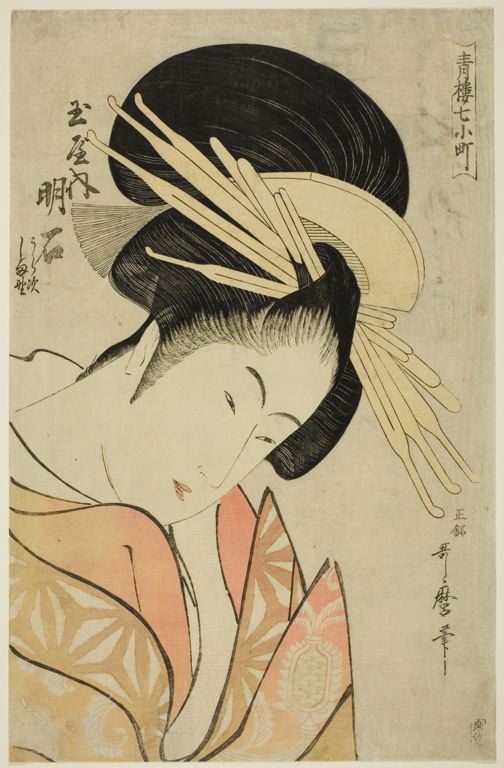
Akashi of the Tamaya, from the series Seven Komachis of Yoshiwara (Seiro nana Komachi) (Tamaya uchi Akashi, Uraji, Shimano)
Woodblock print
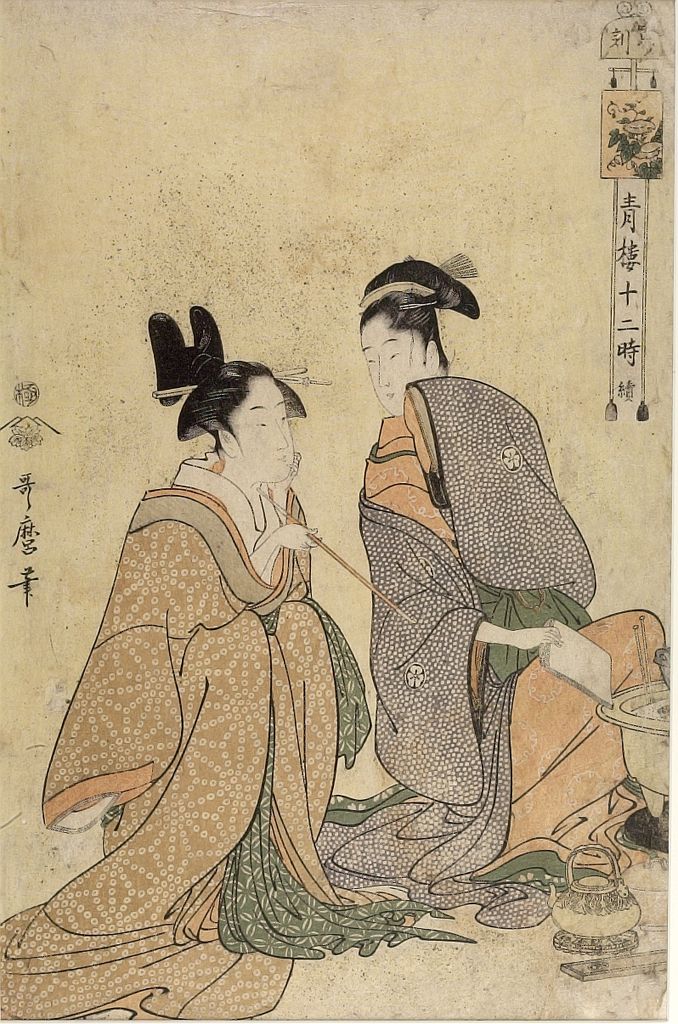
Hour of the Tiger (Tora no koku = 4 AM) from the series Twelve Hours in Yoshiwara (Seirô jûni toki tsuzuki), Late Edo period, circa 1794
Woodblock print
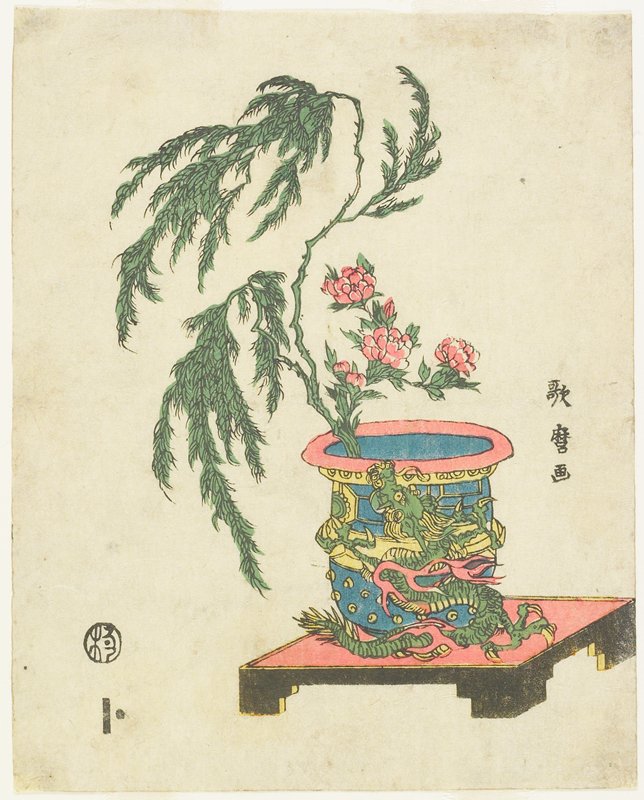
Ikebana arrangement of Peony and Willow in Dragon Pot
1781–1806
Woodblock print (nishiki-e), ink and color on paper
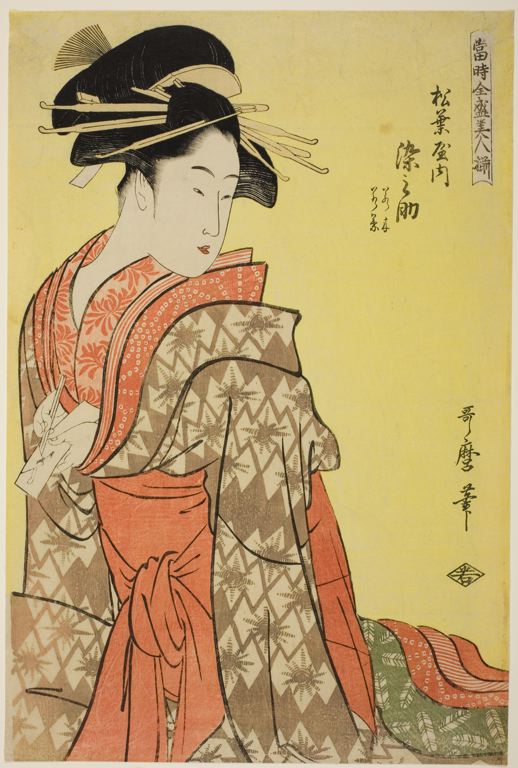
The Greatest Beauties of Our Time (Toji zensei bijin zoroe): Somenosuke of the Matsubaya with Attendants Wakagi and Wakaba
Woodblock print
More Mount Fuji Prints
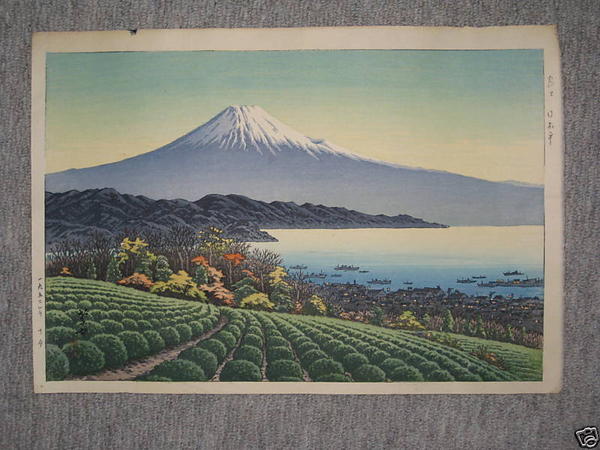
Fuji from tea farm
Woodblock print

Akasaka, Fujikawa, Okazaki, Chiryu, and Narumi, from the series "Famous Places on the Fifty-three Stations of the Tokaido, Five Stations (Tokaido gojusan eki goshuku meisho)"
c. 1830/35
Color woodblock print; oban
![Mount Fuji on a Moonlit Night, Kawai Bridge (Tsukiyo no Fuji [Kawaibashi]), from the series "Selection of Views of the Tokaido (Tokaido fukei senshu)" by Kawase Hasui](https://www.artic.edu/iiif/2/d0960668-1e73-339a-b182-fb995a54bff0/full/843,/0/default.jpg)
Mount Fuji on a Moonlit Night, Kawai Bridge (Tsukiyo no Fuji [Kawaibashi]), from the series "Selection of Views of the Tokaido (Tokaido fukei senshu)"
1947
Color woodblock print; oban

Mt. Fuji in Rain (Ame no Fuji)
n.d.
Color woodblock print
Featured in Collections
Curated cross-cuts that include this print.
Frequently Asked Questions
Tying Thread, from the series “Women’s Handicrafts: Models of Dexterity" ("Fujin tewaza ayatsuri kagami") was created by Kitagawa Utamaro (喜多川歌麿) in c. 1797/98.
Tying Thread, from the series “Women’s Handicrafts: Models of Dexterity" ("Fujin tewaza ayatsuri kagami") depicts mount fuji.