
The Actor Bando Hikosaburo II as Fujitaro, disguised as the ferryman Tomokichi, in the play "Shomei Mugen no Kane," performed at the Nakamura Theater in the ninth month, 1767
- Date:
- 1767
- Medium:
- Color woodblock print; hosoban, benizuri-e
- Source:
- Art Institute of Chicago
Description
This 1767 hosoban benizuri-e color woodblock print at the Art Institute of Chicago shows the actor Bando Hikosaburo II as Fujitaro, disguised as the ferryman Tomokichi, in the kabuki play Shomei Mugen no Kane, performed at the Nakamura Theater in the ninth month of 1767. Bando Hikosaburo II (1741-1768) was a leading actor of the period, and the Shomei Mugen no Kane was one of the many kabuki dramas built around the popular dojoji and bell legends. The convention of yatsushi or disguise - in which a heroic character takes on the guise of a humble worker - was a beloved kabuki dramatic device, giving actors opportunities to display virtuosity by alternating between elegant and earthy registers within a single role. Here Hikosaburo plays a samurai in the disguise of a ferryman. The hosoban benizuri-e format with its pink, green, and black palette was the standard for actor prints in 1767, even as nishiki-e was becoming available for non-theatrical subjects. Shigemasa's command of the Torii-school actor-print idiom was sufficient that he produced these compositions in volume during the late 1760s.
More Prints by Kitao Shigemasa

Women Holding Boy who is Reaching Out to Young Man Below
c. 1776
Color woodblock print; hashira-e

Priest Saigyo Contemplating Mount Fuji
c. 1770s
Color woodblock print; hashira-e

Autumn Moon over Sumida River (Sumida aki zuki), from the series "Eight Views of the Sumida River (Sumidagawa hakkei)"
early 1760s
Color woodblock print; hosoban, mizu-e

Crossing the Bridge at Sano
c. 1774
Color woodblock print; koban
More Mount Fuji Prints
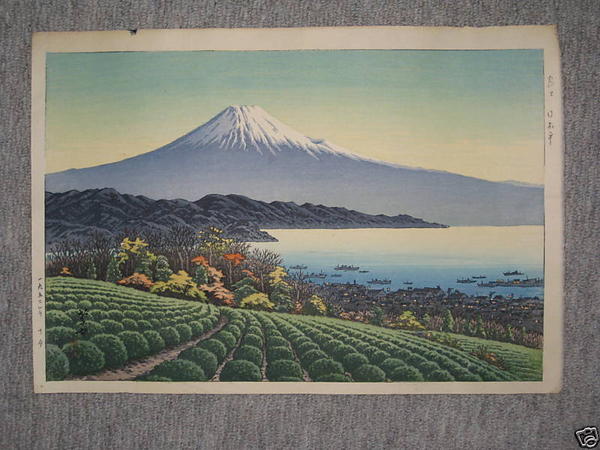
Fuji from tea farm
Woodblock print

Akasaka, Fujikawa, Okazaki, Chiryu, and Narumi, from the series "Famous Places on the Fifty-three Stations of the Tokaido, Five Stations (Tokaido gojusan eki goshuku meisho)"
c. 1830/35
Color woodblock print; oban
![Mount Fuji on a Moonlit Night, Kawai Bridge (Tsukiyo no Fuji [Kawaibashi]), from the series "Selection of Views of the Tokaido (Tokaido fukei senshu)" by Kawase Hasui](https://www.artic.edu/iiif/2/d0960668-1e73-339a-b182-fb995a54bff0/full/843,/0/default.jpg)
Mount Fuji on a Moonlit Night, Kawai Bridge (Tsukiyo no Fuji [Kawaibashi]), from the series "Selection of Views of the Tokaido (Tokaido fukei senshu)"
1947
Color woodblock print; oban

Mt. Fuji in Rain (Ame no Fuji)
n.d.
Color woodblock print
Featured in Collections
Curated cross-cuts that include this print.
Frequently Asked Questions
The Actor Bando Hikosaburo II as Fujitaro, disguised as the ferryman Tomokichi, in the play "Shomei Mugen no Kane," performed at the Nakamura Theater in the ninth month, 1767 was created by Kitao Shigemasa (北尾重政) in 1767.
The Actor Bando Hikosaburo II as Fujitaro, disguised as the ferryman Tomokichi, in the play "Shomei Mugen no Kane," performed at the Nakamura Theater in the ninth month, 1767 depicts mount fuji.