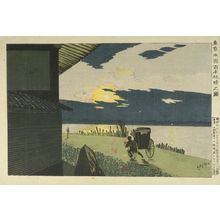
Picture of the Sunrise at Hyapongui, Ryôguku, Edo (Toto Ryôgoku Hyapongui akatsuki no zu), Meiji period, dated 1879
- Medium:
- Woodblock print
- Source:
- Harvard Art Museum
- Image courtesy of
- Harvard Art Museum
Description
This 1879 oban print from Kiyochika's celebrated series of Tokyo light pictures depicts the wooden stakes known as Hyapongui — literally 'hundred stake piles' — along the Sumida River bank at Ryōgoku, rendered at dawn. Hyapongui was a distinctive feature of the Ryōgoku riverscape: rows of old pilings rising from the river's edge, used by boat traffic and familiar to Edo-period inhabitants as a characteristic view of the area. Kiyochika transforms this mundane industrial shoreline into an atmospheric study of early morning light reflected across water, with the stakes creating a rhythmic vertical pattern against a sky graded from deep indigo through pink and gold. The akatsuki (dawn) setting allowed him to deploy the full range of his bokashi technique — the gradual color blending achieved by wiping the woodblock before printing — to render the diffuse glow distinctive of his kōsen-ga style. Ryōgoku, the district adjacent to the famous bridge, was one of the most recognized settings in the Edo visual tradition, and Kiyochika's interpretation reframes it through a Western atmospheric lens while preserving its topographical identity.
More Prints by Kobayashi Kiyochika
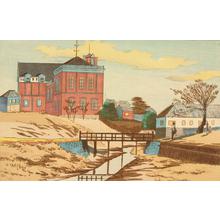
More Night Scenes Prints
Evening in East Africa
Woodblock print
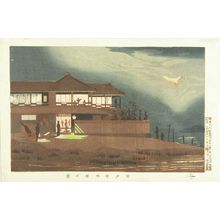
Evening Shower at Teradomari (Teradomari no yau), from the series "Souvenirs of Travel, Second Series (Tabi miyage dai nishu)"
Teradomari no yau
1921
Color woodblock print; oban
![Mount Fuji on a Moonlit Night, Kawai Bridge (Tsukiyo no Fuji [Kawaibashi]), from the series "Selection of Views of the Tokaido (Tokaido fukei senshu)" by Kawase Hasui](https://www.artic.edu/iiif/2/d0960668-1e73-339a-b182-fb995a54bff0/full/843,/0/default.jpg)
Mount Fuji on a Moonlit Night, Kawai Bridge (Tsukiyo no Fuji [Kawaibashi]), from the series "Selection of Views of the Tokaido (Tokaido fukei senshu)"
1947
Color woodblock print; oban

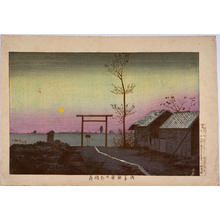
Evening Moon at Nakanoshima, Sapporo (Sapporo Nakanoshima no yuzuki), from the series "Collection of Views of Japan, Eastern Japan Edition (Nihon fukei shu higashi Nihon hen)"
March 1933
Color woodblock print; oban
Frequently Asked Questions
Picture of the Sunrise at Hyapongui, Ryôguku, Edo (Toto Ryôgoku Hyapongui akatsuki no zu), Meiji period, dated 1879 was created by Kobayashi Kiyochika (小林清親).
Picture of the Sunrise at Hyapongui, Ryôguku, Edo (Toto Ryôgoku Hyapongui akatsuki no zu), Meiji period, dated 1879 depicts night scenes.