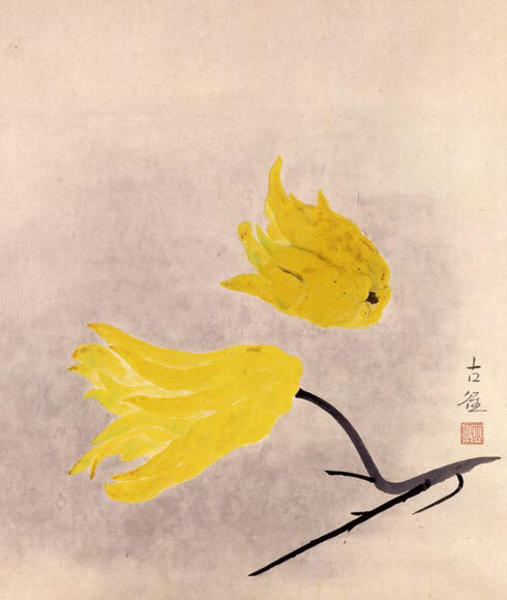
Fingered citron — 仏手柑
- Medium:
- Woodblock print
- Source:
- Japanese Art Open Database
- Image courtesy of
- Japanese Art Open Database
Description
The fingered citron (busshukan, 仏手柑, Citrus medica var. sarcodactylis) is an unusual citrus fruit whose elongated, finger-like segments give it the appearance of a Buddhist hand in a mudra gesture — the source of its Japanese name, meaning Buddha's hand fragrant citrus. It appears in Japanese decorative art as a motif associated with auspiciousness and religious symbolism, and its structural form — multiple tapering yellow protrusions radiating from a shared base — presents a compositional subject with inherent visual complexity. Kokei renders this botanical subject in woodblock, requiring multiple color blocks to capture the gradation from pale yellow at the tips to deeper gold toward the base, with fine line work defining the individual segments and their slight surface texture. Such botanical prints situate Kokei within a broader tradition of Japanese natural history illustration while demonstrating the adaptability of his multiblock technique to static, close-observed subject matter.
More Prints by Tsuruya Kokei

Kataoka Nizaemon XIII as Ishikawa Goemon in the play Sanmon Gosan no Kiri
Mokuhanga (Japanese woodblock)
The Tayu (High-ranking Courtesan)
Woodblock print on ganpi paper with mica
Ichikawa Danshiro IV as Akushichibyoe Kagekiyo
Woodblock print on ganpi paper with mica
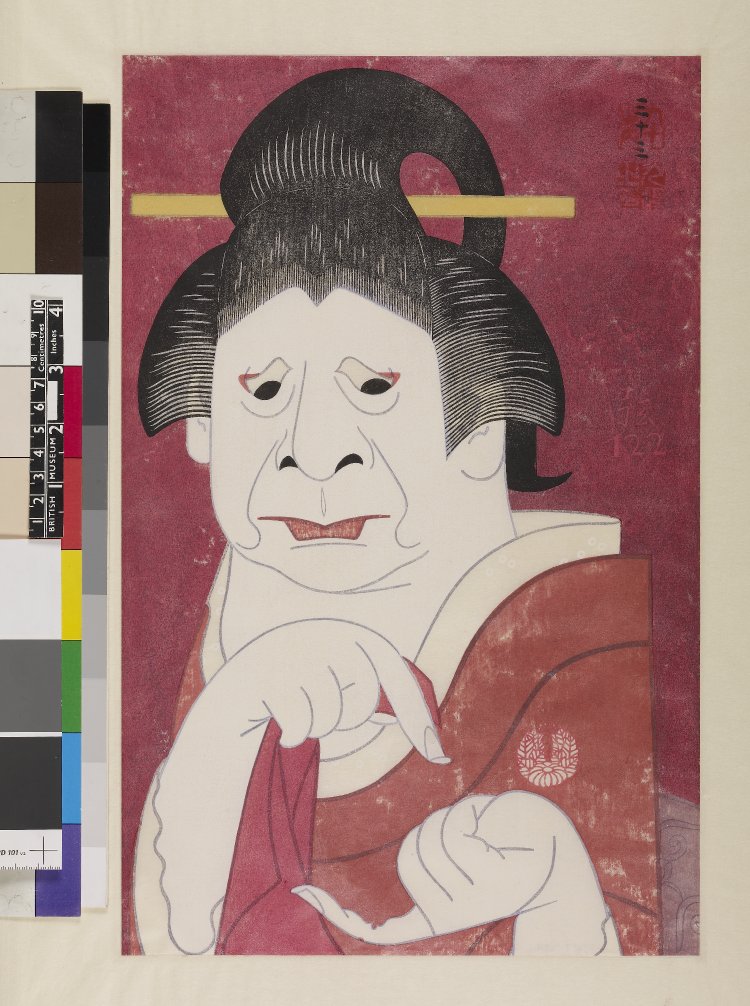
Onoe Baiko VII as Masaoka 七世尾上梅幸の乳人政岡 / Bust portraits VIII (Design 4) 第八期大首絵シリーズの4
Woodblock print
Featured in Collections
Curated cross-cuts that include this print.
Frequently Asked Questions
Fingered citron — 仏手柑 was created by Tsuruya Kokei (弦屋光溪).