
Hachimangu shrine at Tsurugaoka in Kamakura
- Medium:
- Mokuhanga (Japanese woodblock)
- Image courtesy of
- Saru Gallery
Description
Hachimangu shrine at Tsurugaoka in Kamakura depicts the principal Shinto shrine of the former Kamakura shogunal capital, founded by Minamoto no Yoriyoshi in 1063 and relocated to its present site by Yoritomo in 1180. The shrine compound is structured along a long stone-paved approach flanked by torii gates, leading to the maiden dance pavilion and the vermilion main hall raised at the top of a broad stone staircase. Prints of this site commonly select one of three vantages: the approach with the maiden centered, the staircase ascending toward the hongu, or the hongu itself viewed through the surrounding trees. Vermilion lacquered woodwork against dark cryptomeria and stone provides a saturated color contrast that suits the polychrome woodblock technique, with vermilion typically applied from a dedicated block to maintain density. Shrines and temples were a staple of meisho-e from the Edo period and continued as standard subjects for mid-twentieth-century printmakers. Konishi's treatment of Tsurugaoka Hachimangu, repeated in two snow versions, indicates the site held particular interest for him.
More Prints by Konishi Seiichiro


More Temples & Shrines Prints
Fushimi Inari Temple
伏見稲荷
Woodblock print

The Compound of the Tenman Shrine at Kameido in the Snow (Kameido Tenmangu keidai no yuki), from the series "Famous Places in the Eastern Capital (Toto meisho)"
c. 1832/38
Color woodblock print; oban
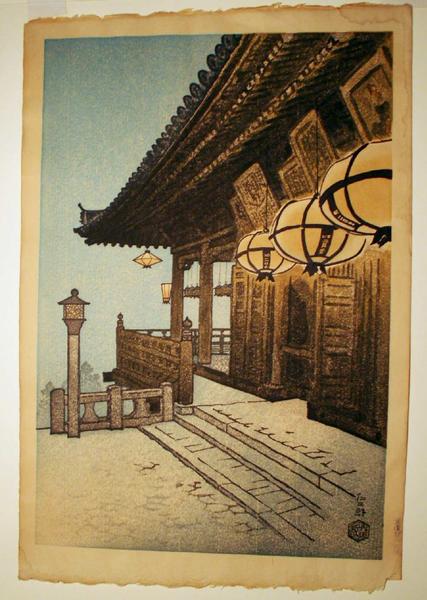
Temple with lanterns
Woodblock print

A Section of the Byodo Temple at Uji (Uji Byodoin no ichibu), from the series "Souvenirs of Travel, Second Series (Tabi miyage dai nishu)"
Uji Byodoin no ichibu
1921
Color woodblock print; oban
Featured in Collections
Curated cross-cuts that include this print.
Frequently Asked Questions
Hachimangu shrine at Tsurugaoka in Kamakura was created by Konishi Seiichiro (小西誠一郎).
Hachimangu shrine at Tsurugaoka in Kamakura depicts temples & shrines.