
Fushimi Inari Temple
伏見稲荷
by Takeji Asano
- Medium:
- Woodblock print
- Format:
- Oban
- Publisher:
- Unsodo
- Source:
- Ukiyo-e.org (via Artelino)
Description
Fushimi Inari Temple depicts the iconic vermillion torii gates of Fushimi Inari Taisha, the head shrine of the Inari deity located in southern Kyoto. This shrine is famous for its thousands of closely spaced torii gates that form tunneling pathways up the sacred Mount Inari, creating one of the most visually striking and photographed scenes in all of Japan.
Takeji Asano's composition captures the distinctive experience of walking through the seemingly endless corridors of bright orange-red gates. The torii, donated by businesses and individuals as offerings to the Shinto deity of rice, prosperity, and foxes, are arranged so densely that they create an enclosed passageway with light filtering through the gaps between the gates. This creates a remarkable interplay of vivid vermillion surfaces and glimpses of the green forested hillside beyond.
As a sosaku-hanga artist, Asano designed, carved, and printed this work entirely by his own hand, giving him direct control over the rendering of the torii gates' distinctive color and the atmospheric effects of light passing through the tunnel-like structure. The technical challenge of depicting the repetitive yet subtly varying forms of the gates — each slightly different in size, spacing, and angle — required careful planning and precise execution. The vermillion color, achieved through multiple careful printings, captures the characteristic brightness of the gates' lacquer finish.
Fushimi Inari Taisha, founded in 711 CE, is one of Kyoto's oldest and most important shrines. The practice of donating torii gates dates back to the Edo period, and today the shrine contains an estimated ten thousand gates along its mountainside paths. Asano's print distills the visual impact of this extraordinary site into a single powerful image. His treatment of the subject has become one of his most popular works, reflecting the shrine's status as an essential Kyoto landmark and demonstrating the woodblock print's capacity to capture architectural subjects of great visual complexity.
More Prints by Takeji Asano



More Temples & Shrines Prints

The Compound of the Tenman Shrine at Kameido in the Snow (Kameido Tenmangu keidai no yuki), from the series "Famous Places in the Eastern Capital (Toto meisho)"
c. 1832/38
Color woodblock print; oban
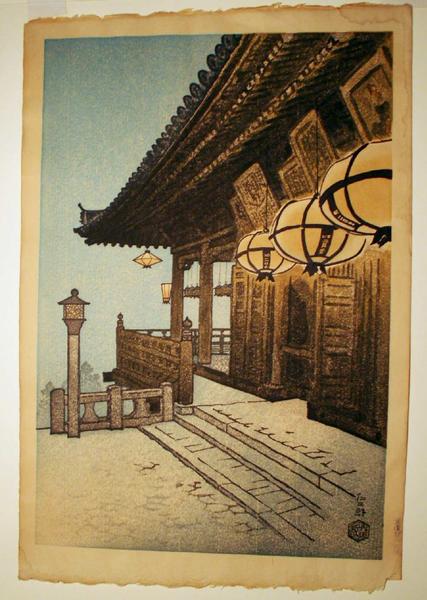
Temple with lanterns
Woodblock print

A Section of the Byodo Temple at Uji (Uji Byodoin no ichibu), from the series "Souvenirs of Travel, Second Series (Tabi miyage dai nishu)"
Uji Byodoin no ichibu
1921
Color woodblock print; oban
Old Rakan Temple, Yabakei, Bungo Province (Bungo Yabakei Ko Rakan-ji), from the series Famous Sights of Japan (Nihon meishō zue)
1897 (Meiji 30)
Woodblock print (nishiki-e); ink and color on paper
Featured in Collections
Curated cross-cuts that include this print.
Frequently Asked Questions
Fushimi Inari Temple (伏見稲荷) was created by Takeji Asano (浅野竹二).
Fushimi Inari Temple uses Bokashi, Nishiki-e, and Moku-hanga, on woodblock print.
Fushimi Inari Temple was published by Unsodo.
Fushimi Inari Temple depicts temples & shrines, set at Kyoto, Fushimi Inari.