
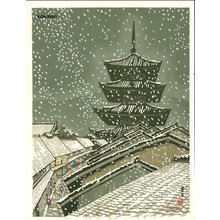
Kyoto snow
- Medium:
- Mokuhanga (Japanese woodblock)
- Image courtesy of
- Saru Gallery
Description
Kyoto snow places the print within the meisho-e tradition of celebrated-place imagery, here narrowed to the seasonal mode of yukigeshiki, or snow scenery. Kyoto offers printmakers a dense vocabulary of subjects suited to snow treatment: temple roofs, narrow lanes of machiya townhouses, stone walls, and bare branches against pale ground. The mokuhanga technique handles falling or settled snow through a combination of reserved white paper, gofun-laden key impressions, and graded bokashi skies that suggest overcast luminosity without literal grey. Konishi Seiichiro's working period in the mid-twentieth century overlaps with sōsaku-hanga and shin-hanga producers who treated Kyoto repeatedly, and his Kyoto snow sits within that broader post-war market for nostalgic, atmospheric views of the old capital. Without documented publisher records, the print is best read on its own terms: a quiet seasonal subject executed with the standard tools of color woodblock — multiple blocks aligned by kentō registration, water-based pigments brushed onto the block, impression by baren onto absorbent washi.
More Prints by Konishi Seiichiro


More Snow Scenes Prints
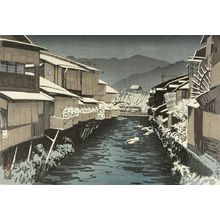
Fair Weather After Snow at Yamato Bridge, Kyoto (Yamato bashi no yukibare), Taishô period, dated 1924
Woodblock print

The Compound of the Tenman Shrine at Kameido in the Snow (Kameido Tenmangu keidai no yuki), from the series "Famous Places in the Eastern Capital (Toto meisho)"
c. 1832/38
Color woodblock print; oban

Miyajima in Snow (Yuki no Miyajima)
Yuki no Miyajima
1929
Color woodblock print; oban
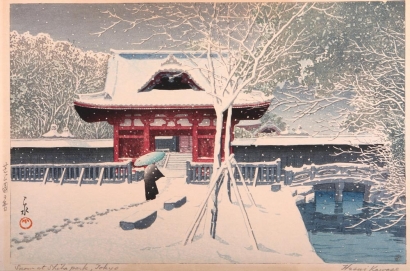
Evening Snow at Shiha Park, Tokyo
1932
Woodblock print
Frequently Asked Questions
Kyoto snow was created by Konishi Seiichiro (小西誠一郎).
Kyoto snow depicts snow scenes.