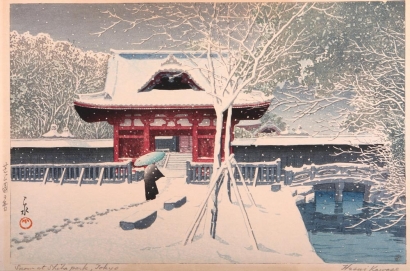
Evening Snow at Shiha Park, Tokyo
by Kawase Hasui
- Date:
- 1932
- Medium:
- Woodblock print
- Format:
- Oban
- Publisher:
- Watanabe Shozaburo
- Edition:
- Published by Watanabe Shozaburo
- Source:
- Art Gallery of Greater Victoria
Description
Evening Snow at Shiba Park in Tokyo, published in 1932, depicts the Shiba Park district of Minato ward — centered on the Zojoji temple's great red gate and the ancient Tokugawa mausolea — under falling evening snow that whitens the park's stone lanterns and muffles the sounds of the surrounding city. The park's combination of sacred architecture (Zojoji is one of Tokyo's largest Buddhist temples) and urban parkland gave Hasui a compositionally rich snow subject, the falling snow equalizing the old temple precincts and the newer park landscaping. The 1932 date places this alongside several other major Tokyo snow subjects Hasui produced that year.
Current Listings
$3,800
More Prints by Kawase Hasui

More Snow Scenes Prints
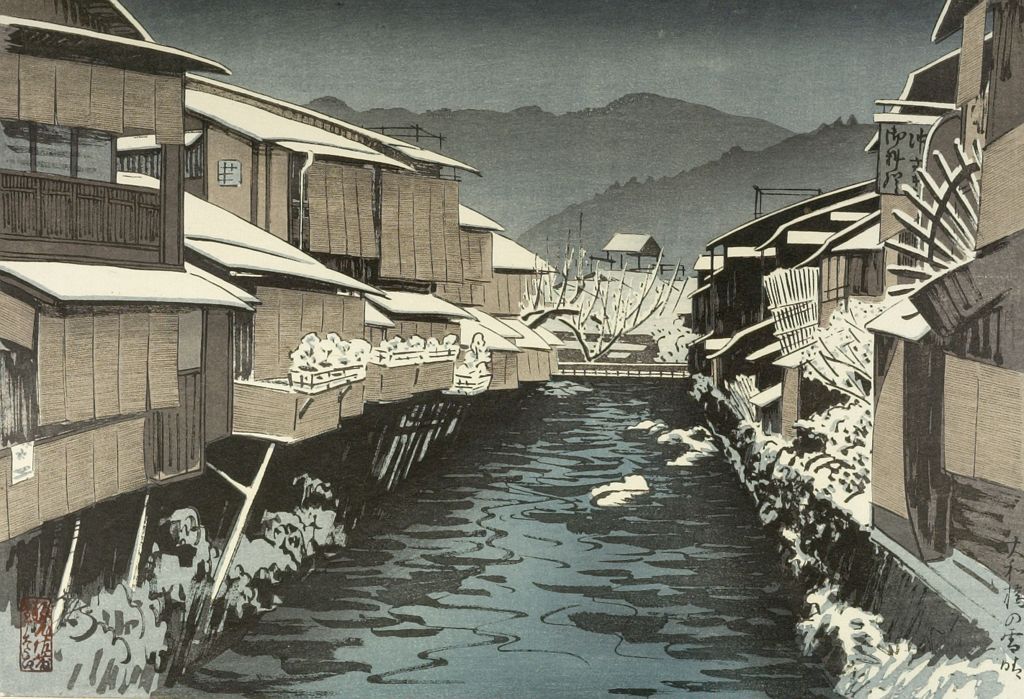
Fair Weather After Snow at Yamato Bridge, Kyoto (Yamato bashi no yukibare), Taishô period, dated 1924
Woodblock print

The Compound of the Tenman Shrine at Kameido in the Snow (Kameido Tenmangu keidai no yuki), from the series "Famous Places in the Eastern Capital (Toto meisho)"
c. 1832/38
Color woodblock print; oban

Miyajima in Snow (Yuki no Miyajima)
Yuki no Miyajima
1929
Color woodblock print; oban
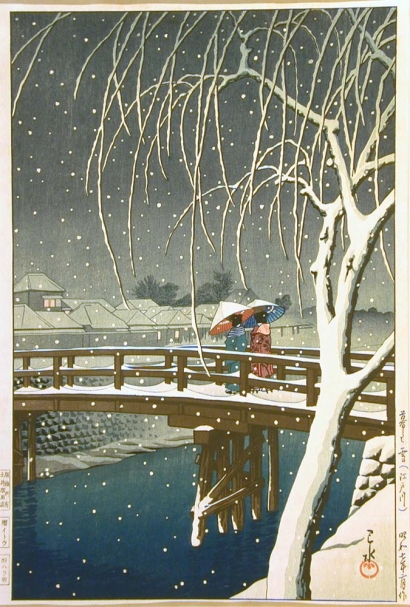
Late Snow Along Edo River
1932
Woodblock print
Featured in Collections
Curated cross-cuts that include this print.
Frequently Asked Questions
Evening Snow at Shiha Park, Tokyo was created by Kawase Hasui (川瀬巴水) in 1932.
Evening Snow at Shiha Park, Tokyo uses Bokashi, on woodblock print.
Evening Snow at Shiha Park, Tokyo was published by Watanabe Shozaburo (1932).
Evening Snow at Shiha Park, Tokyo depicts snow scenes and night scenes, set at Tokyo.