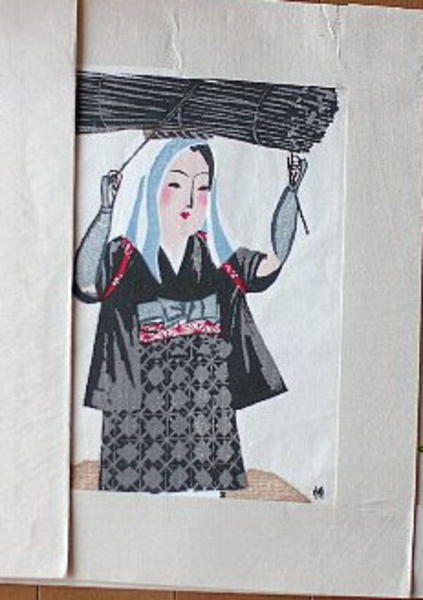
Oharame — 大原女
- Medium:
- Woodblock print
- Edition:
- Self-printed
- Source:
- Japanese Art Open Database
Description
A single woman in a dark kimono with a patterned skirt and red-trimmed sleeves stands facing forward, balancing a large bundle of bound sticks or brushwood on her head, steadying it with both raised hands. She wears a pale blue-and-white hood or headcloth draped over her hair, and her face is rendered with a simple pale complexion, dark eyes, and red lips against a plain tan ground. The print is matted with wide cream-colored borders; a small red seal appears in the lower right corner of the image. This woodblock print, titled "Oharame — 大原女" by Maekawa Senpan, uses a flat, limited palette of black, gray, red, and pale blue.
More Prints by Maekawa Senpan



More Figures Prints
Featured in Collections
Curated cross-cuts that include this print.
Frequently Asked Questions
Oharame — 大原女 was created by Maekawa Senpan (前川千帆).
Oharame — 大原女 depicts figures, market scenes, and daily life.