
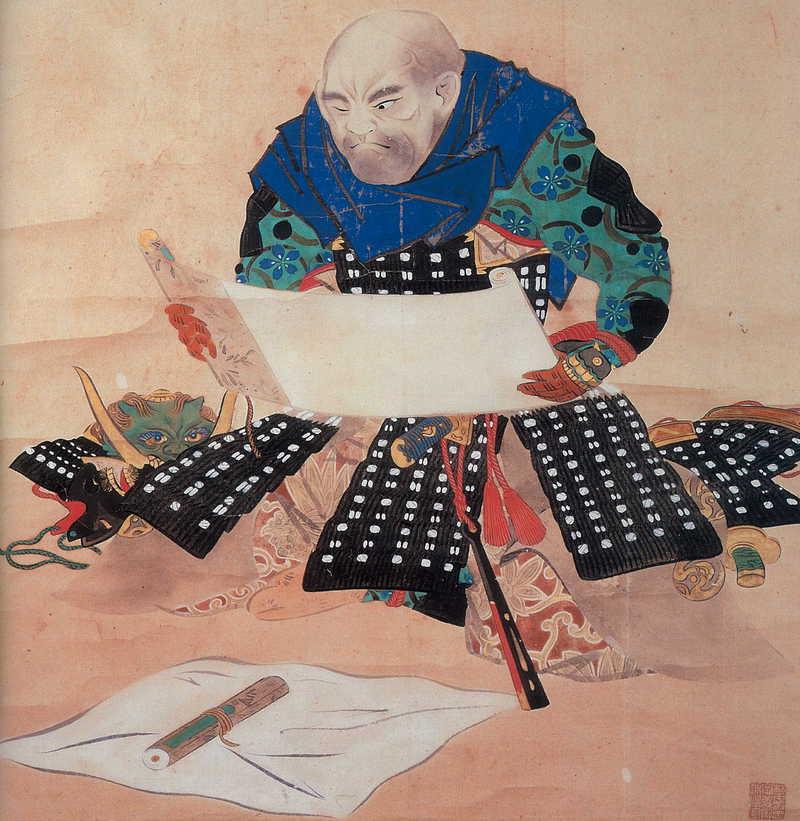
Portrait of Itagaki Nobukata (One of the Twenty-Four Generals of Takeda Shingen)
板垣信方像
- Date:
- 1860 (inscription added 1872)
- Medium:
- Hanging scroll; ink and colour on paper
Description
Portrait of Itagaki Nobukata (板垣信方像) is one of Matsumoto Fūko's earliest documented major works and the founding image of his long association with the Twenty-Four Generals of Takeda Shingen iconography. Itagaki Nobukata (1489–1548) was one of the senior commanders of the Kai-province daimyō Takeda Shingen and is conventionally numbered first among the Twenty-Four Generals; he died at the Battle of Uedahara in 1548. The painting — a hanging scroll in ink and colour on paper, 130.5 by 51.8 centimetres — is held at Erin-ji, the Rinzai temple in Yamanashi that was the Takeda family mortuary, and is now exhibited at the adjacent Takeda Shingen Museum. The dating is unusually precise: Fūko signed and dated the painting itself in 1860, when he was only twenty years old and still working in Kikuchi Yōsai's Edo studio; the inscription was added twelve years later, in May 1872, by the Meiji statesman Itagaki Taisuke (1837–1919), a founder of the Liberty and People's Rights movement who claimed descent from the Sengoku general and visited Erin-ji to add the calligraphic inscription at a memorial ceremony. The portrait shows Nobukata in formal armour, head turned in three-quarter view, with a meticulous treatment of the helmet ornament, lacing and brocade tabard derived directly from Yōsai's Zenken kojitsu codification of Sengoku armour. As the earliest dated work in Fūko's surviving corpus, the painting also documents the Yōsai-derived figural style at the very beginning of his independent career.
More Prints by Matsumoto Fūko

Three Flowers in Snow (Centre Scroll)
雪中三花図 中幅
before 1924
Hanging scroll; ink and colour on silk
Portrait of Yamamoto Kansuke (One of the Twenty-Four Generals of Takeda Shingen)
山本勘助像
c. 1871–1873
Hanging scroll; ink and colour on paper

Portrait of Tsuchiya Masatsugu (One of the Twenty-Four Generals of Takeda Shingen)
土屋昌続像
c. 1871–1873
Hanging scroll; ink and colour on paper

Portrait of Akiyama Nobutomo (One of the Twenty-Four Generals of Takeda Shingen)
秋山信友像
c. 1871–1873
Hanging scroll; ink and colour on paper
Frequently Asked Questions
Portrait of Itagaki Nobukata (One of the Twenty-Four Generals of Takeda Shingen) (板垣信方像) was created by Matsumoto Fūko (松本楓湖) in 1860 (inscription added 1872).