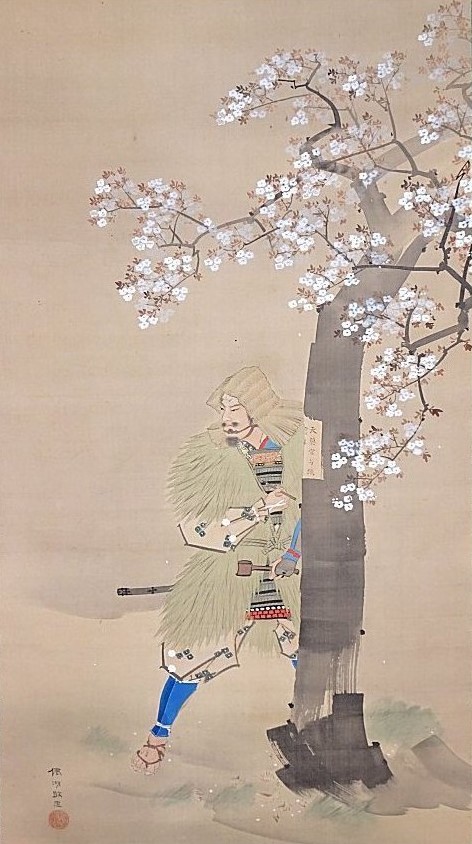
Biography
Matsumoto Fūko (松本楓湖, 1840–1923) was one of the leading historical-narrative painters (rekishiga) of the Meiji period and a founding participant in the Nihon Bijutsuin (Japan Art Institute), the institutional home of modern nihonga established by Okakura Tenshin in 1898. A pupil of Kikuchi Yōsai (菊池容斎, 1788–1878), the early-modern revivalist of the historical-portrait genre, Fūko inherited and extended Yōsai's project of imagining the Japanese past — the Heian court, the Genpei War, the Mongol invasions, the Sengoku battlefields — in disciplined ink-and-colour painting suited to the new public Japan that was emerging after the Restoration. His private academy in Asakusa was for decades one of the leading ateliers of historical painting in Tokyo, and among the many students he trained there were Imamura Shikō and Hayami Gyoshū, who became significant figures of the following generation of nihonga. Fūko himself lived through the entire arc of nineteenth- and early-twentieth-century Japanese painting, from his apprenticeship in late-Edo Edo to his service as a juror of the government's Bunten (Ministry of Education Art Exhibition) after its founding in 1907, and his career is one of the principal threads through which the indigenous painting tradition was carried across the discontinuity of 1868.
Fūko was born on 9 October 1840 in Terauchi, a village in Kawachi District of Hitachi Province (present-day Inashiki, Ibaraki Prefecture), the third son of Matsumoto Sōan, a practitioner of Chinese medicine and a Confucian scholar who taught local children; the painter's given name was Tadasada. His early aptitude for drawing was encouraged, and in 1853, at the age of fourteen, he went up to Edo to study under Oki Ichiga, a painter of the Tottori domain known for richly coloured bird-and-flower work. After Ichiga's death he entered, in 1856, the studio of Satake Eikai, a leading disciple of Tani Bunchō and official painter to the Hikone domain, taking the art name Eiga. The decisive turn in his training came in 1868, when — already basing his historical subjects on Kikuchi Yōsai's illustrated compendium of exemplary historical figures, the Zenken kojitsu (前賢故実) — he obtained his teacher's permission to enter Yōsai's studio and adopted the name Fūko, by which he is known. From Yōsai he absorbed both the iconographic apparatus of the historical-narrative tradition and its disciplined, line-led drawing manner.
The first major work of Fūko's career, and the one that established his reputation as a painter of historical warriors, was a set of hanging scrolls depicting the Twenty-Four Generals of Takeda Shingen (武田二十四将), the celebrated band of warriors who served the Kai-province daimyō through the Sengoku wars. Painted in the early 1870s and presented to Erin-ji (恵林寺) — the Rinzai temple in Yamanashi that was the mortuary temple of the Takeda house — in 1872, the series is now held at the Takeda Shingen Museum at Erin-ji. Each general is rendered in ink and light colour in the manner Yōsai had codified; the best-known of the portraits, that of the general Itagaki Nobukata, carries an inscription added by the Meiji statesman Itagaki Taisuke, who claimed descent from him.
Through the 1870s and 1880s Fūko built up a Tokyo workshop, opening a private academy, the Anya-dō (安雅堂画塾), at his home in Eikyū-chō in Asakusa, where he is said to have trained some four hundred pupils over the course of his career. He became known above all for large-scale historical and mythological compositions. His six-panel folding screen Mōko shūrai – Heiteikan zu (蒙古襲来・碧蹄館図屏風), pairing the thirteenth-century Mongol invasion with the late-sixteenth-century Korean campaign, was shown at the Fourth National Industrial Exhibition, held in Kyoto in 1895, and he continued to treat historical and mythological subjects on a large scale through the late Meiji and Taishō periods.
Fūko's institutional prominence dates from the late 1890s. In 1898 he was among the painters — alongside Hashimoto Gahō, Yokoyama Taikan, Shimomura Kanzan, Hishida Shunsō, and Saigō Kogetsu — who joined Okakura Tenshin in founding the Nihon Bijutsuin. He remained one of its senior members through the institute's difficult first decade, and through his Asakusa academy he trained pupils, among them Imamura Shikō and Hayami Gyoshū, who went on to become leading figures of the reconstituted Nihon Bijutsuin and its Inten exhibitions after Yokoyama Taikan revived the institute in 1914.
From the founding of the Bunten in 1907 Fūko served as one of its jurors, sitting on the panel for its first four exhibitions as one of the senior nihonga representatives. In 1919 he was appointed a member of the Imperial Art Academy (Teikoku Bijutsuin), an honour conferred on the most distinguished senior painters of the Meiji generation.
Fūko died in Tokyo on 22 June 1923, a few months before the Great Kantō Earthquake destroyed much of the Tokyo art world; he was eighty-two. He is buried at Zenshō-an (全生庵) in Yanaka, the Rinzai temple associated with the bakumatsu statesman Yamaoka Tesshū. His position in the history of modern Japanese painting is a double one: as a pupil of Kikuchi Yōsai he carried the historical-narrative tradition of the early nineteenth century into the post-Restoration period, and as a teacher of Imamura Shikō and Hayami Gyoshū he handed that tradition on to the generation that would define nihonga in the decades between the wars.
Key Facts
- Active Period
- 1840–1923
- Nationality
- 🇯🇵Japan
- Movement
- Meiji/Taishō Prints
- Subjects
- WinterBirds & Flowers
- Works Indexed
- 8
Frequently Asked Questions
Matsumoto Fūko (松本楓湖, 1840–1923) was one of the leading historical-narrative painters (rekishiga) of the Meiji period and a founding participant in the Nihon Bijutsuin (Japan Art Institute), the institutional home of modern nihonga established by Okakura Tenshin in 1898. A pupil of Kikuchi Yōsai (菊池容斎, 1788–1878), the early-modern revivalist of the historical-portrait genre, Fūko inherited and extended Yōsai's project of imagining the Japanese past — the Heian court, the Genpei War, the Mongol invasions, the Sengoku battlefields — in disciplined ink-and-colour painting suited to the new public Japan that was emerging after the Restoration. His private academy in Asakusa was for decades one of the leading ateliers of historical painting in Tokyo, and among the many students he trained there were Imamura Shikō and Hayami Gyoshū, who became significant figures of the following generation of nihonga. Fūko himself lived through the entire arc of nineteenth- and early-twentieth-century Japanese painting, from his apprenticeship in late-Edo Edo to his service as a juror of the government's Bunten (Ministry of Education Art Exhibition) after its founding in 1907, and his career is one of the principal threads through which the indigenous painting tradition was carried across the discontinuity of 1868.
Matsumoto Fūko was active from 1840 to 1923. They were associated with the Meiji/Taishō Prints movement.
Matsumoto Fūko's work was shaped by the Meiji/Taishō Prints tradition in Japanese woodblock printmaking. Meiji/Taishō Prints: Meiji and Taishō era prints (1868–1926) bridge the transition from traditional ukiyo-e to the modern shin-hanga and sosaku-hanga movements.
Matsumoto Fūko's prints frequently feature winter, birds & flowers.
Original prints by Matsumoto Fūko can be found in collections including Erin-ji Temple, Yamanashi (via Wikimedia Commons), Private collection (via Wikimedia Commons).
Woodblock Prints by Matsumoto Fūko (8)

Portrait of Itagaki Nobukata (One of the Twenty-Four Generals of Takeda Shingen)
板垣信方像
1860 (inscription added 1872)
Hanging scroll; ink and colour on paper
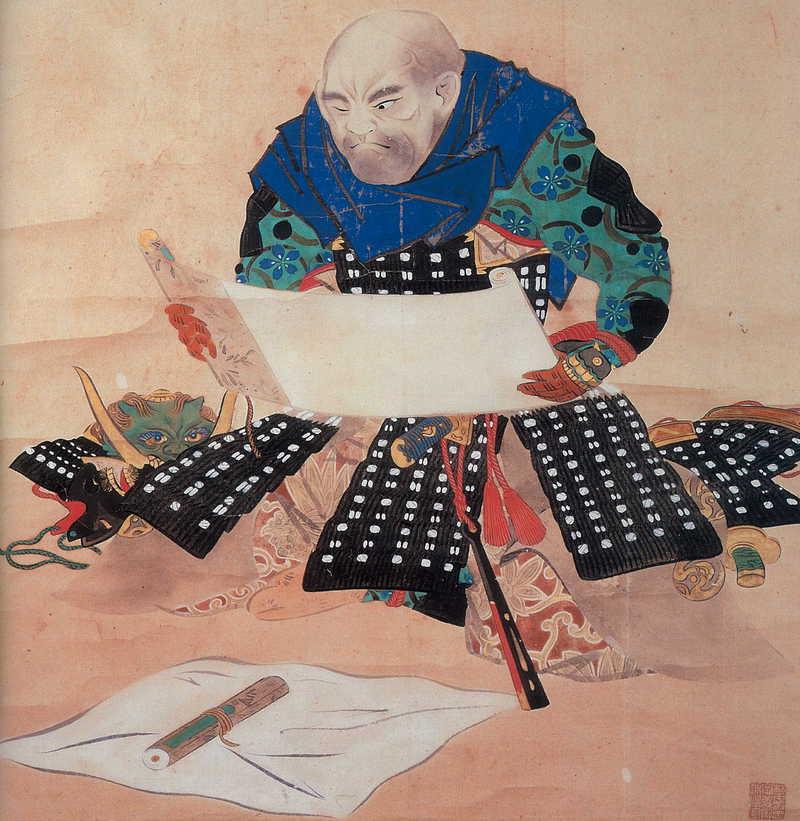
Portrait of Yamamoto Kansuke (One of the Twenty-Four Generals of Takeda Shingen)
山本勘助像
c. 1871–1873
Hanging scroll; ink and colour on paper

Portrait of Tsuchiya Masatsugu (One of the Twenty-Four Generals of Takeda Shingen)
土屋昌続像
c. 1871–1873
Hanging scroll; ink and colour on paper

Portrait of Akiyama Nobutomo (One of the Twenty-Four Generals of Takeda Shingen)
秋山信友像
c. 1871–1873
Hanging scroll; ink and colour on paper

Three Flowers in Snow (Centre Scroll)
雪中三花図 中幅
before 1924
Hanging scroll; ink and colour on silk

Ushiwakamaru (The Young Minamoto no Yoshitsune)
牛若丸
before 1924
Hanging scroll; ink and colour on silk
Kojima Takanori Inscribing the Cherry Tree
児島高徳
before 1924
Hanging scroll; ink and colour on silk
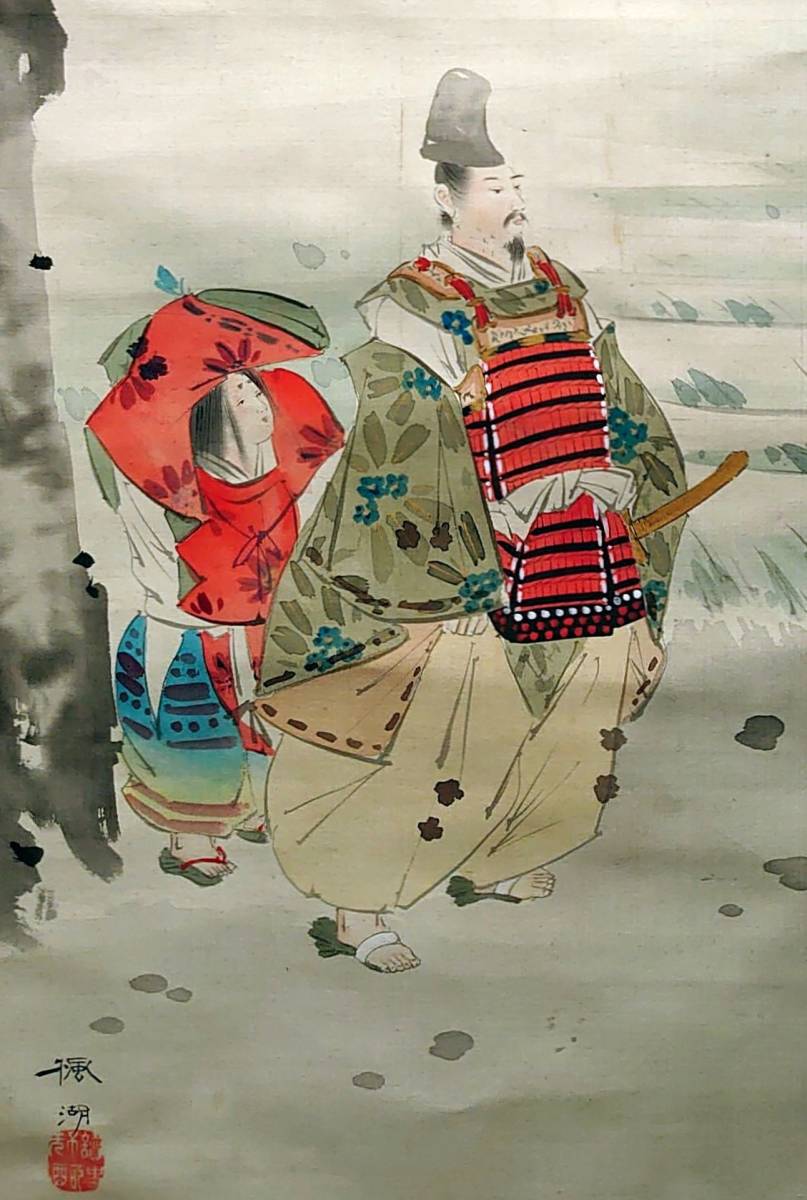
Warrior and Attendant
武将と従者図
before 1924
Hanging scroll; ink and colour on silk