
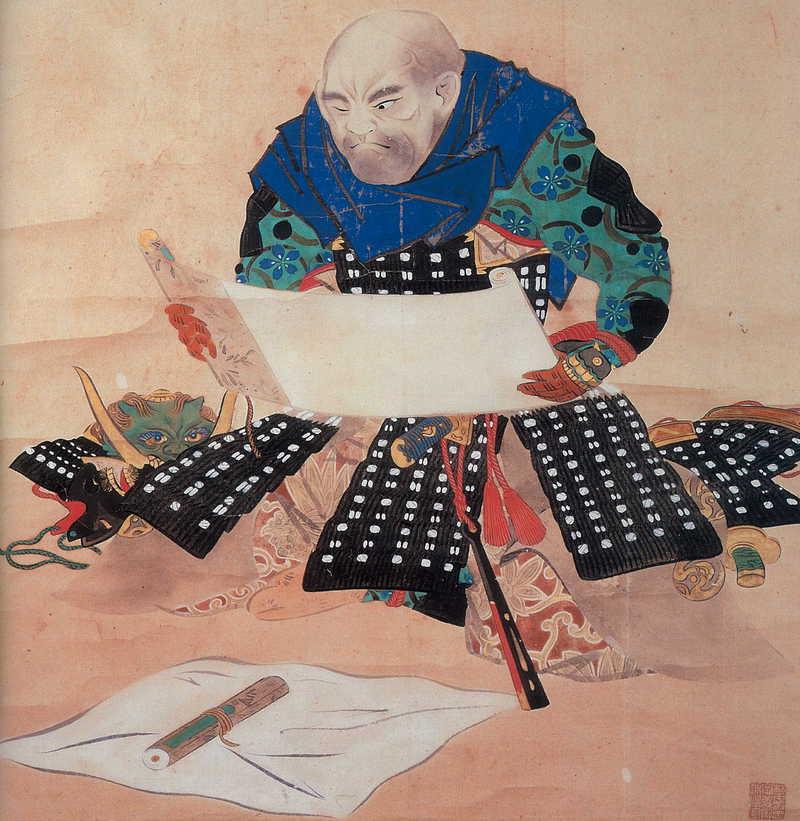
Portrait of Tsuchiya Masatsugu (One of the Twenty-Four Generals of Takeda Shingen)
土屋昌続像
- Date:
- c. 1871–1873
- Medium:
- Hanging scroll; ink and colour on paper
Description
Portrait of Tsuchiya Masatsugu (土屋昌続像) is one of the twenty-four hanging scrolls of the Twenty-Four Generals of Takeda Shingen series Matsumoto Fūko produced for Erin-ji Temple in Yamanashi between 1871 and 1873. Tsuchiya Masatsugu (1545–1575) was a Takeda retainer who served Shingen and then his son Katsuyori, and who was killed at the catastrophic Battle of Nagashino in 1575, where Oda Nobunaga's matchlock volleys broke the Takeda cavalry charge and effectively ended the Takeda house as an independent military power. Fūko presents him in formal armour of the Tenshō period, head turned in three-quarter view, with the same linear, colour-on-paper manner he applied to the rest of the series — a manner directly inherited from his teacher Kikuchi Yōsai's Zenken kojitsu of the 1840s and 1850s. The Erin-ji series, executed when Fūko was in his early thirties and not yet a public figure, established him as the principal Meiji-era painter of Sengoku military subjects and remains his most accessible single body of work; the portraits are conserved at Erin-ji in Kōshū-shi, Yamanashi Prefecture, and are exhibited in rotation at the adjacent Takeda Shingen Museum.
More Prints by Matsumoto Fūko

Portrait of Itagaki Nobukata (One of the Twenty-Four Generals of Takeda Shingen)
板垣信方像
1860 (inscription added 1872)
Hanging scroll; ink and colour on paper

Three Flowers in Snow (Centre Scroll)
雪中三花図 中幅
before 1924
Hanging scroll; ink and colour on silk
Portrait of Yamamoto Kansuke (One of the Twenty-Four Generals of Takeda Shingen)
山本勘助像
c. 1871–1873
Hanging scroll; ink and colour on paper

Portrait of Akiyama Nobutomo (One of the Twenty-Four Generals of Takeda Shingen)
秋山信友像
c. 1871–1873
Hanging scroll; ink and colour on paper
Frequently Asked Questions
Portrait of Tsuchiya Masatsugu (One of the Twenty-Four Generals of Takeda Shingen) (土屋昌続像) was created by Matsumoto Fūko (松本楓湖) in c. 1871–1873.