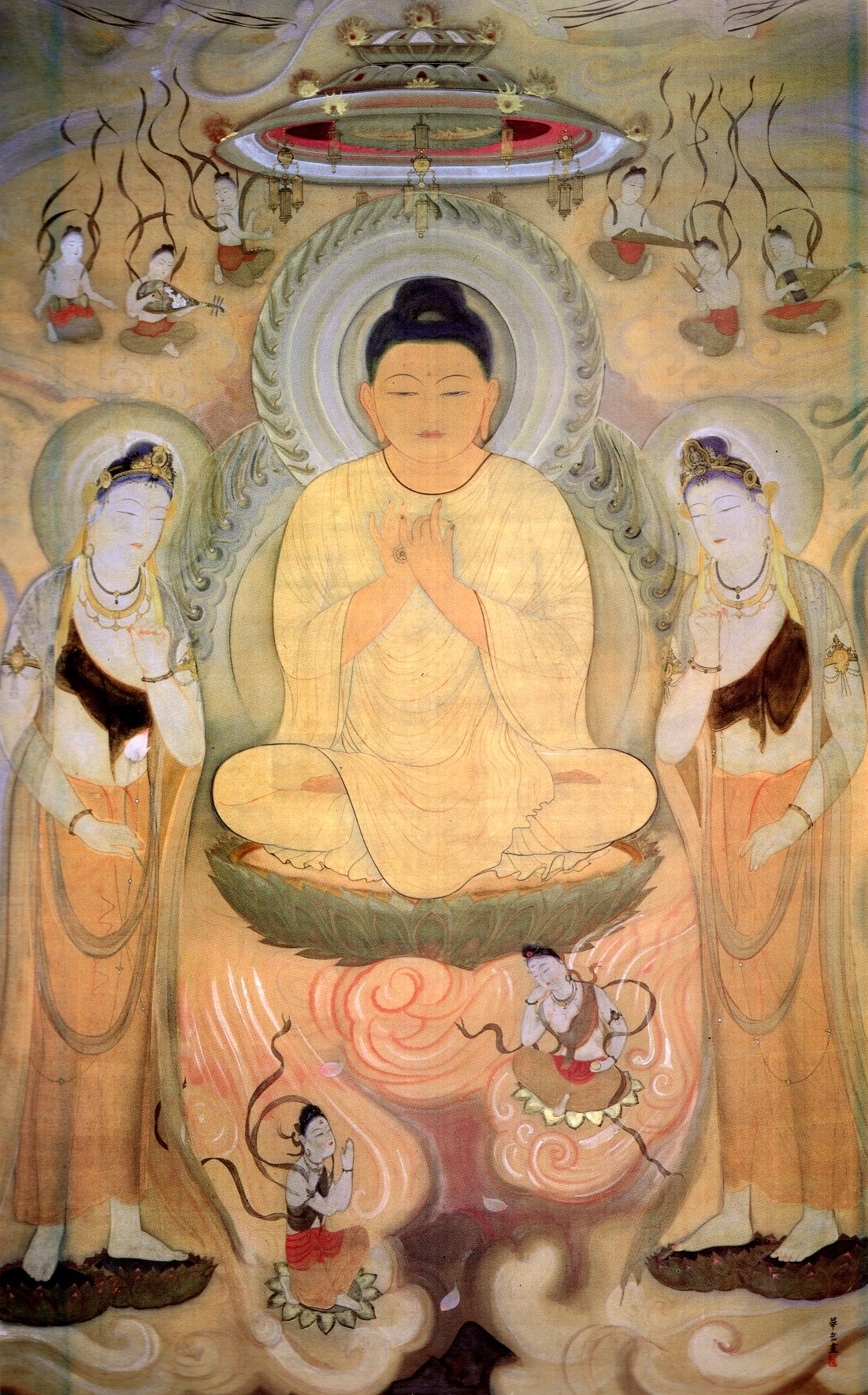
Amitābha (Amida)
阿弥陀如来図
- Date:
- 1916
- Medium:
- Ink and color on silk; hanging scroll
- Source:
- Wikimedia Commons
Description
Amitābha (Amida) is a hanging-scroll painting by Murakami Kagaku in ink and color on silk, dated 1916, depicting the Buddha of the Western Paradise — the central figure of the Pure Land tradition that has shaped Japanese popular religion for nearly a thousand years. Painted at the age of twenty-eight, in the period immediately preceding his co-founding of the Kokuga Sōsaku Kyōkai in 1918 with Tsuchida Bakusen, Ono Chikkyō, Sakakibara Shihō, and Nonagase Banka, the work belongs to the very early stage of the Buddhist figural tradition that would dominate Kagaku's mature career. The figure of Amida is rendered in the iconographic conventions of the Pure Land tradition — seated in meditation, the hands forming the meditation mudra, the body framed by a mandorla — but treated with the soft, atmospheric line and muted color that distinguish Kagaku's personal handling from the brighter, more decorative Pure Land paintings of medieval Japan. The work prefigures the great Buddhist paintings of his Kokuga period (1918-1927) and his Suma retirement years (1927-1939), and stands as an essential document of the formation of Kagaku's distinctive synthesis of Buddhist iconography, Indian Ajanta-cave influence, and modern Kyoto nihonga technique.
More Prints by Murakami Kagaku



Frequently Asked Questions
Amitābha (Amida) (阿弥陀如来図) was created by Murakami Kagaku (村上華岳) in 1916.