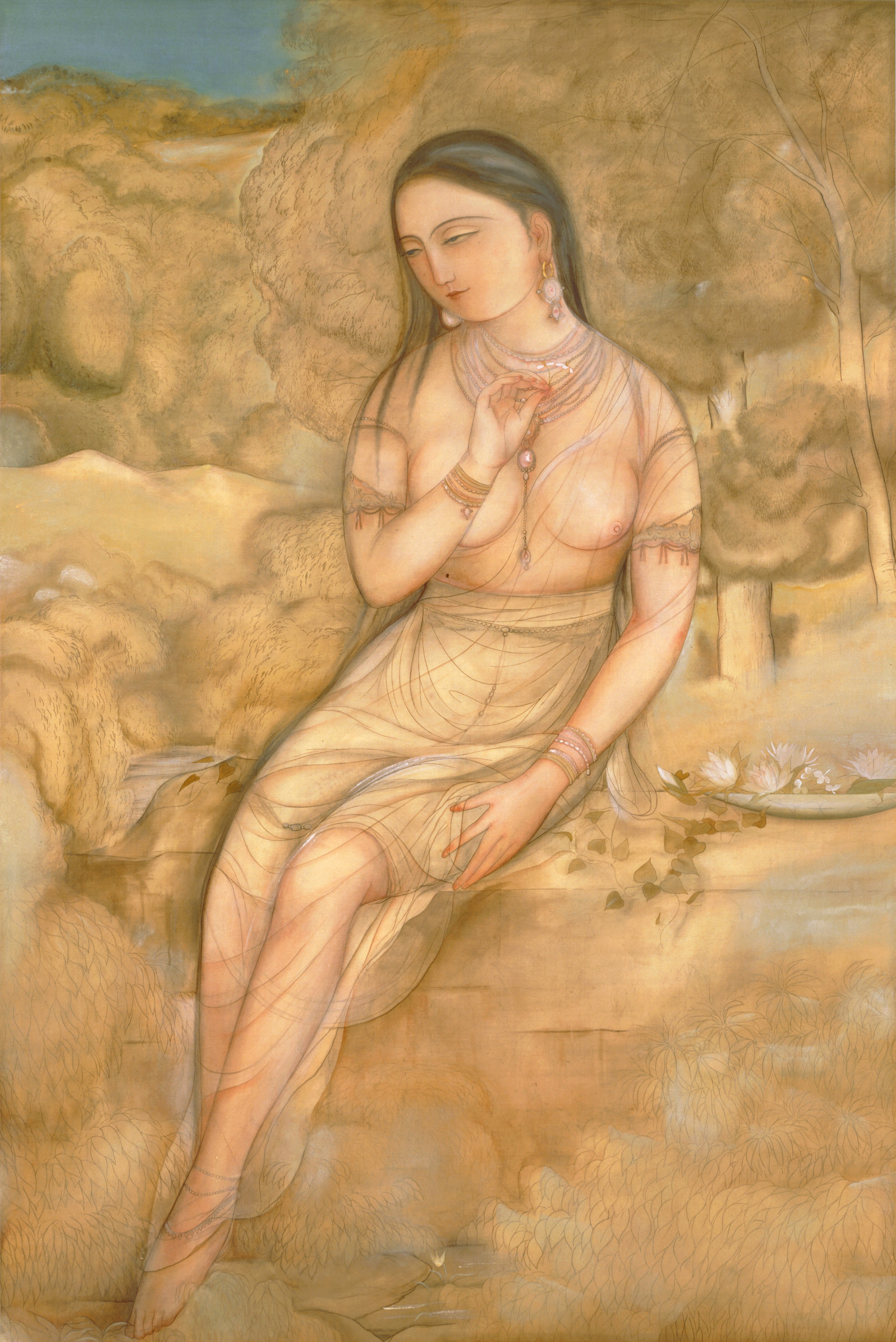
Nude (Rafu)
裸婦図
- Date:
- 1920
- Medium:
- Color on silk; hanging scroll
- Source:
- Yamatane Museum of Art
Description
Nude (Rafu, 裸婦図) is a hanging-scroll painting by Murakami Kagaku in color on silk, completed in 1920 and now held by the Yamatane Museum of Art in Tokyo. Designated an Important Cultural Property of Japan in 1995 — one of the very few twentieth-century paintings to receive that designation — Rafu was Kagaku's contribution to the third Kokuten exhibition of the Kokuga Sōsaku Kyōkai in 1920 and became immediately the most discussed Japanese painting of the year. The work depicts a frontal, life-sized female figure in the iconographic pose of a seated bodhisattva, drawing simultaneously on the contour line of the Ajanta cave paintings of central India, on the sensuous modeling of Tang-dynasty Chinese Bodhisattva sculptures, and on the anatomical seriousness of contemporary European life-painting. Kagaku himself described the work as a portrait of "the eternal woman, the source of mankind's longing for everlasting beauty," and the painting consciously dissolves the boundaries between religious icon and secular nude, between Indian, Chinese, Japanese, and Western traditions, and between the categorical modes of nihonga and yōga. The result is at once erotically charged and devotionally serene, a synthesis that anticipated by several years the great syntheses of the international modernist movement of the 1920s and that gave Taishō-period Buddhist humanism its central pictorial statement.
More Prints by Murakami Kagaku


Frequently Asked Questions
Nude (Rafu) (裸婦図) was created by Murakami Kagaku (村上華岳) in 1920.