
Biography
Murakami Kagaku (1888–1939) was a Japanese painter whose work occupies a singular position in the history of early twentieth-century nihonga: an artist who turned away from the public stage of the great exhibition halls in mid-career, secluded himself near Kobe, and devoted the last part of his life to a small body of intensely meditative Buddhist figures and ink landscapes that have come to be recognized as one of the most introspective achievements of modern Japanese painting. He was born Takeda Shinichi in Osaka on July 3, 1888. After his parents divorced during his childhood he was raised in Kobe, and in 1904 he took the surname of his maternal grandfather, Murakami. Drawn to drawing from an early age, in 1903 — at the age of fifteen — he entered the Kyoto City School of Arts and Crafts (Kyōto Shiritsu Bijutsu Kōgei Gakkō), from which he graduated in 1907. He continued his training at the Kyoto City Specialist School of Painting (Kyōto Shiritsu Kaiga Senmon Gakkō), the leading academy of Kyoto nihonga. His painting Nigatsu no koro ("Landscape in February"), a snow-bound scene, was accepted at the Fifth Bunten national exhibition in 1911 and received an honorable mention, announcing his arrival on the Kyoto painting scene.
At the Kyoto schools Kagaku studied within the circle of the great Maruyama-Shijō master Takeuchi Seihō, the dominant figure of the Kyoto nihonga establishment, whose synthesis of Edo-period naturalism with Western realism shaped a whole generation of painters. Among his contemporaries were several who would help define modern Kyoto nihonga — Tsuchida Bakusen, Ono Chikkyō, Sakakibara Shihō, and Nonagase Banka — and the bonds he formed with them would become the foundation of his mature career. From early in his career Kagaku immersed himself in the religious art of the Buddhist tradition, in the sutras and in Pure Land and Zen texts, and this devotion steadily displaced landscape as the central focus of his art. In 1916 a Buddhist-themed work brought him a special prize at the tenth Bunten exhibition, and that same year he moved into Kōdai-ji temple in Kyoto as a lay monk.
In 1918, dissatisfied with the increasingly conservative direction of the official salons, Kagaku joined Bakusen, Chikkyō, Shihō, and Banka to found the Kokuga Sōsaku Kyōkai (National Creative Painting Association), a Kyoto-based breakaway society — with Takeuchi Seihō among its advisors — whose mission was to liberate nihonga from the rigidly judged conventions of the government exhibitions and to open it to the influence of post-Impressionist European painting, of Indian and Central Asian Buddhist art, and of personal expressive ambition. The society's exhibitions, known as the Kokuten, became the principal venue for Kagaku's emergence as a national figure. At the second Kokuten in 1919 he showed Kiyohime at the Hidaka River — the legendary subject of the Dōjōji story — and at the third, in 1920, the work titled simply Rafu (Nude), which provoked an immediate critical sensation and remains the work for which he is most widely known. Both paintings were later designated Important Cultural Properties of Japan.
Rafu — a frontal, life-sized female nude in the Indian-Buddhist iconographic posture of a bodhisattva, painted in ink and color on silk and now held by the Yamatane Museum of Art in Tokyo — fused the contour line of Indian cave painting, the modeling of Tang-dynasty bodhisattva sculpture, and the sensuous anatomy of contemporary European life-painting into a single image. The work consciously dissolved the boundaries between religious icon and secular nude, and between the Indian, Chinese, Japanese, and Western traditions, and it stands as one of the central documents of Taishō-period Buddhist humanism.
The early 1920s marked the height of Kagaku's public career, in which he produced major bodhisattva figures and contributed regularly to the Kokuten. But his health, never robust, had begun to fail — he suffered from a chronic asthma that would shadow the rest of his life — and in 1923 he left Kyoto for Ashiya, in Hyōgo prefecture. In 1927 he moved to Kobe, and from then until his death he lived in relative seclusion, painting almost exclusively at home. He worked on a small scale — chiefly Buddhist figures in ink with light color, and atmospheric ink landscapes in the Chinese literati manner — and sold only through a small circle of trusted patrons and dealers. The work of these final years constitutes what many critics regard as among the most spiritually concentrated bodies of work in twentieth-century Japanese painting: solitary bodhisattvas in meditation, mountainous landscapes drowned in cloud, and Buddhist deities such as Amida and Fudō rendered in a fragile, calligraphic manner.
Kagaku's late style is dominated by ink and by an extreme economy of means: bodhisattva figures drawn in a few pale lines with minimal color, and landscapes that evoke vast space through the interplay of dry brush and wet wash, the whole suffused with a metaphysical stillness drawn from his lifelong reading of Zen and Pure Land Buddhist texts. He also wrote extensively during these years on the aesthetics of his own practice, and his essays and journals — published after his death — constitute one of the most important bodies of art-theoretical writing produced by any twentieth-century Japanese painter, positioning him in conscious opposition to both academic nihonga and the Western-style oil painting of his contemporaries.
Kagaku died in Kobe on November 11, 1939, at the age of fifty-one, his final years increasingly confined by the asthma that had long troubled him. A series of posthumous retrospectives established his work as one of the central achievements of modern Japanese painting.
Kagaku's posthumous reputation has grown steadily through the postwar decades, and his work is held by major Japanese institutions including the National Museum of Modern Art, Tokyo, the National Museum of Modern Art, Kyoto, and the Yamatane Museum of Art, among others. He is now understood as a central nihonga painter of the Taishō-period Buddhist revival, as one of the founding members of the Kokuga society that gave Kyoto nihonga its modern form, and as a rare twentieth-century Japanese painter whose mature work transcends the categorical opposition of nihonga and yōga. Although he was not a printmaker — and so falls on the margins of the woodblock tradition familiar to most Western collectors of Japanese art — his place among the major nihonga masters of the early twentieth century, alongside figures such as Yokoyama Taikan, Hishida Shunsō, Hayami Gyoshō, and his Kokuga colleagues Bakusen and Chikkyō, makes him an essential figure for any account of the period.
Key Facts
- Active Period
- 1888–1939
- Nationality
- 🇯🇵Japan
- Movement
- Meiji/Taishō Prints
- Subjects
- Autumn FoliageBirds & Flowers
- Works Indexed
- 8
Frequently Asked Questions
Murakami Kagaku (1888–1939) was a Japanese painter whose work occupies a singular position in the history of early twentieth-century nihonga: an artist who turned away from the public stage of the great exhibition halls in mid-career, secluded himself near Kobe, and devoted the last part of his life to a small body of intensely meditative Buddhist figures and ink landscapes that have come to be recognized as one of the most introspective achievements of modern Japanese painting. He was born Takeda Shinichi in Osaka on July 3, 1888. After his parents divorced during his childhood he was raised in Kobe, and in 1904 he took the surname of his maternal grandfather, Murakami. Drawn to drawing from an early age, in 1903 — at the age of fifteen — he entered the Kyoto City School of Arts and Crafts (Kyōto Shiritsu Bijutsu Kōgei Gakkō), from which he graduated in 1907. He continued his training at the Kyoto City Specialist School of Painting (Kyōto Shiritsu Kaiga Senmon Gakkō), the leading academy of Kyoto nihonga. His painting Nigatsu no koro ("Landscape in February"), a snow-bound scene, was accepted at the Fifth Bunten national exhibition in 1911 and received an honorable mention, announcing his arrival on the Kyoto painting scene.
Murakami Kagaku was active from 1888 to 1939. They were associated with the Meiji/Taishō Prints movement.
Murakami Kagaku's work was shaped by the Meiji/Taishō Prints tradition in Japanese woodblock printmaking. Meiji/Taishō Prints: Meiji and Taishō era prints (1868–1926) bridge the transition from traditional ukiyo-e to the modern shin-hanga and sosaku-hanga movements.
Murakami Kagaku's prints frequently feature autumn foliage, birds & flowers.
Original prints by Murakami Kagaku can be found in collections including Kyoto Municipal Museum of Art, Yamatane Museum of Art, Adachi Museum of Art, National Museum of Modern Art, Tokyo.
Woodblock Prints by Murakami Kagaku (8)
Landscape in February
二月乃頃
1911
Color on silk; hanging scroll
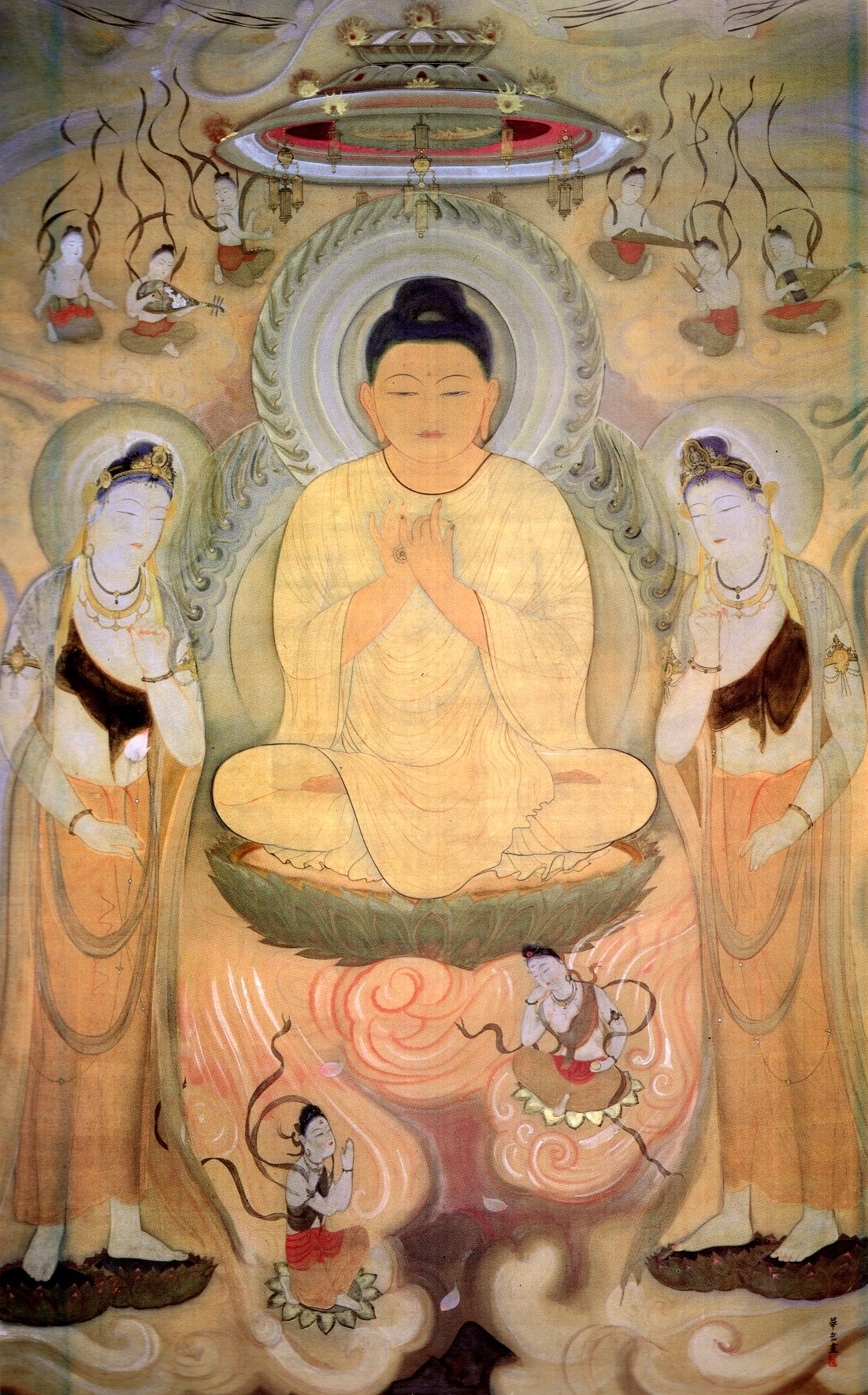
Amitābha (Amida)
阿弥陀如来図
1916
Ink and color on silk; hanging scroll

Amida Buddha
阿弥陀図
1916
Ink and color on silk; hanging scroll

Kiyohime at the Hidaka River
日高川清姫図
1919
Color on silk; hanging scroll

Autumnal Scenery
秋景図
1919
Ink and color on paper; hanging scroll
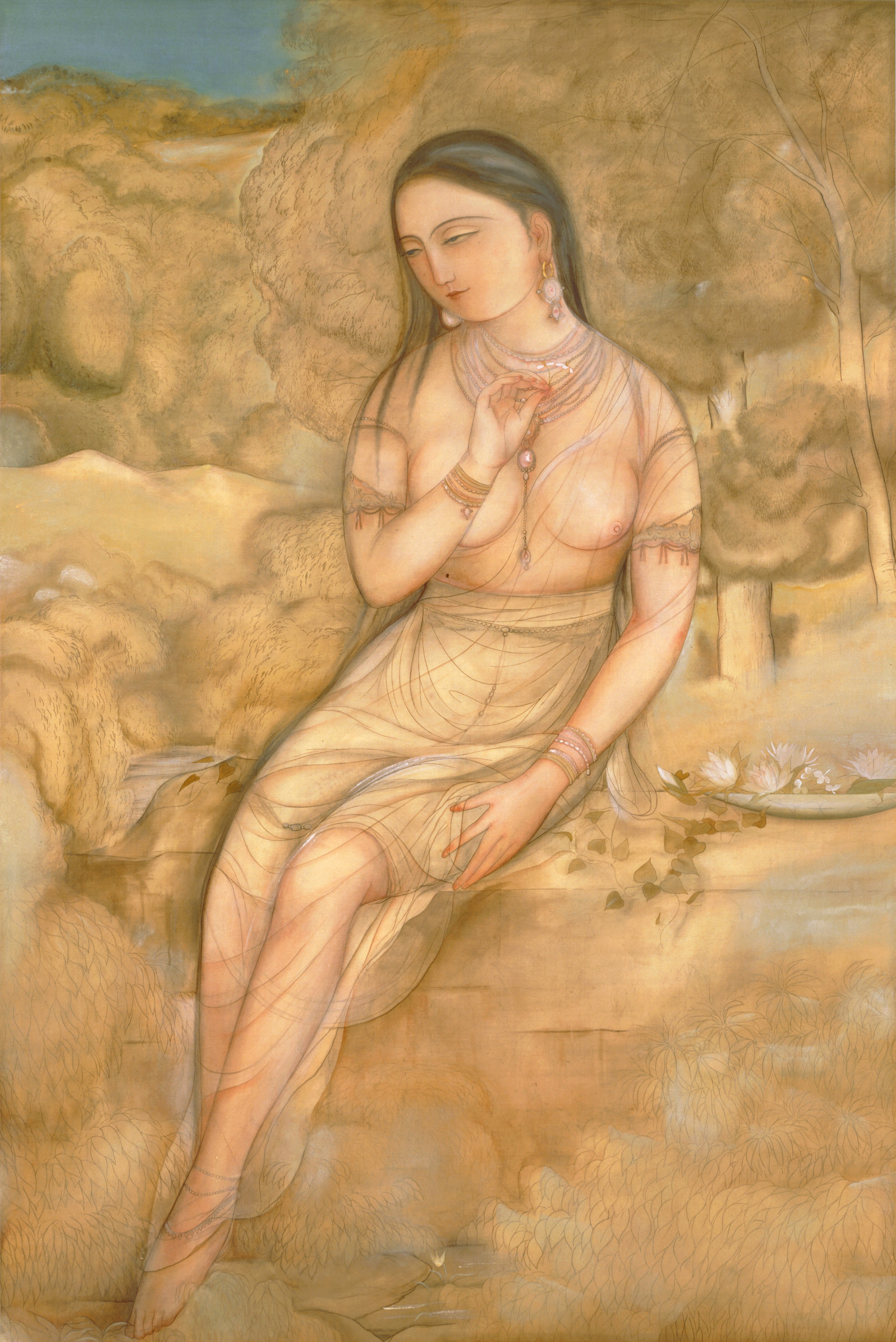
Nude (Rafu)
裸婦図
1920
Color on silk; hanging scroll

Seated Avalokiteshvara with Lotus
蓮華持観音図
1935
Ink and light color on paper; hanging scroll

Scattering Flowers above the Clouds (Sange)
雲上散華之図
1938
Ink and color on silk; hanging scroll