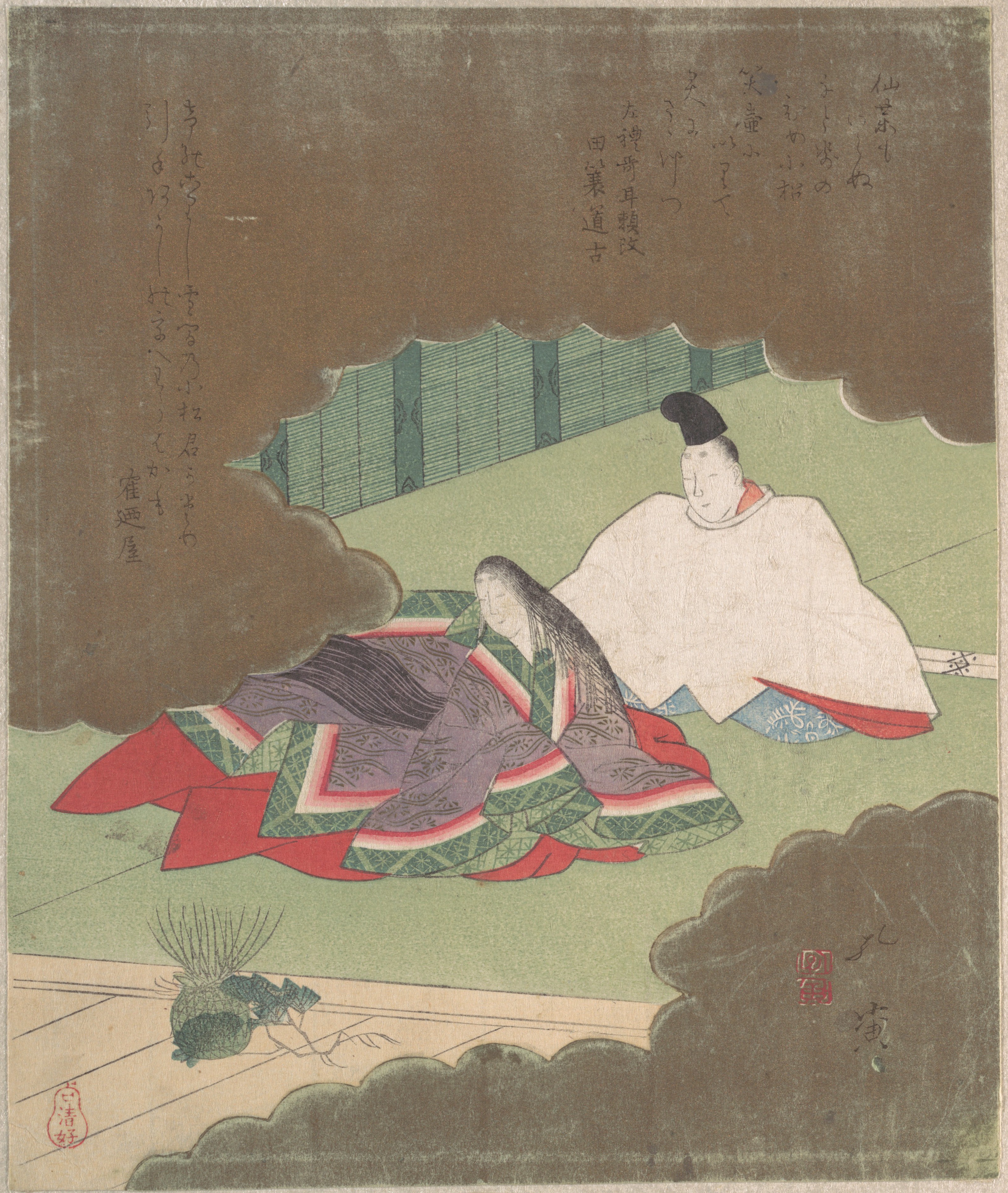
Man and Woman in Court Dress Looking at Young Pines for New Year Ceremony
- Date:
- 19th century
- Medium:
- Woodblock print (surimono); ink and color on paper; 21.6 x 18.3 cm
- Source:
- Metropolitan Museum of Art
Description
This 19th-century surimono by Nagayama Kōin, held by the Metropolitan Museum of Art (accession JP2217) in the H. O. Havemeyer Collection given by Mrs. H. O. Havemeyer in 1929, depicts a man and woman in court dress contemplating young pines arrayed for the New Year ceremony of komatsubiki — the courtly tradition of pulling up young pine seedlings on the first Day of the Rat in the New Year as a wish for longevity. The composition treats the figures in the formal court robes of the imperial Heian aristocracy, a deliberately archaicizing choice that gives the print the literary register of the classical waka tradition while the New Year subject ties it to the surimono format's central function as a privately commissioned gift for the New Year occasion. Printed in ink and color on paper at 21.6 by 18.3 centimeters, the print belongs to the standard shikishi-ban surimono format favored by the kyōka poetry clubs that commissioned the genre, and the heavy paper, controlled coloring, and reserved background are characteristic of the upper register of late Bunka and Bunsei surimono production. Kōin's training in the Maruyama-Shijō school of naturalistic painting is visible in the controlled brushwork of the figural drawing, particularly in the carefully modeled robes and the precise rendering of the young pine sprigs, which the Shijō tradition treated with the same disciplined botanical attention that Maruyama Ōkyo applied to his hanging-scroll subjects. The Havemeyer Collection's acquisition of the print in the late nineteenth century placed it in one of the foundational American holdings of Japanese surimono, and its presence in the Met's Asian Art department documents Kōin's standing in the contemporary surimono economy and his connection to the elite kyōka circles whose poetry would originally have accompanied the image. The subject's link to Heian court ceremony, in dialogue with the late Edo surimono format, exemplifies the kind of refined classical-poetic literacy that the surimono tradition cultivated for its educated patrons, and Kōin's rendering of the courtly scene reflects the broader Maruyama-Shijō engagement with classical Japanese subjects rendered in the school's naturalistic visual idiom.
More Prints by Nagayama Kōin

Frequently Asked Questions
Man and Woman in Court Dress Looking at Young Pines for New Year Ceremony was created by Nagayama Kōin (長山孔寅) in 19th century.