
Pine tree
- Medium:
- Mokuhanga (Japanese woodblock)
- Image courtesy of
- Saru Gallery
Description
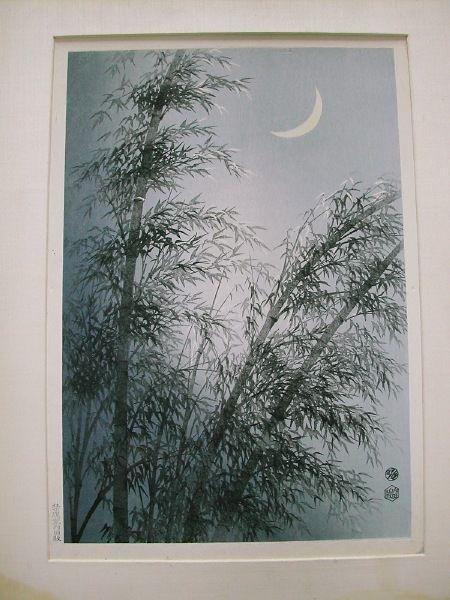
A study of matsu, the pine, which holds a sustained position in Japanese symbolism as an emblem of endurance, longevity, and resilience through winter. Without the moon present, this print likely concentrates on the structural form of the tree itself — the twisting trunk, the layered horizontal needle clusters, the furrowed bark. Matsubara's carving exploits the directional grain of the wood block, letting the medium's own structure suggest bark patterning. Where ukiyo-e and shin-hanga traditions render pines through fine outline and color modulation, the sosaku-hanga approach favored by Matsubara reduces the tree to broad carved planes and visible gouge marks. The palette is likely limited — black, perhaps a single accent — pressed into washi paper with the baren. Pine Tree connects to a long lineage of pine subjects in Japanese art, from the Muromachi-era ink paintings of Hasegawa Tōhaku to the ukiyo-e of Hokusai, while operating within Matsubara's modernist reduction. Within her own body of work, it sits among the natural-world prints that complement her religious and literary subjects.
More Prints by Naoko Matsubara

More Trees Prints


Featured in Collections
Curated cross-cuts that include this print.
Frequently Asked Questions
Pine tree was created by Naoko Matsubara (松原直子).
Pine tree depicts trees.