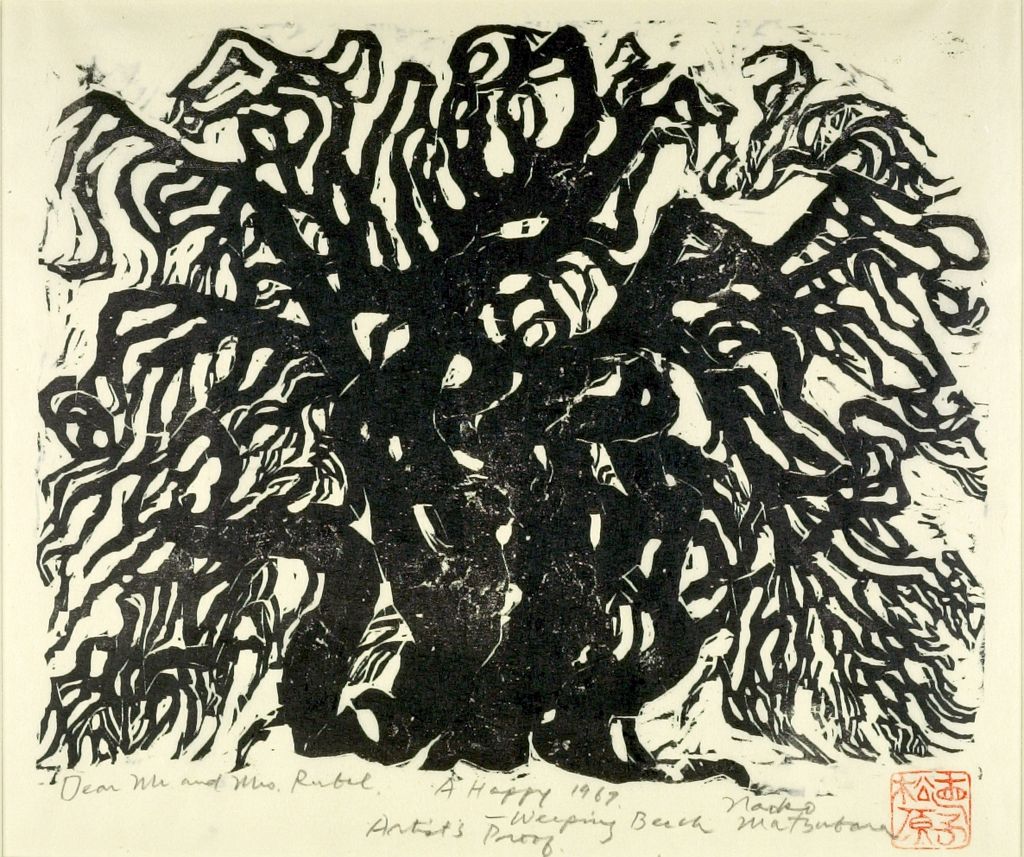
Weeping Beech Tree, Shôwa period, dated 1967
- Medium:
- Woodblock print
- Source:
- Harvard Art Museum
- Image courtesy of
- Harvard Art Museum
Description
Weeping Beech Tree, dated 1967, depicts a species of deciduous tree whose pendulous, cascading branch structure offers Matsubara's printmaking a subject of pronounced vertical rhythm and organic complexity. Unlike the pine — a symbol deeply embedded in Japanese visual tradition — the weeping beech is a tree associated with the temperate landscapes of North America and Europe, reflecting the Canadian context of Matsubara's working life at this period. The cascading branch lines would be rendered through long, fluid gouge strokes that follow the downward pull of the limbs, while the trunk's smooth, pale bark might be conveyed through reserved paper tone or lightly inked areas. The composition likely centers the tree against a spare background, treating the branch structure as a graphic field rather than a realistic portrait of a specific specimen. Produced in the same year as Quaker Meeting, this print belongs to a cluster of early Shōwa works in which Matsubara establishes the connection between natural forms and contemplative inner states that would characterize her mature practice.
More Prints by Naoko Matsubara

More Trees Prints


Featured in Collections
Curated cross-cuts that include this print.
Frequently Asked Questions
Weeping Beech Tree, Shôwa period, dated 1967 was created by Naoko Matsubara (松原直子).
Weeping Beech Tree, Shôwa period, dated 1967 depicts trees.