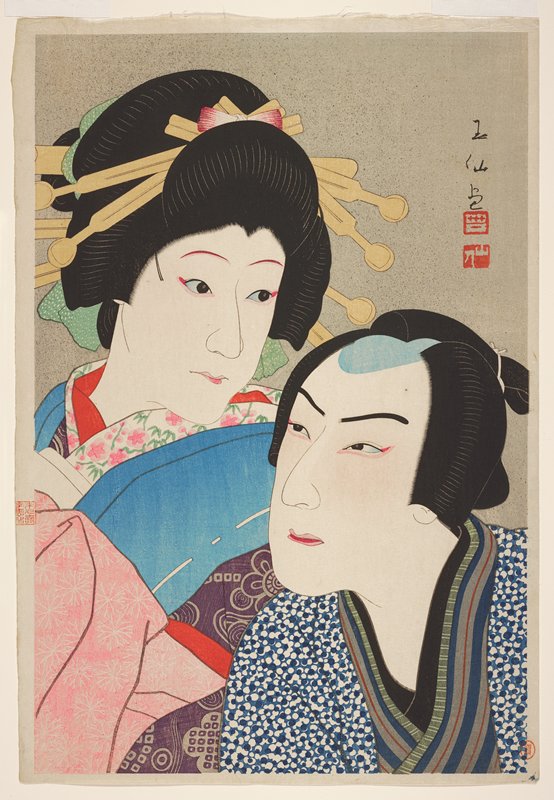
Morita Kanya XIII as the Lion in Shakkyo, dated 1926, is a Natori Shunsen actor portrait drawn from the celebrated dance play Shakkyo, The Stone Bridge, in which a wandering monk encounters the lion guardian of the bodhisattva Manjushri at a bridge in the Chinese mountains. Shakkyo descends from a fifteenth-century Noh play and was adapted in the nineteenth century into one of the most spectacular pieces of kabuki dance, featuring the lion's hair-tossing display, the keburi, that culminates the performance. Shunsen (1886-1960), a Kubota-trained nihonga painter who turned to the woodblock designer's role under publisher Watanabe Shozaburo, treated such material as portraiture rather than spectacle. He cropped Morita Kanya XIII close, set the lion mask and white-haired mane against a quietly worked ground, and let the actor's face carry the dance's contained ferocity without depicting the climactic motion that defined the role in live performance. The image belongs to Shunsen's earliest sequence of Watanabe-published yakusha-e, the foundation of the shin-hanga, or new prints, revival of the actor portrait. Watanabe's shop paired Shunsen's drawings with master carvers and printers whose handling of the lion's tresses, the gilded brocade of the costume, and the mica or gauffrage finish of the ground produced an effect entirely distinct from the saturated, action-driven Edo-period yakusha-e of Toshusai Sharaku or Utagawa Kunisada. Morita Kanya XIII (1885-1932) was one of the leading actor-managers of his generation, head of the Morita line and a key figure in Meiji and Taisho theatrical reform, with a career closely tied to the Shintomi-za and later Tokyo theatres. Although the brief carries no specific museum citation for this impression, the design is well represented in the public yakusha-e holdings indexed through ukiyo-e.org, and comparable copies are preserved at the Art Institute of Chicago, the British Museum, and the Fine Arts Museums of San Francisco among other institutions documenting Shunsen's Shakkyo plate. The sheet records both a leading kabuki actor in a defining role and the technical standard of the Watanabe workshop at its peak.