
A Dancer
- Date:
- Late 17th to 18th century
- Medium:
- Color woodblock print
- Source:
- Art Institute of Chicago
Description
A late seventeenth-century color woodblock print of a single female dancer, rendered with the soft, slender proportions that became Nishikawa Sukenobu's signature contribution to early Kamigata bijin-ga. The dancer is shown in mid-gesture, her sleeves and skirts caught in motion, the long flow of fabric exploiting the supple line Sukenobu had inherited from Tosa-school training. Unlike the bold kabuki-derived dancers being produced in Edo at the same period by Torii-school artists, Sukenobu's figure carries the quieter, more domestic refinement associated with Kyoto teahouse entertainment — a young woman performing privately rather than declaiming on a public stage. The print is preserved in the collection of the Art Institute of Chicago, one of the strongest holdings of Sukenobu material in North America. As an isolated figure on a plain ground, the work distills the formula that Sukenobu would apply across hundreds of ehon pages over the following five decades: the gracefully tilted head, the precisely indicated hairline, the carefully arranged collar of the outer robe, and the unmistakable rhythm of a body that has been observed in motion and then settled into idealized stillness.
More Prints by Nishikawa Sukenobu
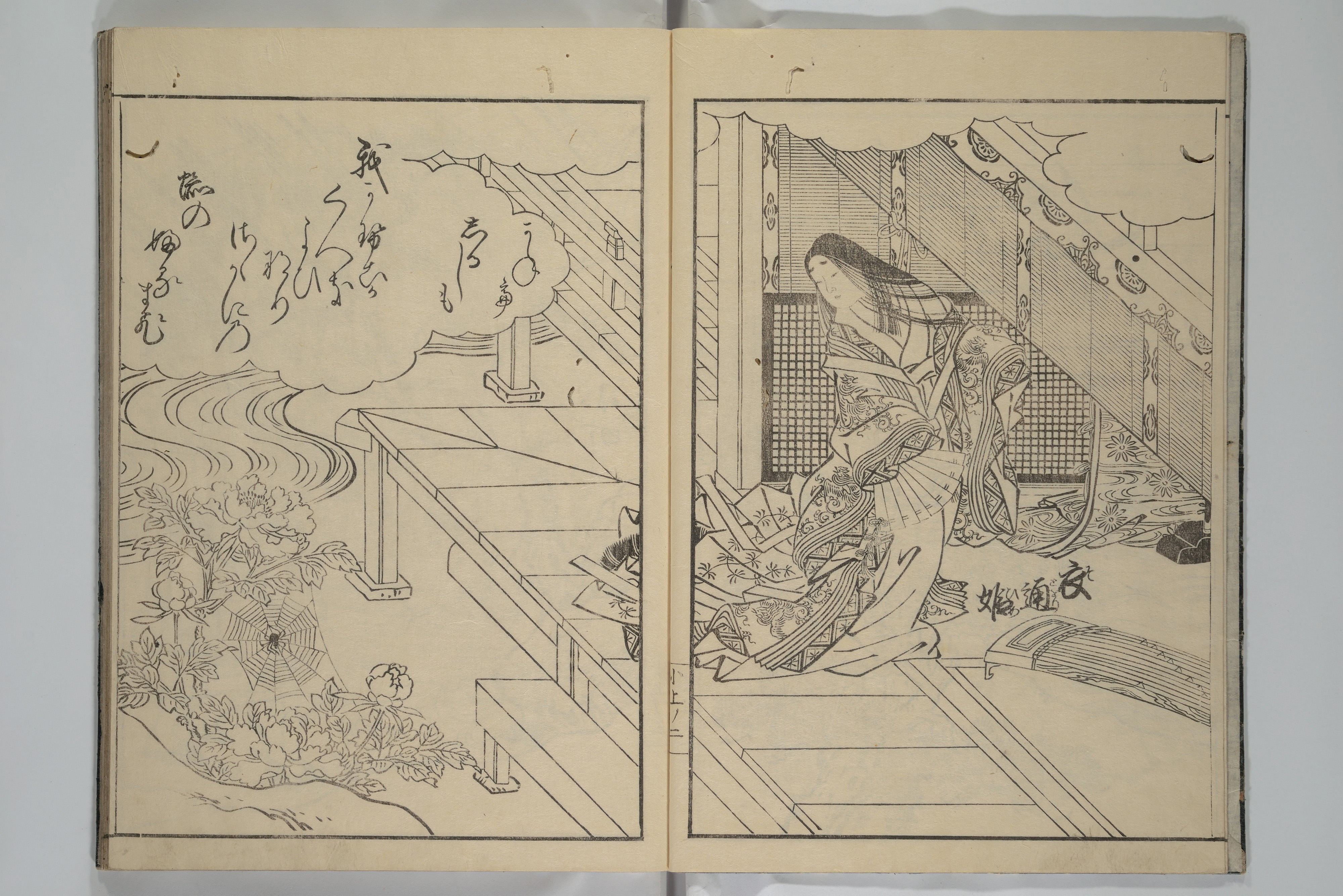
Picture Book of Komatsubara (Ehon komatsubara) 絵本小松原
1761
Woodblock-printed book; ink on paper

Courtesan Walking
1739
From a woodblock printed book (sumizuri-e), ink on paper

Kayō hyakunin isshu taisei
1781 Anei 10
Woodblock- printed book; 1 vol.

Ehon Tokiwagusa
17th/18th century
Woodblock- printed book; 3 vols.
Frequently Asked Questions
A Dancer was created by Nishikawa Sukenobu (西川祐信) in Late 17th to 18th century.