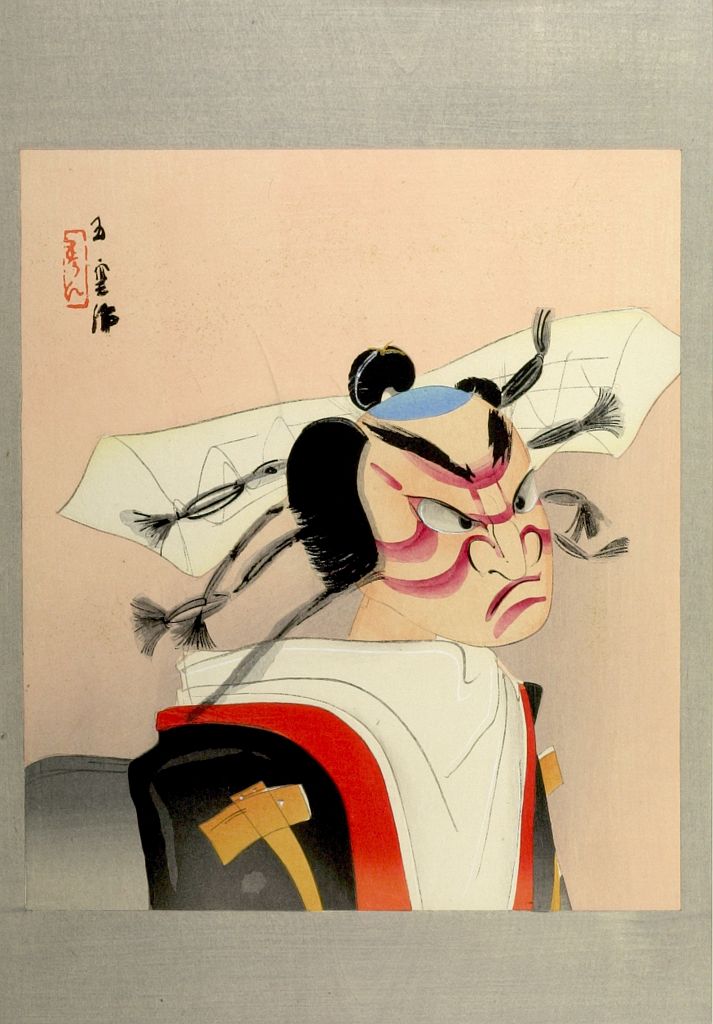
Bunraku Puppet
文楽人形
- Date:
- c. 1922-1928 (Dai Chikamatsu Zenshū album, Asahi Shimbunsha, Osaka)
- Medium:
- Color woodblock print
Description
Bunraku Puppet is held by Harvard Art Museums (Arthur M. Sackler Museum, object 206206) and represents one of Nishimura Goun's contributions to the Dai Chikamatsu Zenshū (Complete Works of Chikamatsu, 大近松全集), a sixteen-volume luxury edition of Chikamatsu Monzaemon's collected plays issued by Asahi Shimbunsha of Osaka between approximately 1922 and 1928. The edition assembled the most accomplished Kyoto and Tokyo nihonga painters of the period — including Uemura Shōen, Kaburaki Kiyokata, Kitano Tsunetomi, Nishiyama Suishō, and Goun himself — each contributing color-woodblock frontispiece designs treating scenes, characters, or stagecraft elements from Chikamatsu's plays. Goun specialized in the bunraku puppets that were the original performers of Chikamatsu's jōruri texts. The composition isolates a single puppet figure against a plain ground, its head, costume, and the hands of the unseen puppeteer all rendered in confident sumi line accented with mineral color. The Kyoto carvers and printers contracted for the Zenshū preserved the brush-drawn quality of Goun's original ink design with notable fidelity; the modulation of line weight where the figure's silk costume folds against the puppeteer's grip is a direct transcription of his calligraphic ease. The Harvard impression carries the artist's seal and demonstrates the high production values that distinguished the Asahi edition from contemporary trade ukiyo-e: heavier paper, more saturated pigments, and tighter registration. Bunraku puppet theater (bunraku, 文楽), centered in Osaka since the eighteenth century, was the original medium for Chikamatsu's playwriting before adaptation into the kabuki repertoire, and Goun's choice of subject grounds the Zenshū's literary contents in their original performance context.
More Prints by Nishimura Goun



Frequently Asked Questions
Bunraku Puppet (文楽人形) was created by Nishimura Goun (西村五雲) in c. 1922-1928 (Dai Chikamatsu Zenshū album, Asahi Shimbunsha, Osaka).