
Biography
Nishimura Goun (西村五雲, 1877-1938) was a leading Kyoto-school painter of the late Meiji, Taishō, and early Shōwa eras, celebrated above all as an animal painter of unusual observational acuity. Born Nishimura Genjirō in Kyoto on 6 November 1877, he was the son of a merchant family with no painterly background; his second son Nishimura Takuzō would later become a nihonga painter in his own right. At the age of thirteen, in 1890, Goun entered the studio of Kishi Chikudō (1826-1897), the last major exponent of the Kishi school descending from Ganku, whose specialty in tigers and other large animals would echo through Goun's mature practice. Very few works from this earliest period survive. After Chikudō's death in 1897, Goun transferred in 1899 to the studio of Takeuchi Seihō (1864-1942), the dominant figure of modern Kyoto painting and the leading synthesizer of Maruyama-Shijō naturalism with European observational realism. Goun's mature style would draw on both lineages — the Kishi school's instinct for the heroic animal portrait, and Seihō's commitment to drawing animals from sustained personal observation in the field and at the Kyoto Municipal Zoo.
Goun's public reputation was established at the First Bunten (Ministry of Education Art Exhibition) in 1907, where his hanging scroll Polar Bear (Roaring) (白熊 (咆哮)) — drawn from sketches he had made at the Kyoto Municipal Zoo — won a Third Prize. The painting, now in the Yamatane Museum of Art collection, depicts a polar bear caught in mid-roar, the dense white fur and bared teeth rendered with a precision that earned the work a permanent place in the early Bunten canon. For a Kyoto-school painter not yet thirty, the prize was a major arrival. Goun then withdrew from the Bunten for several years; he reappeared in 1911 at the Fifth Bunten with Evening on the Pasture (まきばの夕), which received an Honorable Mention and was purchased by the Imperial Household. In 1913 he was appointed instructor at the Kyoto Municipal School of Arts and Crafts, but later that same year the death of his eldest son triggered a severe nervous collapse from which he did not fully recover until 1917. The illness shaped the rest of his life: he was of a generally fragile constitution, exhibited sparingly at the major government salons, and his oeuvre is smaller than the careers of contemporaries like Seihō or Imao Keinen.
The second half of his career delivered a steady accumulation of official honors. In 1924 he became professor at the Kyoto Municipal School of Painting (the predecessor of Kyoto City University of Arts). In 1933 he was appointed a member of the Imperial Art Academy (Teikoku Bijutsuin), and in 1937 he was elevated to the Imperial Arts Academy (Teikoku Geijutsuin) and named a juror of the newly reorganized New Bunten. He maintained a teaching studio, Shinchō-sha (晨鳥社), through which he transmitted his approach to a younger generation that included Yamaguchi Kayō (1899-1984), perhaps his most distinguished pupil. The major animal and nature paintings of his maturity confirmed his standing as one of the leading animal painters of interwar Japan. He died on 16 September 1938 at age sixty.
Goun's contribution to the woodblock print is small relative to his painted oeuvre but historically important. Like most leading Kyoto-school painters of the early twentieth century, he occasionally supplied designs to publishing projects that translated nihonga brush originals into color woodblock. The most significant of these for Goun was the Dai Chikamatsu Zenshū (Complete Works of Chikamatsu), a sixteen-volume edition of the plays of Chikamatsu Monzaemon whose accompanying set of eighteen color woodblock prints was issued by the Society for the Publication of the Complete Works of Chikamatsu (Dai Chikamatsu zenshū kankōkai) between 1922 and 1925. The prints brought together a roster of leading Kyoto and Tokyo painters — among them Uemura Shōen, Kaburaki Kiyokata, Kitano Tsunetomi, Nishiyama Suishō, Kikuchi Keigetsu, Okada Saburōsuke, and Goun himself — each contributing a single design drawn from Chikamatsu's repertoire; the blocks were carved by Yamagishi Kazue and the prints pulled by Nishimura Kumakichi. Goun's own print treats the bunraku puppet theater, his fluid sumi line and carefully observed costume detail translating well to the woodblock medium. Apart from the Chikamatsu commission Goun's printed output is sparse, and his reputation in print collecting rests primarily on this contribution. His prints and paintings are held in major Japanese and international museum collections, including the Yamatane Museum of Art, home to the prize-winning polar bear painting.
Key Facts
- Active Period
- 1877–1938
- Nationality
- 🇯🇵Japan
- Movement
- Meiji/Taishō Prints
- Subjects
- Birds & Flowers
- Works Indexed
- 9
Frequently Asked Questions
Nishimura Goun (西村五雲, 1877-1938) was a leading Kyoto-school painter of the late Meiji, Taishō, and early Shōwa eras, celebrated above all as an animal painter of unusual observational acuity. Born Nishimura Genjirō in Kyoto on 6 November 1877, he was the son of a merchant family with no painterly background; his second son Nishimura Takuzō would later become a nihonga painter in his own right. At the age of thirteen, in 1890, Goun entered the studio of Kishi Chikudō (1826-1897), the last major exponent of the Kishi school descending from Ganku, whose specialty in tigers and other large animals would echo through Goun's mature practice. Very few works from this earliest period survive. After Chikudō's death in 1897, Goun transferred in 1899 to the studio of Takeuchi Seihō (1864-1942), the dominant figure of modern Kyoto painting and the leading synthesizer of Maruyama-Shijō naturalism with European observational realism. Goun's mature style would draw on both lineages — the Kishi school's instinct for the heroic animal portrait, and Seihō's commitment to drawing animals from sustained personal observation in the field and at the Kyoto Municipal Zoo.
Nishimura Goun was active from 1877 to 1938. They were associated with the Meiji/Taishō Prints movement.
Nishimura Goun's work was shaped by the Meiji/Taishō Prints tradition in Japanese woodblock printmaking. Meiji/Taishō Prints: Meiji and Taishō era prints (1868–1926) bridge the transition from traditional ukiyo-e to the modern shin-hanga and sosaku-hanga movements.
Nishimura Goun's prints frequently feature birds & flowers.
Original prints by Nishimura Goun can be found in collections including Harvard Art Museums via ukiyo-e.org, Kyoto Municipal Museum of Art (via Wikimedia Commons), Adachi Museum of Art (Google Art Project via Wikimedia Commons), Wikimedia Commons (Bachmann Eckenstein Japanese Art).
Woodblock Prints by Nishimura Goun (9)
Landscape of Yoshino
吉野山風景
c. 1900
Color and ink on silk

Willow Tree and Distant Mountain
柳に遠山図
1917 (Taishō 6)
Hanging scroll; ink and color on silk

Quietness (Seishuku)
静寂
1932
Hanging scroll; ink and color on silk
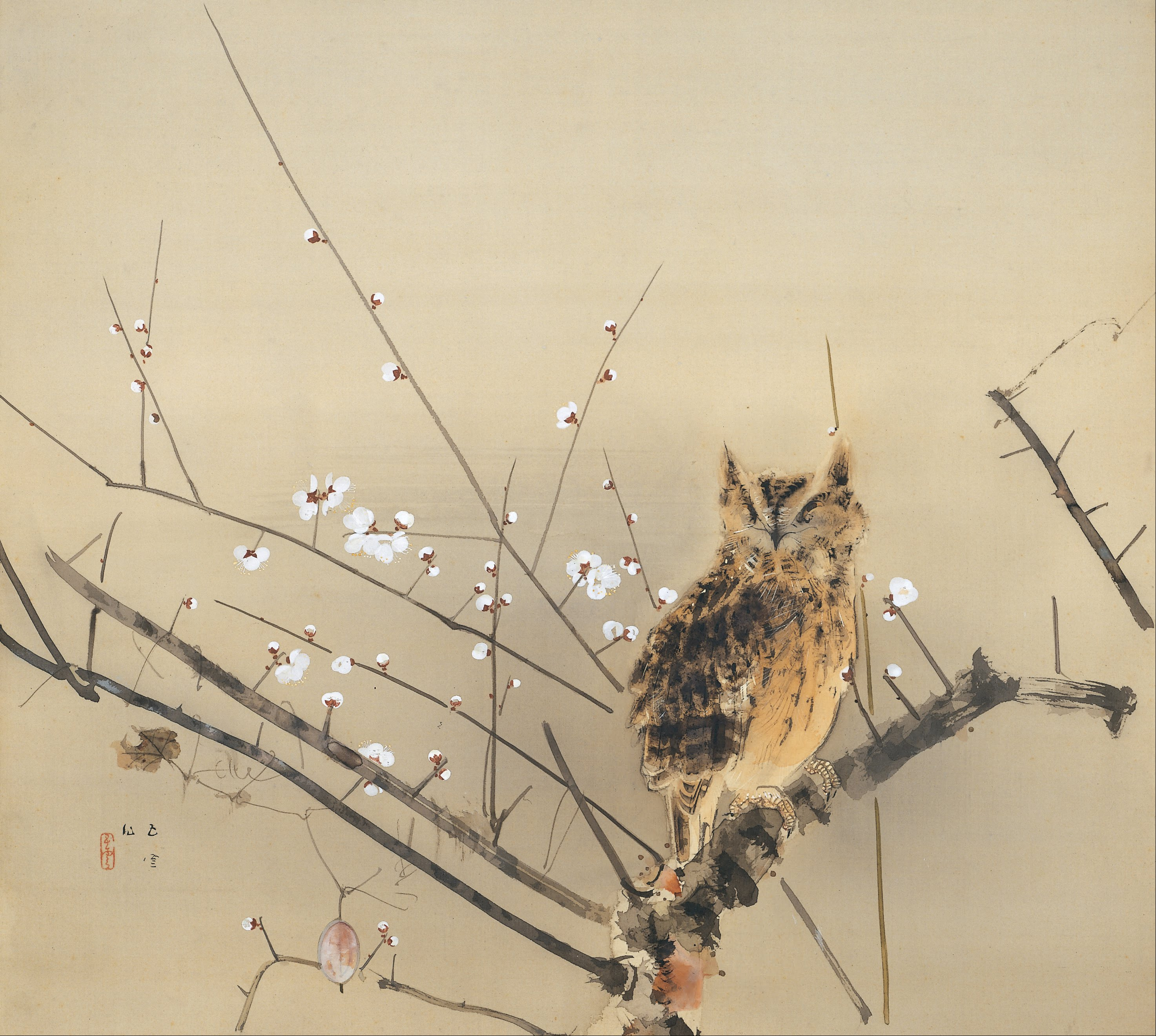
Early Plum Blossoms
早梅
1936
Hanging scroll; ink and color on silk

Spontaneous Garden Plat (Shizen no en)
自然の苑
1938
Hanging scroll; ink and color on silk

Cranes (pair of screens, right panel)
群鶴図屏風 (右隻)
early 20th century
One of a pair of six-panel folding screens; ink and color on paper

Cucumber and Vegetables
胡瓜と野菜
early 20th century
Ink and color on paper

Cranes (pair of screens, left panel)
群鶴図屏風 (左隻)
early 20th century
One of a pair of six-panel folding screens; ink and color on paper
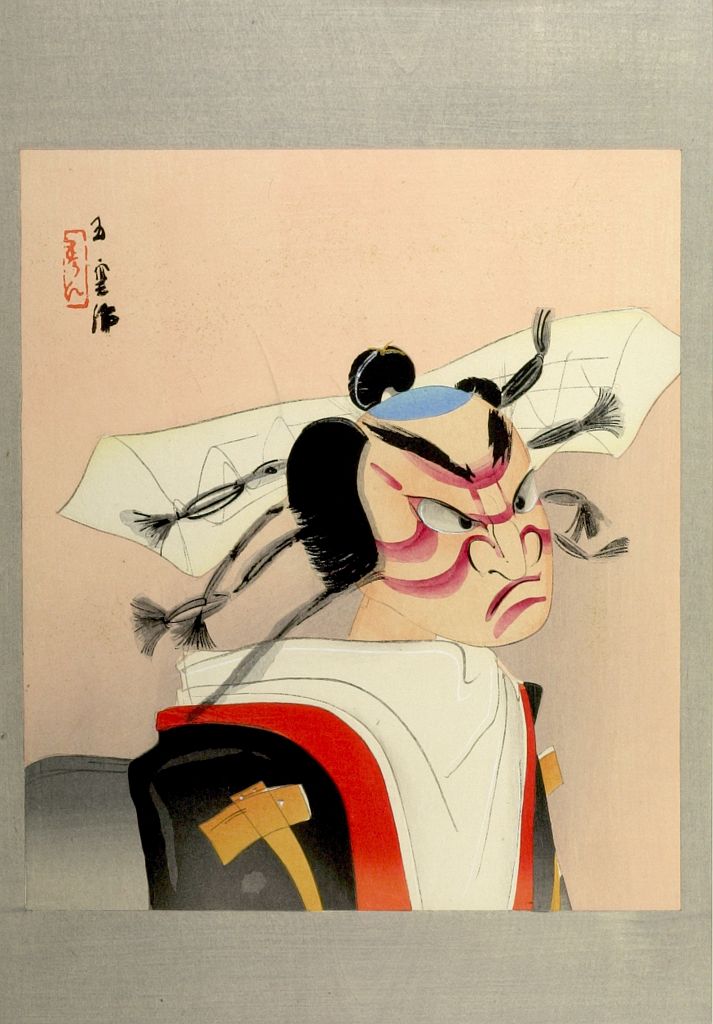
Bunraku Puppet
文楽人形
c. 1922-1928 (Dai Chikamatsu Zenshū album, Asahi Shimbunsha, Osaka)
Color woodblock print