
Saigyo Hoshi gazing at Mt. Fuji
- Date:
- c. 1730s
- Medium:
- Hand-colored woodblock print; hosoban, urushi-e
- Source:
- Art Institute of Chicago
Description
This hosoban urushi-e in the Art Institute of Chicago depicts the twelfth-century monk-poet Saigyo Hoshi (1118-1190) gazing at Mount Fuji, one of the most iconic subjects in Japanese poetic and visual culture. Saigyo, a Buddhist priest and waka master who had renounced the warrior life for a peripatetic religious vocation, was associated above all with his contemplative encounter with Fuji, and the image of him before the mountain was a standard figure for poetic enlightenment, religious resignation, and the relationship between Japanese landscape and Japanese verse. Shigenaga's treatment renders Saigyo as a small figure with traveling staff and the white robes of the wandering monk, with Mount Fuji's distinctive cone rising behind him; the hosoban format and urushi-e technique adapt the classical poetic subject to the format of the popular print. The mitate logic of mid-Edo ukiyo-e is implicit here: Saigyo is at once the historical poet and a model for any Edo viewer who might aspire to similar contemplative seriousness. The Chicago impression preserves the keyblock line and the urushi gloss in usable state and demonstrates Shigenaga's command of classical literary subjects.
More Prints by Nishimura Shigenaga

Eagle and Monkey
c. 1725
Hand-colored woodblock print; hosoban, urushi-e

Jurojin with crane and tortoise
18th century
Woodblock print; hashira-e, sumizuri-e

Yokihi (Chinese: Yang Guifei) with attendant
18th century
Woodblock print; hosoban, sumizuri-e

The Sumiyoshi Dance
18th century
Hand-colored woodblock print; hosoban, urushi-e
More Mount Fuji Prints
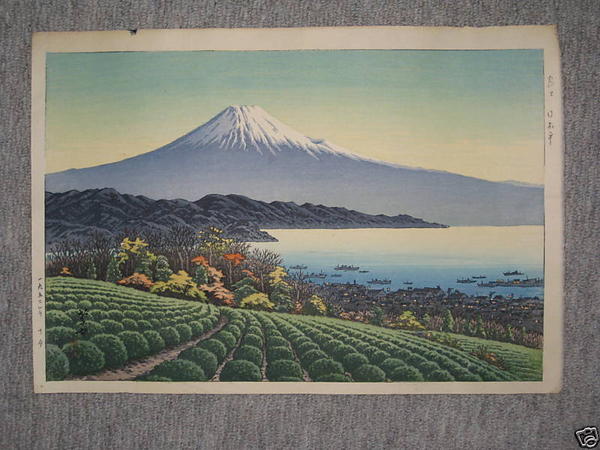
Fuji from tea farm
Woodblock print

Akasaka, Fujikawa, Okazaki, Chiryu, and Narumi, from the series "Famous Places on the Fifty-three Stations of the Tokaido, Five Stations (Tokaido gojusan eki goshuku meisho)"
c. 1830/35
Color woodblock print; oban
![Mount Fuji on a Moonlit Night, Kawai Bridge (Tsukiyo no Fuji [Kawaibashi]), from the series "Selection of Views of the Tokaido (Tokaido fukei senshu)" by Kawase Hasui](https://www.artic.edu/iiif/2/d0960668-1e73-339a-b182-fb995a54bff0/full/843,/0/default.jpg)
Mount Fuji on a Moonlit Night, Kawai Bridge (Tsukiyo no Fuji [Kawaibashi]), from the series "Selection of Views of the Tokaido (Tokaido fukei senshu)"
1947
Color woodblock print; oban

Mt. Fuji in Rain (Ame no Fuji)
n.d.
Color woodblock print
Featured in Collections
Curated cross-cuts that include this print.
Frequently Asked Questions
Saigyo Hoshi gazing at Mt. Fuji was created by Nishimura Shigenaga (西村重長) in c. 1730s.
Saigyo Hoshi gazing at Mt. Fuji depicts mount fuji.