
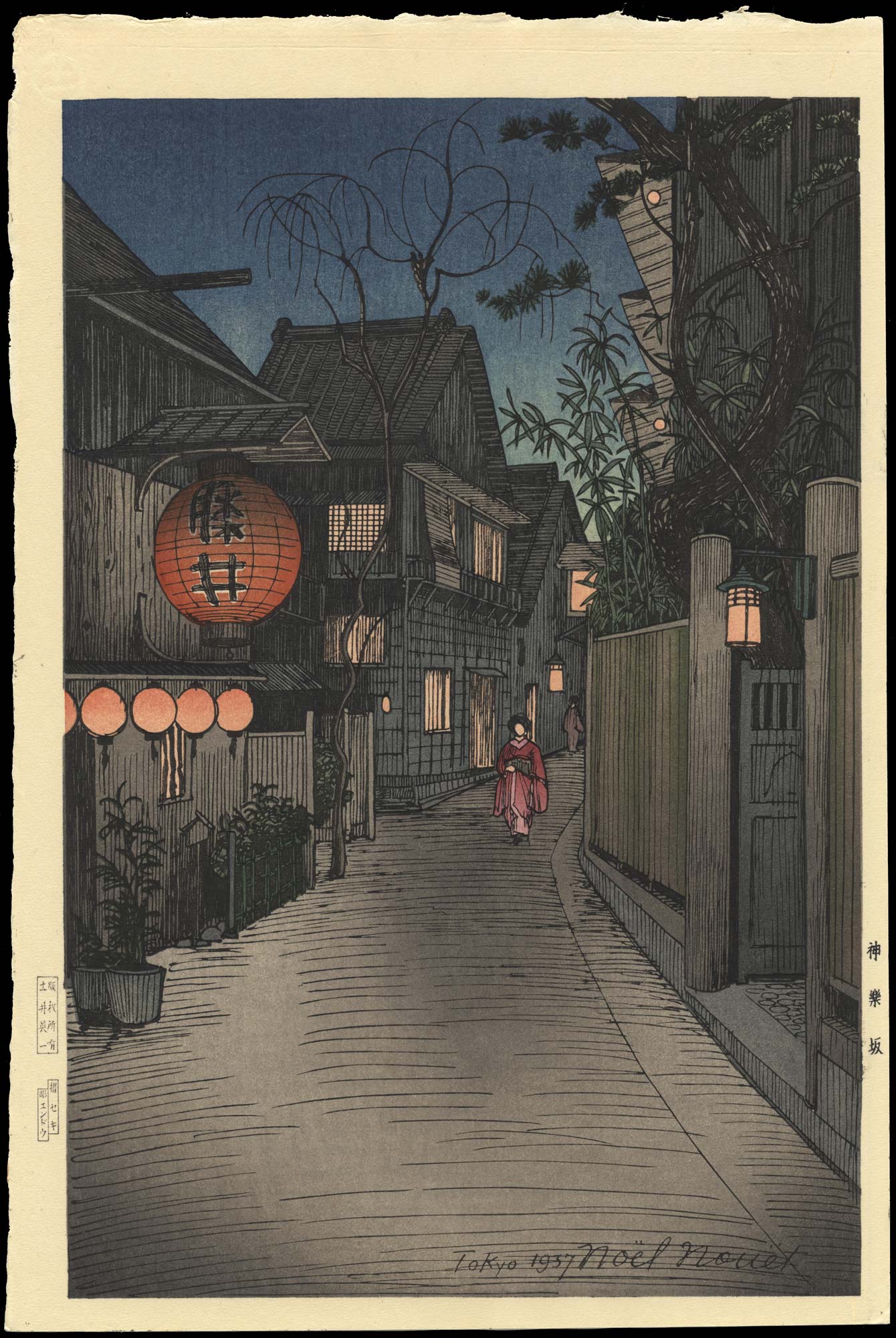
Jinrakuzaka
by Noël Nouët
- Source:
- ukiyo-e.org
Description
Jinrakuzaka by Noel Nouet, recorded in the Japancoll archive on ukiyo-e.org, portrays one of the named slopes that lattice the hilly western neighborhoods of Tokyo, capturing a particular street corner with the quiet topographical attention that runs through Nouet's entire body of Tokyo views. Slopes, or zaka, occupy a distinctive place in Tokyo's urban imagination because each carries a historical name tied to a temple, a noble residence, a guild, or a folk anecdote, and walking the city's slopes was a recognized literary pastime well before Nouet arrived from France in 1926. As a French shin-hanga artist working in close partnership with the publisher Doi Sadaichi, Nouet contributed a series of Tokyo prints that combined his training in Western drawing and illustration with the traditional woodblock craft of Japanese carvers and printers. The composition typical of his slope subjects places the viewer partway up or down the incline, framing the street with utility poles, low wooden houses, occasional shop signs, and pedestrians rendered in shorthand, while the perspective gently exaggerates the rise of the road to make the slope itself the protagonist. Nouet's palette favors restrained blues, soft ochres, and atmospheric grays rather than the saturated color of earlier ukiyo-e, and he often selects a quiet hour, late afternoon or just after rain, when the city's everyday textures stand out without the press of crowds. Jinrakuzaka belongs to this register: an ordinary slope elevated to subject status through careful framing and the dignified treatment that traditional woodblock printing confers. Beyond its aesthetic interest, the print holds value as a record of a specific Tokyo street as it appeared before postwar reconstruction altered the city's grain, and it stands as a representative example of how a European resident, working through Japanese craftsmen, helped extend the shin-hanga movement's range of subjects into the lived, walkable Tokyo of the early Showa years.
More Prints by Noël Nouët

Featured in Collections
Curated cross-cuts that include this print.
Frequently Asked Questions
Jinrakuzaka was created by Noël Nouët.