
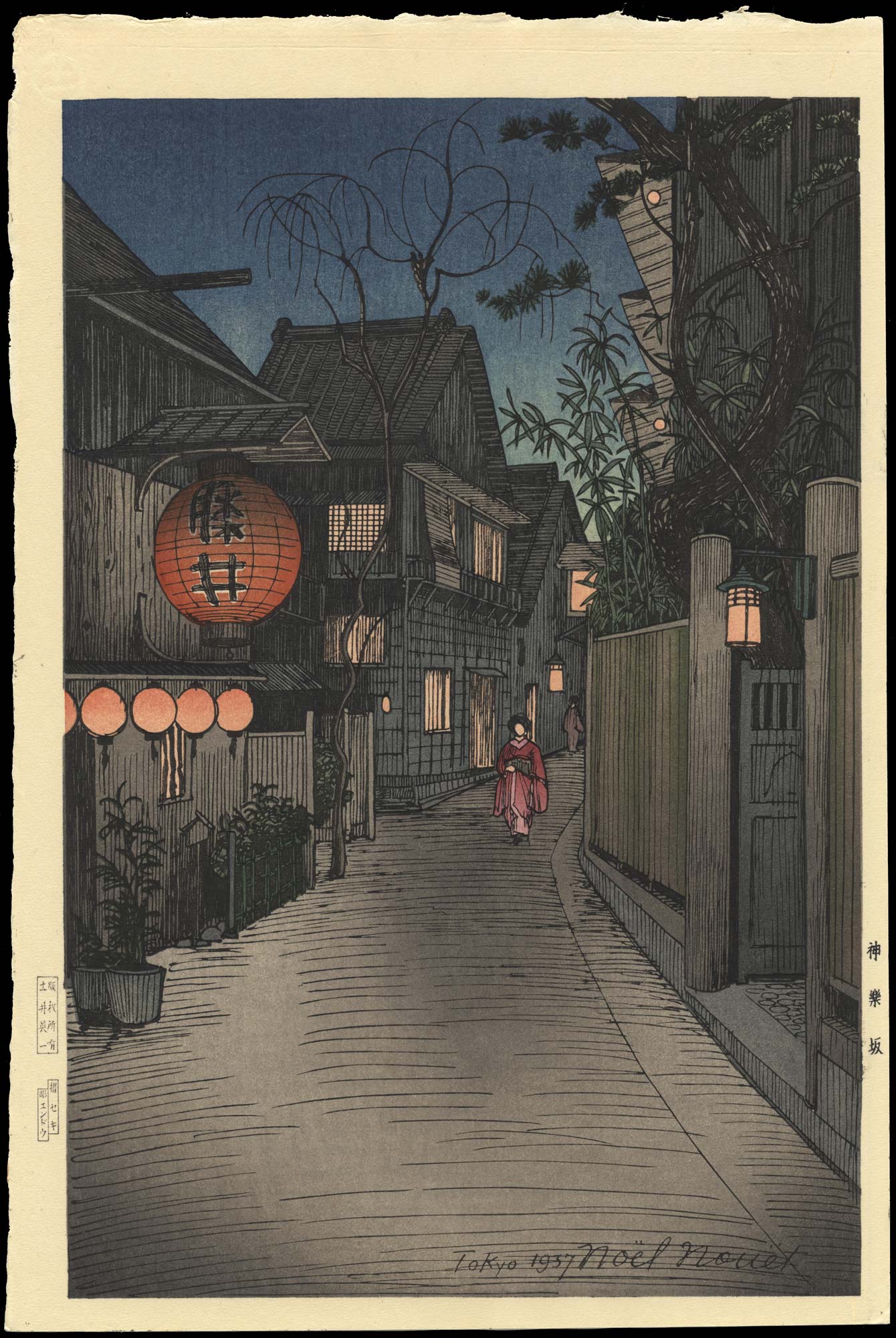
Kagurazaka
by Noël Nouët
- Medium:
- Mokuhanga (Japanese woodblock)
- Image courtesy of
- Saru Gallery
Description
This print depicts Kagurazaka, the steeply sloping street in Tokyo's Ushigome district that was historically a geisha quarter and remains one of the city's most atmospheric neighborhoods. The name refers to the slope's association with kagura, the sacred music performed at the nearby Akagi Shrine. Nouët likely renders the characteristic incline rising past wooden machiya, paper lanterns, and the narrow side alleys (yokocho) for which the district is known, capturing the transitional moment when older Edo townscapes still persisted alongside early Showa modernization. As with much of Nouët's Tokyo work, the composition would draw on his European training in perspective and architectural drawing while employing the flat color planes, registered keyblock outlines, and bokashi gradations of mokuhanga production. The print belongs to the broader cycle of Tokyo views Nouët produced alongside his Mount Fuji series during his decades in Japan, documenting specific neighborhoods of the capital with the eye of a long-term resident rather than a visitor. The Kagurazaka subject places it within the meisho-e tradition of celebrated places, here filtered through a Franco-Japanese sensibility distinctive to Nouët among shin-hanga–era printmakers.
More Prints by Noël Nouët

Featured in Collections
Curated cross-cuts that include this print.
Frequently Asked Questions
Kagurazaka was created by Noël Nouët.