
Untitled work by Noël Nouët
by Noël Nouët
- Source:
- ukiyo-e.org
Description
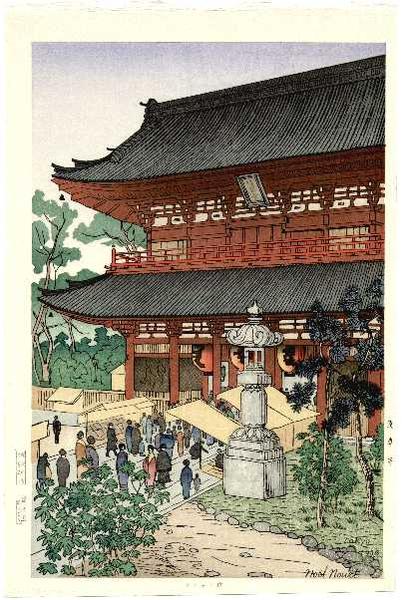
This untitled print by Noel Nouet depicts the Kanda Myojin shrine, one of Tokyo's most storied Shinto sanctuaries, captured with the contemplative European sensibility that distinguishes Nouet's contribution to French shin-hanga. As referenced in the ukiyo-e.org record, the work belongs to Nouet's broader project of documenting Tokyo views during the prewar and early Showa period, when the artist lived in Japan as a teacher of French language and literature. Born in Brittany in 1885 and arriving in Tokyo in 1926, Nouet brought an outsider's eye to the city's neighborhoods, shrines, bridges, and street life, working in close collaboration with the publisher Doi Sadaichi who supervised the carving and printing through traditional shin-hanga workshops. The Kanda Myojin shrine, situated on a hillside in the Kanda district, has long served as a tutelary deity site for merchants and craftsmen of the eastern wards, and Nouet's composition treats the temple architecture with a measured attention to the relationship between built form and surrounding atmosphere rather than ceremonial spectacle. The print exemplifies the hybrid character of French shin-hanga: the underlying drawing carries Western draughtsmanship and a graphic illustrator's clarity of contour, while the printing techniques, mineral pigments, and registration of color blocks belong to the centuries-old woodblock tradition. Nouet typically worked in muted tonal harmonies, favoring overcast skies, blue-gray shadows, and softly graded backgrounds that lend his Tokyo views a quiet, observational mood quite distinct from the more theatrical landscapes of contemporaries such as Hasui or Yoshida. His shrines and temples function less as religious monuments than as nodes of daily life within the urban fabric, recorded by a foreign resident who walked the city extensively before the wartime destruction reshaped its character. The image survives today as both an aesthetic object and a documentary record of Kanda Myojin in its mid-twentieth-century state.
More Prints by Noël Nouët

Featured in Collections
Curated cross-cuts that include this print.
Frequently Asked Questions
(untitled) was created by Noël Nouët.