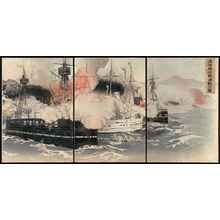
Picture of the Naval Battle Capturing Haiyang Island (Kaiyôtô senryô kaisen no zu)
by Ogata Gekko
- Medium:
- Woodblock print
- Source:
- Museum of Fine Arts Boston
- Image courtesy of
- Museum of Fine Arts Boston
Description
Kaiyōtō senryō kaisen no zu documents the Japanese naval action that secured Haiyang Island (Hai-yang Tao) during the Sino-Japanese War, a strategic operation in the Yellow Sea theater. The capture of Haiyang Island in late 1894 gave Japan a forward base during the campaign against the Liaodong Peninsula. Gekko renders the battle with the compositional conventions of the Meiji war-print genre: warships shown in three-quarter perspective, gun smoke billowing across the picture plane, and water rendered with vigorous wave forms. Island topography visible in the distance would anchor the scene geographically, distinguishing this print from generic naval compositions. As with Gekko's other war prints, the palette likely employs deep prussian blues for the sea and sky against the sharp whites and reds of Japanese naval ensigns.
More Prints by Ogata Gekko
More Landscapes Prints

Lake Kugushi in Wakasa Province (Wakasa Kugushiko), from the series Souvenirs of Travel I (Tabi miyage dai isshu)"
Wakasa Kugushiko
1920
Color woodblock print; oban
Autumn Maple Leaves at Takao, from the album Eight Views of Kyoto (Kyôto hakkei)
Woodblock print

The Beach at Kaiganji in Sanuki Province (Sanuki Kaiganji no hama), from the series "Collection of Views of Japan II, Kansai Edition (Nihon fukei shu II Kansai hen)"
1934
Color woodblock print; oban

Tea Kettle, section of a sheet from the series "Mirror of Stone Rubbings of Views of the Provinces" (Kohon meihitsu ishizuri kagami)
n.d.
Woodblock print; ishizuri-e, section of harimaze sheet
Featured in Collections
Curated cross-cuts that include this print.
Frequently Asked Questions
Picture of the Naval Battle Capturing Haiyang Island (Kaiyôtô senryô kaisen no zu) was created by Ogata Gekko (尾形月耕).
Picture of the Naval Battle Capturing Haiyang Island (Kaiyôtô senryô kaisen no zu) depicts landscapes.