
Mt. Fuji
by Ogata Gekko
- Medium:
- Mokuhanga (Japanese woodblock)
- Image courtesy of
- Saru Gallery
Description
A study of the mountain treated as the principal subject, likely shown in one of its canonical aspects — snow-capped summit against a clearing sky, or seen across a bay or pine plain. Gekko's Fuji compositions typically use a restricted palette dominated by indigo and grey, with bokashi gradations along the sky and at the base of the cone to suggest atmosphere. The figure of Fuji is built up through careful registration of separate color blocks, and the contour of the peak relies on a strong keyblock impression rather than heavy outlining. Within Gekko's work, repeated returns to Fuji place him in the long meisho-e lineage of Hokusai and Hiroshige while also speaking to the mountain's renewed symbolic weight in the Meiji period as a national emblem. His Fuji prints sit alongside his war prints and historical subjects as part of a sustained engagement with Japanese identity at a moment when its terms were being publicly reformulated.
More Prints by Ogata Gekko
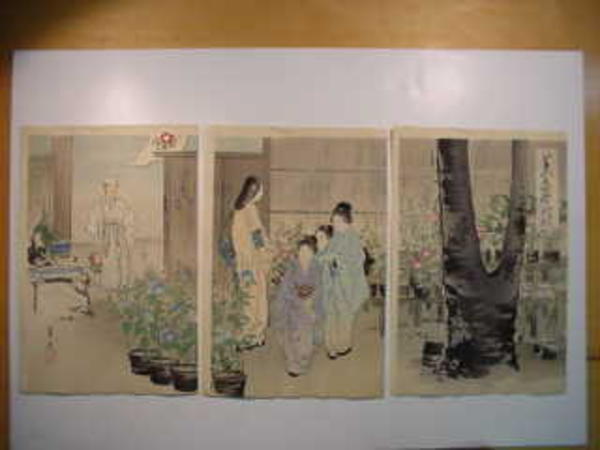
MORNING GLORIES AT IRIYA, TOKYO
Woodblock print

Nippon-damashii, Kyokaku 日本魂 侠客 / Gekko zuihitsu 月耕随筆
Woodblock print
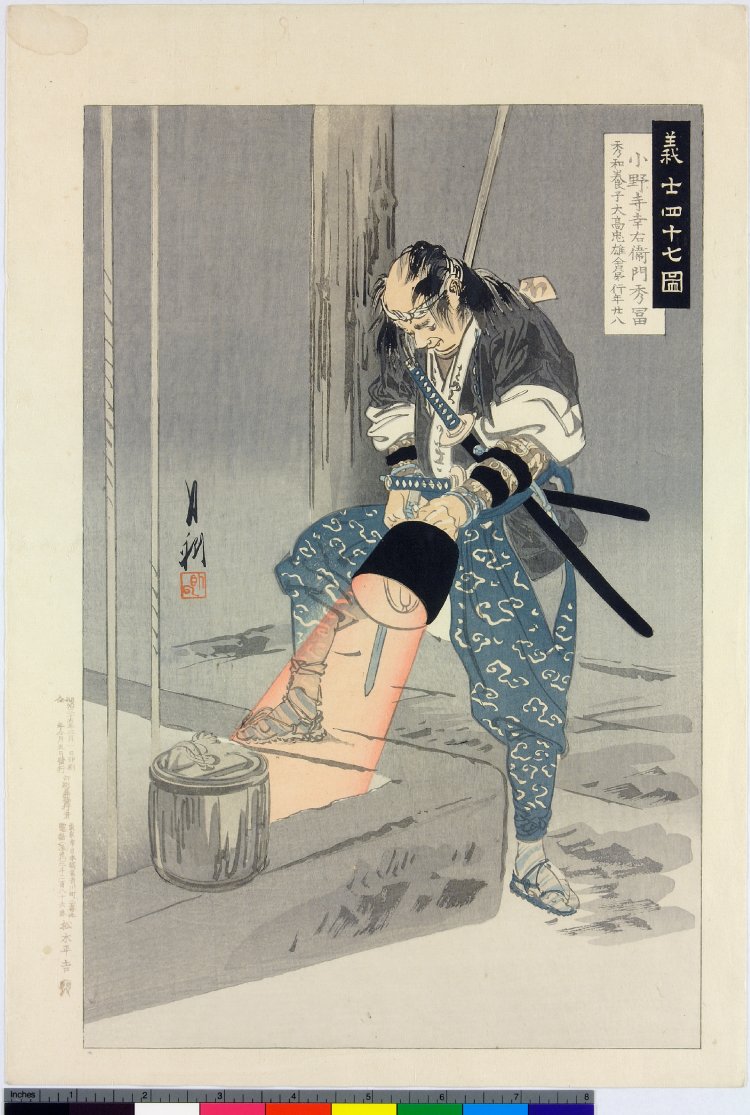
Onodera Koemon Hidetomi 小野寺幸右衛門秀富 / Gishi shijushichi zu 義士四十七図
Woodblock print
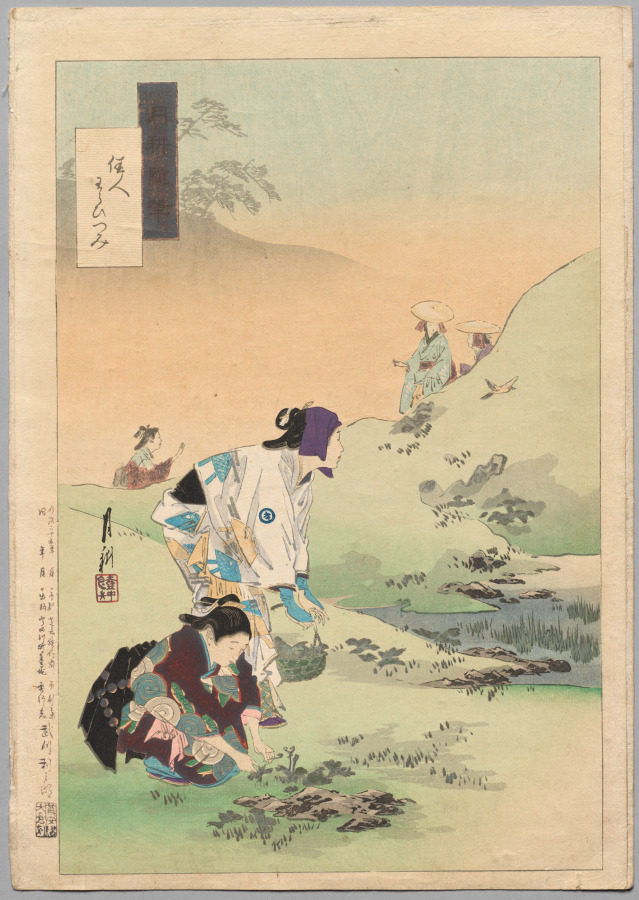
Beauties Harvesting Bracken, from the series Gekkō’s Miscellaney
c. 1886–1899
Woodblock print, ink and color on paper
More Mount Fuji Prints
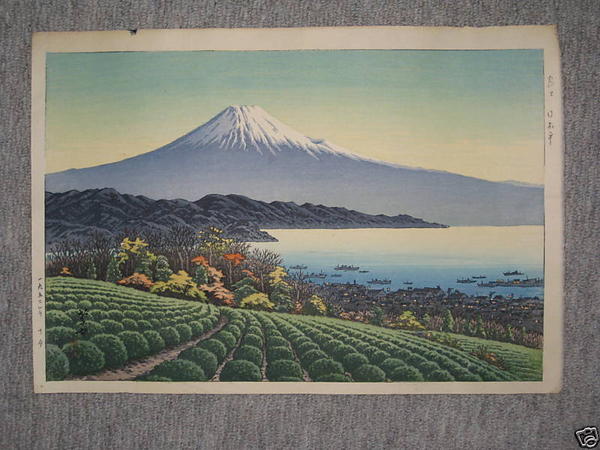
Fuji from tea farm
Woodblock print

Akasaka, Fujikawa, Okazaki, Chiryu, and Narumi, from the series "Famous Places on the Fifty-three Stations of the Tokaido, Five Stations (Tokaido gojusan eki goshuku meisho)"
c. 1830/35
Color woodblock print; oban
![Mount Fuji on a Moonlit Night, Kawai Bridge (Tsukiyo no Fuji [Kawaibashi]), from the series "Selection of Views of the Tokaido (Tokaido fukei senshu)" by Kawase Hasui](https://www.artic.edu/iiif/2/d0960668-1e73-339a-b182-fb995a54bff0/full/843,/0/default.jpg)
Mount Fuji on a Moonlit Night, Kawai Bridge (Tsukiyo no Fuji [Kawaibashi]), from the series "Selection of Views of the Tokaido (Tokaido fukei senshu)"
1947
Color woodblock print; oban

Mt. Fuji in Rain (Ame no Fuji)
n.d.
Color woodblock print
Featured in Collections
Curated cross-cuts that include this print.
Frequently Asked Questions
Mt. Fuji was created by Ogata Gekko (尾形月耕).
Mt. Fuji depicts mount fuji.