
Mt. Fuji and stone lanterns
by Ogata Gekko
- Medium:
- Mokuhanga (Japanese woodblock)
- Image courtesy of
- Saru Gallery
Description
A meisho-e juxtaposing the sacred mountain with stone lanterns (ishi-dōrō), likely sited at a Shinto shrine approach where rows of votive lanterns frame distant views of Fuji. The composition exploits the contrast between the dense, near-foreground masonry of the lanterns — rendered with carved volume and grey washes — and the airy, almost flat conical silhouette of the peak beyond. Such configurations were a recognizable trope in Edo-period meisho prints, where shrine architecture and Mt. Fuji were paired to assert spatial and spiritual continuity. Gekko's handling typically employs bokashi gradation across the sky, with pink or salmon tones near the horizon suggesting dawn or dusk light. Within his oeuvre, prints combining religious architecture with landscape were a recurring vehicle for Meiji-era discussions of national heritage, particularly after the 1868 separation of Buddhism and Shinto (shinbutsu bunri) reshaped many shrine sites and altered their visual iconography.
More Prints by Ogata Gekko
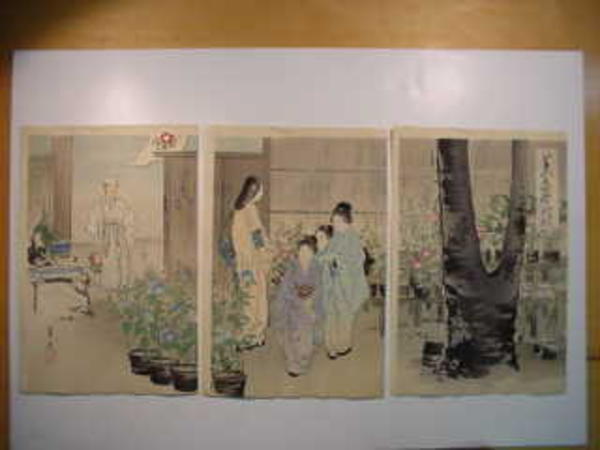
MORNING GLORIES AT IRIYA, TOKYO
Woodblock print

Nippon-damashii, Kyokaku 日本魂 侠客 / Gekko zuihitsu 月耕随筆
Woodblock print
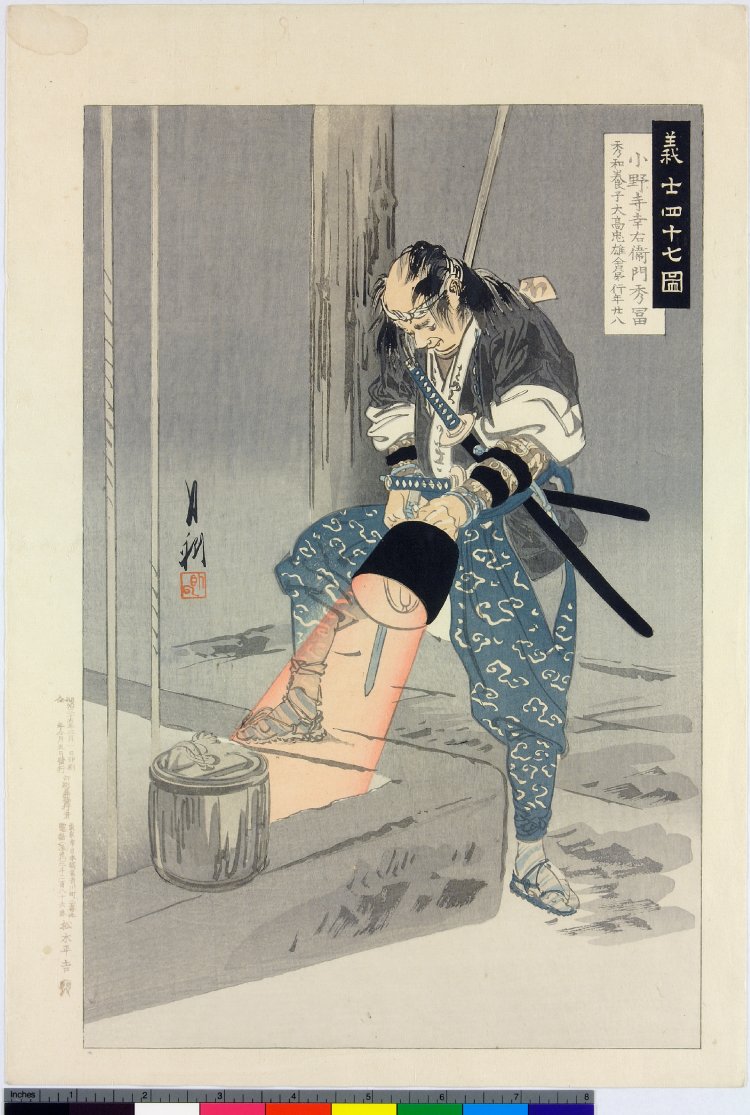
Onodera Koemon Hidetomi 小野寺幸右衛門秀富 / Gishi shijushichi zu 義士四十七図
Woodblock print
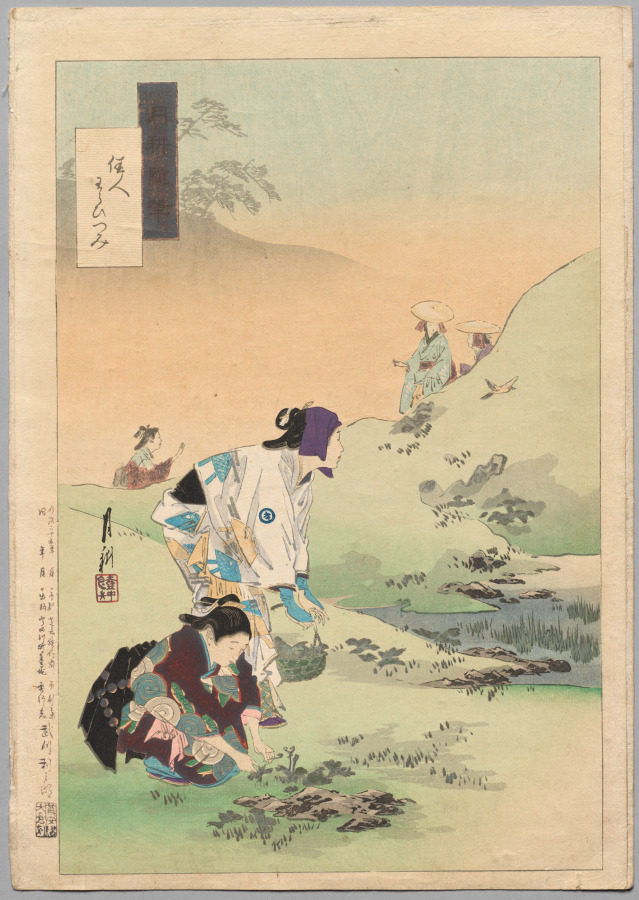
Beauties Harvesting Bracken, from the series Gekkō’s Miscellaney
c. 1886–1899
Woodblock print, ink and color on paper
More Mount Fuji Prints
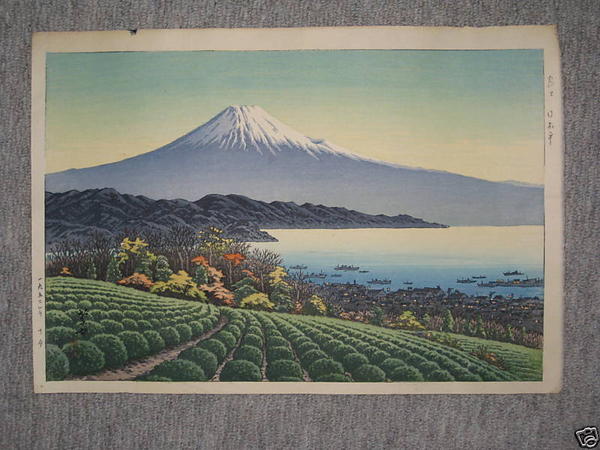
Fuji from tea farm
Woodblock print

Akasaka, Fujikawa, Okazaki, Chiryu, and Narumi, from the series "Famous Places on the Fifty-three Stations of the Tokaido, Five Stations (Tokaido gojusan eki goshuku meisho)"
c. 1830/35
Color woodblock print; oban
![Mount Fuji on a Moonlit Night, Kawai Bridge (Tsukiyo no Fuji [Kawaibashi]), from the series "Selection of Views of the Tokaido (Tokaido fukei senshu)" by Kawase Hasui](https://www.artic.edu/iiif/2/d0960668-1e73-339a-b182-fb995a54bff0/full/843,/0/default.jpg)
Mount Fuji on a Moonlit Night, Kawai Bridge (Tsukiyo no Fuji [Kawaibashi]), from the series "Selection of Views of the Tokaido (Tokaido fukei senshu)"
1947
Color woodblock print; oban

Mt. Fuji in Rain (Ame no Fuji)
n.d.
Color woodblock print
Featured in Collections
Curated cross-cuts that include this print.
Frequently Asked Questions
Mt. Fuji and stone lanterns was created by Ogata Gekko (尾形月耕).
Mt. Fuji and stone lanterns depicts mount fuji.