
Mt. Fuji in the distance
by Ogata Gekko
- Medium:
- Mokuhanga (Japanese woodblock)
- Image courtesy of
- Saru Gallery
Description
A landscape composition in which Fuji appears as a small but commanding element on the horizon, framed by foreground subjects — likely figures, trees, or coastal elements — that establish scale and atmospheric perspective. Gekko frequently employed bokashi (graduated color washes) to suggest distance and weather, and prints of this kind use the recession of the cone behind layers of cloud or mist to evoke the meisho-e tradition reaching back to Hokusai and Hiroshige. The technical work involves careful registration of the multiple blocks needed for sky gradients alongside the denser linework of nearer elements. As an artist working through the Meiji period, Gekko both inherited and modernized this iconography; his Fuji prints participated in a sustained late-nineteenth-century interest in landscape that ran alongside his concurrent production of war prints, bijin-ga, and historical subjects. The composition typifies his willingness to handle the mountain as backdrop rather than singular subject, locating it within everyday observation.
More Prints by Ogata Gekko
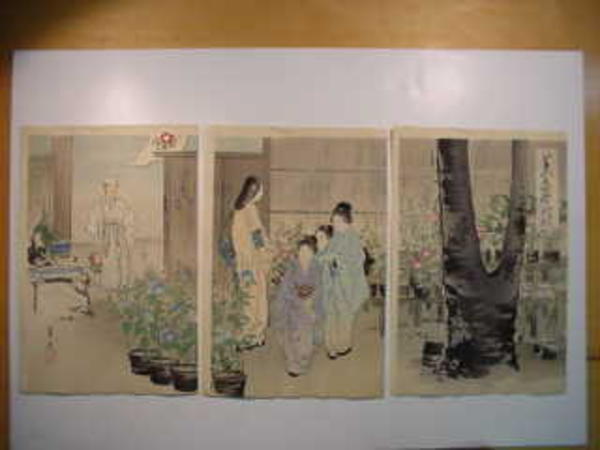
MORNING GLORIES AT IRIYA, TOKYO
Woodblock print

Nippon-damashii, Kyokaku 日本魂 侠客 / Gekko zuihitsu 月耕随筆
Woodblock print
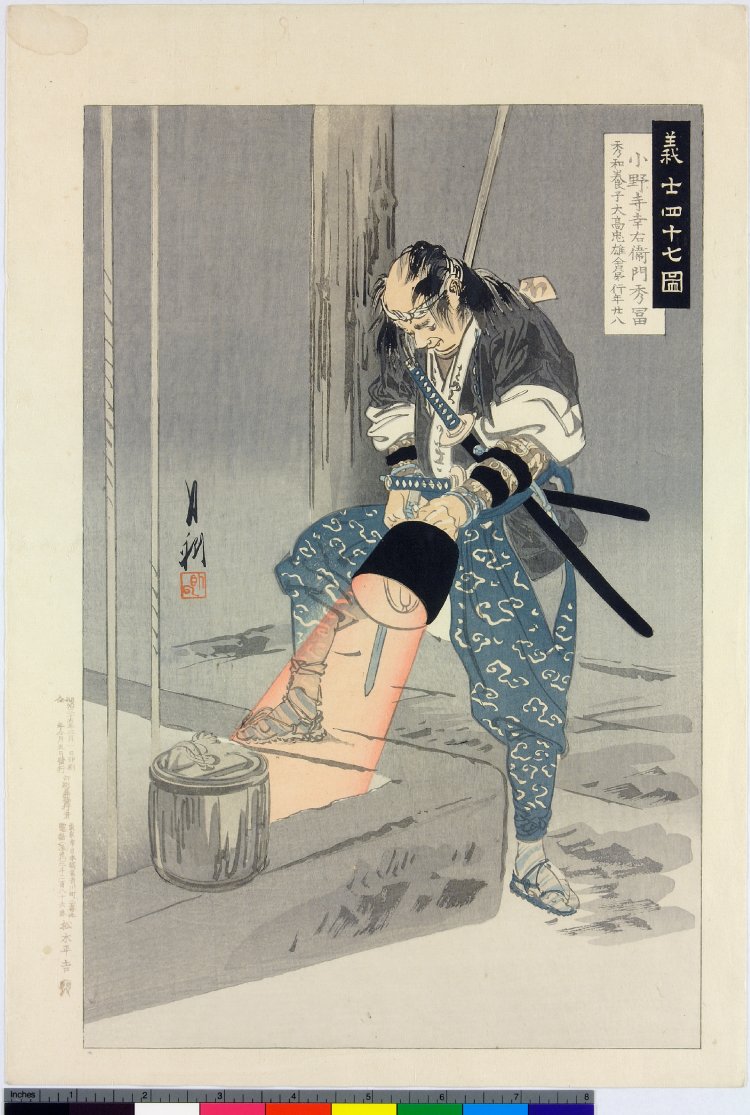
Onodera Koemon Hidetomi 小野寺幸右衛門秀富 / Gishi shijushichi zu 義士四十七図
Woodblock print
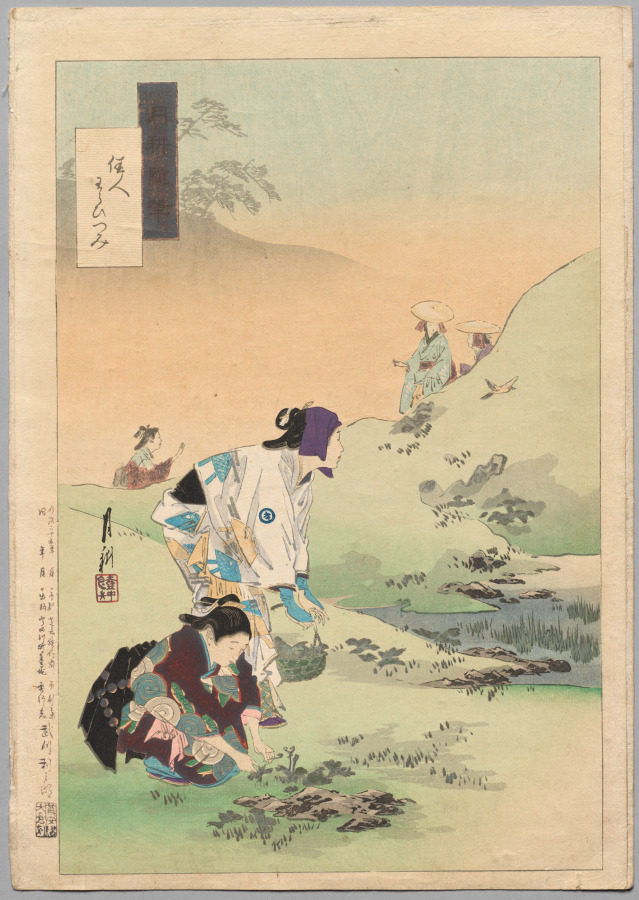
Beauties Harvesting Bracken, from the series Gekkō’s Miscellaney
c. 1886–1899
Woodblock print, ink and color on paper
More Mount Fuji Prints
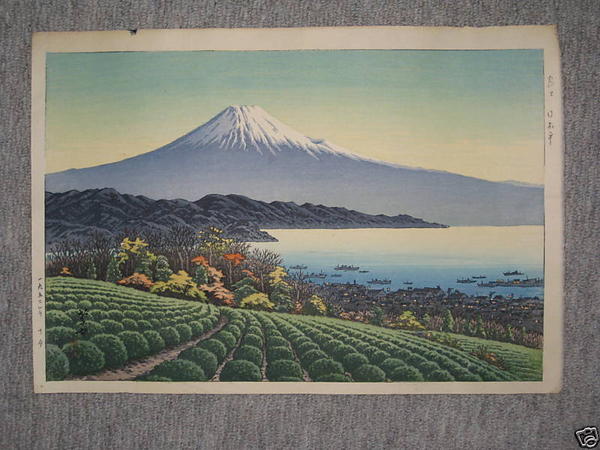
Fuji from tea farm
Woodblock print

Akasaka, Fujikawa, Okazaki, Chiryu, and Narumi, from the series "Famous Places on the Fifty-three Stations of the Tokaido, Five Stations (Tokaido gojusan eki goshuku meisho)"
c. 1830/35
Color woodblock print; oban
![Mount Fuji on a Moonlit Night, Kawai Bridge (Tsukiyo no Fuji [Kawaibashi]), from the series "Selection of Views of the Tokaido (Tokaido fukei senshu)" by Kawase Hasui](https://www.artic.edu/iiif/2/d0960668-1e73-339a-b182-fb995a54bff0/full/843,/0/default.jpg)
Mount Fuji on a Moonlit Night, Kawai Bridge (Tsukiyo no Fuji [Kawaibashi]), from the series "Selection of Views of the Tokaido (Tokaido fukei senshu)"
1947
Color woodblock print; oban

Mt. Fuji in Rain (Ame no Fuji)
n.d.
Color woodblock print
Featured in Collections
Curated cross-cuts that include this print.
Frequently Asked Questions
Mt. Fuji in the distance was created by Ogata Gekko (尾形月耕).
Mt. Fuji in the distance depicts mount fuji.