
Two White Cockatoos on Red Bar
by Ohara Koson
- Source:
- ukiyo-e.org
Description
Two White Cockatoos on Red Bar is a striking shin-hanga kacho-e woodblock print by Ohara Koson, the early twentieth-century Japanese artist who became the definitive master of bird-and-flower compositions for the modern revival of ukiyo-e printmaking. The image presents a pair of brilliantly white cockatoos perched together on a vivid red horizontal bar, their plumage rendered through delicate gradations of mica-like white pigment against an unadorned background that throws the birds into sculptural relief. Koson uses the saturated vermilion of the perch as a structural anchor, allowing the eye to rest first on this single bold accent before traveling upward to register the subtle textures of feathers, the careful articulation of crests, and the quiet interaction between the two paired birds. This compositional restraint, paired with the use of the empty field to suggest air and atmosphere rather than depicting a literal habitat, exemplifies the design principles that distinguished Koson's mature work for publisher Watanabe Shozaburo and the shin-hanga movement more broadly. Watanabe, the central impresario of the new prints revival in Tokyo, encouraged Koson to refine traditional kacho-e conventions for an international audience that prized aesthetic clarity and decorative power, and prints such as this one demonstrate how successfully the partnership translated classical bird-and-flower painting into the woodblock medium for export. The cockatoo, an exotic subject in the Japanese visual vocabulary, was a recurring favorite for Koson, who returned to white parrots and cockatoos repeatedly across his career under his various signatures, including Shoson and Hoson. This impression is documented through the ukiyo-e.org aggregator, which collects records of Koson's prints from museum and dealer holdings worldwide, preserving images of compositions whose original publication dates and series affiliations are not always fully recorded.
More Prints by Ohara Koson

Cat and Goldfish
c. 1928–1930
Woodblock print, ink and color on paper
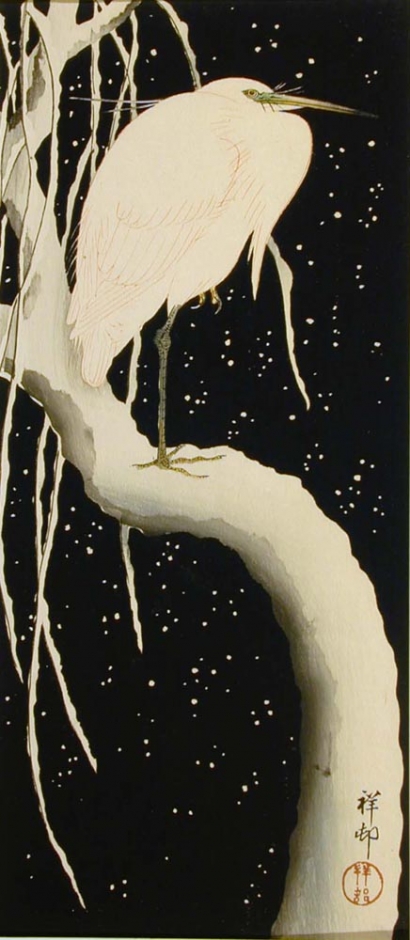
Heron or Egret
c. 1900–1945
Woodblock print
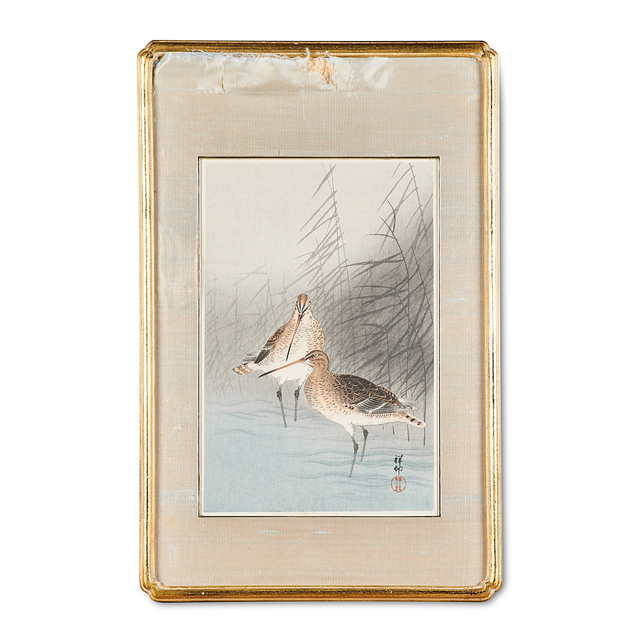
"Snipes and Reeds," 1926 and "Wild Ducks and Pampas Grass"
Two woodblocks in colors (framed separately)
Magpie with Pink and White Magnolia Blossoms
Shōwa period, circa 1931
Woodblock print in "ōban" format; ink and color on paper
More Birds & Flowers Prints
Featured in Collections
Curated cross-cuts that include this print.
Frequently Asked Questions
Two White Cockatoos on Red Bar was created by Ohara Koson (小原古邨).
Two White Cockatoos on Red Bar depicts birds & flowers.