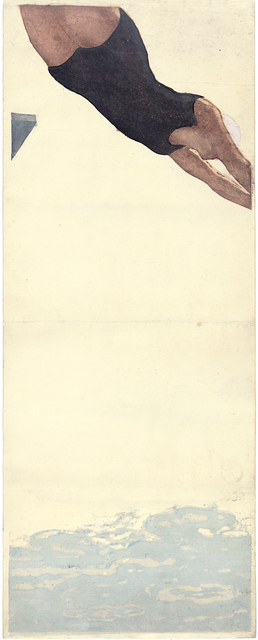
Diving
- Date:
- 1932
- Medium:
- Color woodcut on paper
- Image courtesy of
- Artsy
Description
Diving (Tobikomi), produced by Onchi Koshiro in 1932, is a striking interwar work that captures the artist at a moment when he was actively engaging with Western modernist figural strategies while continuing to develop his own woodblock vocabulary. The composition isolates a figure in mid-dive — body extended, limbs articulated through a small set of clean carved planes — against a simplified ground that suggests sky and water without rendering them descriptively. The print belongs to a wider strand of early Showa modernism in which Japanese artists — painters, photographers, and printmakers alike — turned to athletic, swimming, and beach subjects as emblems of contemporary urban life, drawing on European Art Deco and on the body culture promoted by 1920s and 1930s magazines. Onchi's interest, however, is not anecdotal: Diving uses the athlete's body as a structural device, an opportunity to study how figure, air, and edge can be balanced through carved line and inked tone, in much the way that his interwar Cubist-influenced still lifes used domestic objects to organize tightly composed pictorial space. The work is fully consistent with the sosaku-hanga (creative print) principle Onchi had championed since the Tsukuhae years of the mid-1910s, in which the artist personally designed, carved, and printed each impression so that every mark carried direct authorship; nothing in Diving was delegated to a publisher or a workshop, an insistence that distinguished his practice from the shin-hanga (new prints) studios of Watanabe Shozaburo and others, where division of labor was the norm. The print also sits within Onchi's wider interest in the modern human figure, an interest that ran from his 1915 Bathers in the Tsukuhae circle through his 1920s portraits and into his deeply influential portraits of writers, including the celebrated 1943 abstract Portrait of the Poet Hagiwara Sakutaro. Although no museum source is documented for this specific impression in the present records, the work can be examined through Artsy's listing for this print (https://www.artsy.net/artwork/koshiro-onchi-diving), which preserves a clear image and provenance information. For students of Onchi Koshiro, the 1932 Diving is a useful counterweight to his more familiar abstract late prints: it shows him fully invested in modernist figuration in the interwar years, treating the diver's leap as both a sign of contemporary life and a formal problem to be solved through woodblock.
More Prints by Onchi Koshiro

Featured in Collections
Curated cross-cuts that include this print.
Frequently Asked Questions
Diving was created by Onchi Koshiro (恩地孝四郎) in 1932.