Biography
Onchi Koshiro (1891-1955) was a Japanese artist widely regarded as the father of modern Japanese abstract printmaking and one of the founding figures of the sosaku-hanga (creative prints) movement. A visionary who challenged the centuries-old collaborative system of Japanese woodblock production, Onchi championed the radical idea that the artist should be the sole creator of a print — designing, carving, and printing the work entirely by hand. His pioneering abstract compositions, lyrical portraits, and experimental techniques opened new expressive possibilities for the woodblock medium and profoundly influenced generations of Japanese printmakers who followed him.
Born on July 2, 1891, in Tokyo, Onchi grew up in a cultured household that valued both traditional Japanese arts and Western learning. His father was an official in the Imperial Household Agency, and young Koshiro was exposed from an early age to the finest examples of Japanese art and culture. He attended the Tokyo Fine Arts School (Tokyo Bijutsu Gakko, now Tokyo University of the Arts), where he studied Western-style painting and developed a strong foundation in drawing, color theory, and composition. However, it was during his student years that he first encountered the ideas that would lead him to printmaking and, specifically, to the sosaku-hanga philosophy.
The sosaku-hanga movement had its intellectual roots in the belief, promoted by artists and critics in the early twentieth century, that a true work of art must be the product of a single creative vision. This stood in direct opposition to the traditional ukiyo-e system, still championed by the shin-hanga movement, in which an artist designed an image that was then carved and printed by separate teams of specialized craftsmen. For Onchi and his sosaku-hanga colleagues, this division of labor diluted the artistic integrity of the final print. They argued that only when an artist personally controlled every stage of production — from initial concept through carving and printing — could the resulting work be considered a genuine expression of individual creativity.
In 1914, Onchi and two fellow students, Fujimori Shizuo and Tanaka Kyokichi, founded the journal "Tsukuhae" (Moon Reflections), which became an important platform for sosaku-hanga ideas. The journal published original prints by the three founders and other like-minded artists, along with critical essays that articulated the theoretical underpinnings of the creative print movement. This publication marked the beginning of Onchi's lifelong commitment to promoting sosaku-hanga as a modern artistic practice equal in stature to painting and sculpture.
Throughout the 1920s and 1930s, Onchi developed his artistic practice in several directions simultaneously. He produced figurative prints — landscapes, still lifes, and portraits — that demonstrated the expressive potential of the artist-as-sole-creator approach. These works, while representational, already showed the tendency toward simplification, bold design, and emphasis on the physical qualities of the medium that would characterize his mature style. He experimented with different papers, inks, and printing techniques, exploring the unique marks that could be achieved when the artist directly engaged with the materials of printmaking rather than delegating technical execution to specialists.
It was in the realm of abstraction, however, that Onchi made his most revolutionary contributions. Beginning in the 1930s, he created a series of abstract compositions that were among the first purely non-representational works in the history of Japanese printmaking. His landmark series "Poem" (also known as "Poem No." followed by a number) explored abstract form and color in ways that paralleled — and in some cases anticipated — developments in Western abstract art. These prints used organic shapes, flowing lines, and carefully modulated color fields to create compositions that evoked musical and poetic qualities without depicting recognizable objects. Works such as "Poem No. 8: Season of Butterflies" (1948) and other entries in the series are now recognized as masterpieces of twentieth-century printmaking.
Onchi's abstract prints were remarkably innovative in their technique as well as their imagery. He employed a wide range of materials beyond traditional wood — including fabric, string, paper, and leaves — to create textured printing surfaces that produced effects impossible to achieve with conventional woodblocks. These experimental methods anticipated the mixed-media approaches that would become widespread in Western printmaking only decades later. His willingness to push beyond the boundaries of traditional materials and techniques reflected his belief that the sosaku-hanga artist should be unconstrained by convention, free to explore whatever means best served the creative vision.
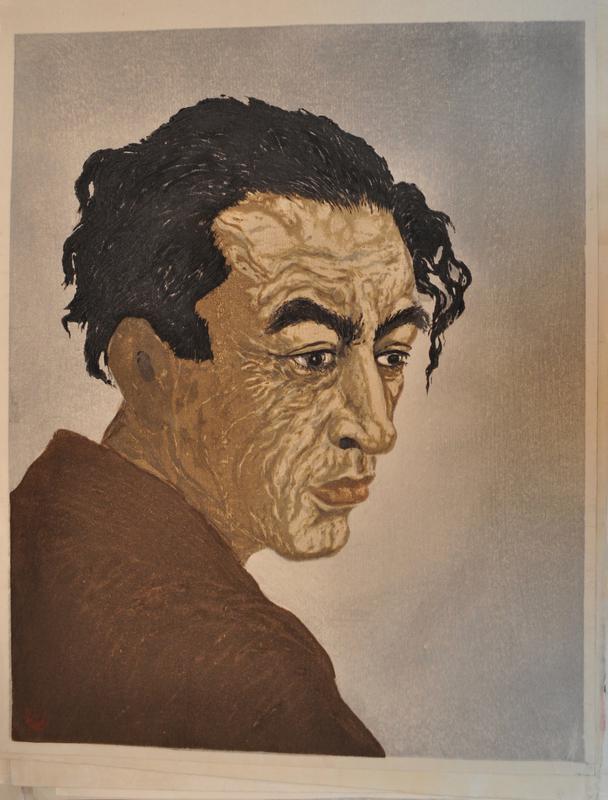
In addition to his abstract work, Onchi produced a distinguished body of portrait prints that rank among the finest achievements of Japanese printmaking. His portraits of fellow artists, writers, and cultural figures — including the celebrated "Portrait of the Poet Hagiwara Sakutaro" — combine sensitive characterization with bold formal invention. These portraits are not photographic likenesses but interpretive renderings that seek to capture the inner spirit and intellectual character of the subject through simplified forms, expressive line work, and the creative use of texture and color.
Onchi was also a significant figure as an organizer, teacher, and mentor. He played a leading role in several printmaking organizations, including the Nihon Sosaku-Hanga Kyokai (Japan Creative Print Association) and the Ichimoku-kai (First Thursday Society), which he founded in 1939 and which served as a vital gathering place for sosaku-hanga artists for many years. Through these organizations and his personal mentorship, Onchi influenced a generation of younger artists, including Jun'ichiro Sekino, Azechi Umetaro, and many others who would carry the sosaku-hanga movement forward.
His role as a book designer was also considerable. Onchi designed hundreds of book covers and illustrations during his career, applying his modernist aesthetic sensibility to the world of commercial publishing. His book designs, like his prints, combined Japanese aesthetic traditions with influences from European modernism, creating a distinctive visual language that influenced Japanese graphic design for decades.
During World War II, Onchi continued to work despite the hardships of wartime Japan. After the war, he experienced a remarkable creative resurgence. The postwar period saw growing international interest in Japanese printmaking, and Onchi's work began to receive recognition outside Japan. His prints were included in major international exhibitions, and he was increasingly acknowledged as a major figure in world printmaking.
Onchi Koshiro died on June 3, 1955, in Tokyo, at the age of sixty-three. His death came just as the international recognition of sosaku-hanga was reaching its peak, with Japanese creative printmakers winning major prizes at the Sao Paulo and Ljubljana international print biennials. Onchi's legacy is immense: he is credited with establishing abstract printmaking in Japan, with pioneering experimental techniques that expanded the possibilities of the medium, and with nurturing the sosaku-hanga movement from a small circle of idealistic young artists into a major force in twentieth-century art. His work is held in numerous museum collections worldwide, including the Museum of Modern Art, New York; the National Museum of Modern Art, Tokyo; the British Museum; the Art Institute of Chicago; and the Honolulu Museum of Art.
Key Facts
- Active Period
- 1891–1955
- Nationality
- 🇯🇵Japan
- Movement
- Sōsaku-hanga
- Works Indexed
- 178
Frequently Asked Questions
Onchi Koshiro (1891-1955) was a Japanese artist widely regarded as the father of modern Japanese abstract printmaking and one of the founding figures of the sosaku-hanga (creative prints) movement. A visionary who challenged the centuries-old collaborative system of Japanese woodblock production, Onchi championed the radical idea that the artist should be the sole creator of a print — designing, carving, and printing the work entirely by hand. His pioneering abstract compositions, lyrical portraits, and experimental techniques opened new expressive possibilities for the woodblock medium and profoundly influenced generations of Japanese printmakers who followed him.
Onchi Koshiro was active from 1891 to 1955. They were associated with the Sōsaku-hanga movement.
Onchi Koshiro's work was shaped by the Sōsaku-hanga tradition in Japanese woodblock printmaking. Sōsaku-hanga: ## What is sōsaku-hanga? Sōsaku-hanga (創作版画, "creative prints") was a twentieth-century Japanese print movement defined by a single commitment: the artist must design, carve, and print every work alone.
Onchi Koshiro's prints frequently feature abstract, portraits, figures, landscapes, daily life, seascapes.
Original prints by Onchi Koshiro can be found in collections including Japanese Art Open Database, Honolulu Museum of Art, Art Institute of Chicago, British Museum.
External Resources
Series by Onchi Koshiro
Woodblock Prints by Onchi Koshiro (178)
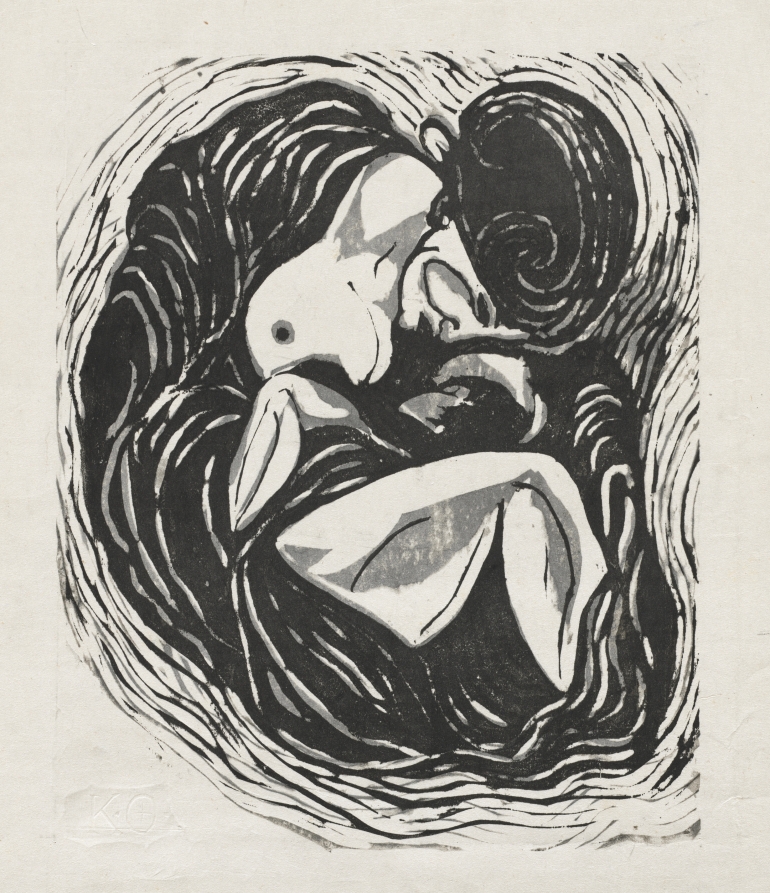
Mother and Child
c. 1915–1955
Color woodblock print
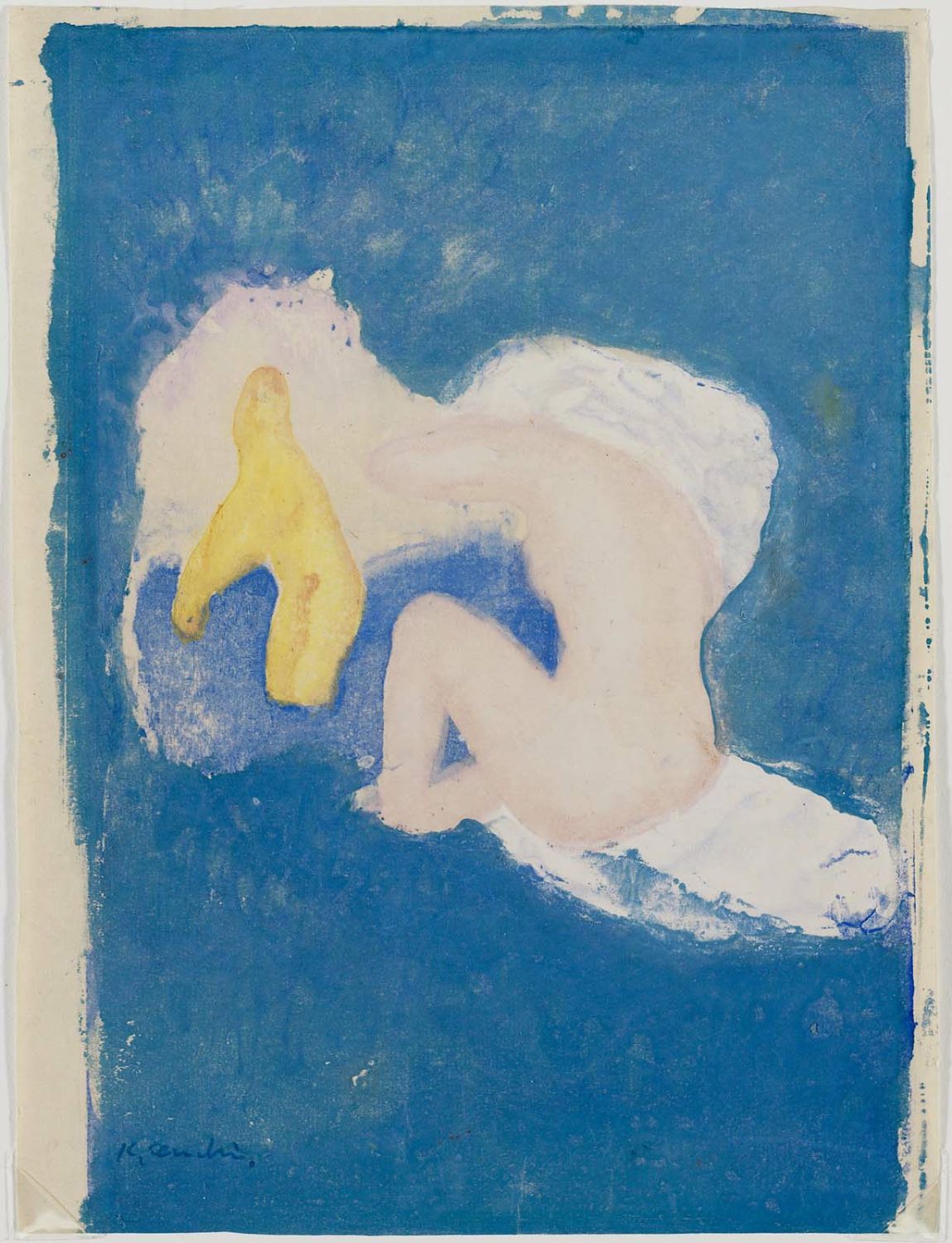
Bathers
浴女
1915
Color woodblock print

A Spring, from the series "Happiness"
1916
Color woodblock print

Impression of a violinist (a portrait of Suwa Nejiko (1920-2012))
Mokuhanga (Japanese woodblock)

Mirror, from the series "Eight Women of Modern Times (Imayo fujin hattai no uchi)"
1929
Color woodblock print; edition 12/80

Among the Rocks
1929
Color woodblock print

Inside the Hogaku Theater (Hogakuza naikei), from the series "New One Hundred Views of Tokyo (Shin Tokyo hyakkei)"
1929
Color woodblock print

Hair
1930
Color woodblock print
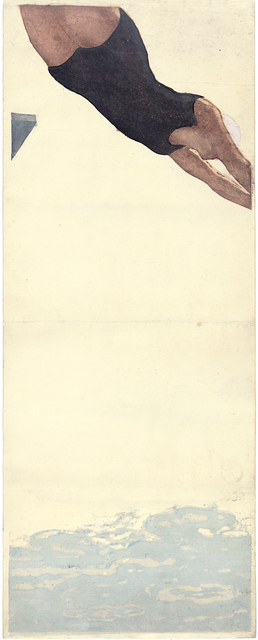
Diving
1932
Color woodcut on paper

Mannequin in the Studio
1936
Color woodblock print

The Sea (Umi)
1937
Color woodblock print; triptych

Sketch for the print "Portrait of Yamada Kosaku"
1938
Pastel on Japanese paper (mitsumata fiber), graphite

Calendar Sheet August 1940
Mokuhanga (Japanese woodblock)

Calendar Sheet December 1941
Mokuhanga (Japanese woodblock)

Album of New Year cards 1941
Mokuhanga (Japanese woodblock)

Album of New Year cards 1942
Mokuhanga (Japanese woodblock)
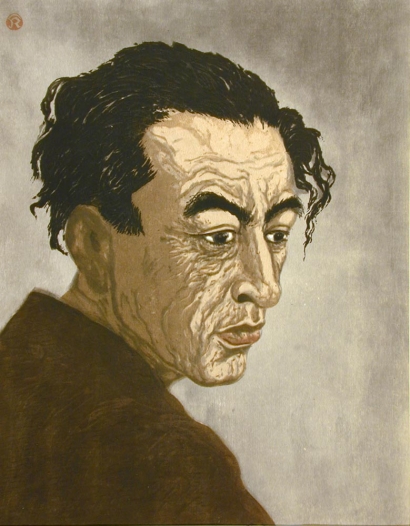
Portrait of the Poet Hagiwara Sakutaro
萩原朔太郎像
1943
Color woodblock print

Portrait of the Poet Hagiwara Sakutaro (1886–1942), Author of “Ice Island,” 1943
1943
Color woodblock print

Calendar Sheet May 1943
Mokuhanga (Japanese woodblock)

Niju Bridge at the Imperial Palace, from the series Recollections of Tokyo
1945
Color woodblock print

Tokyo Station, from the series Recollections of Tokyo
1945
Color woodblock print
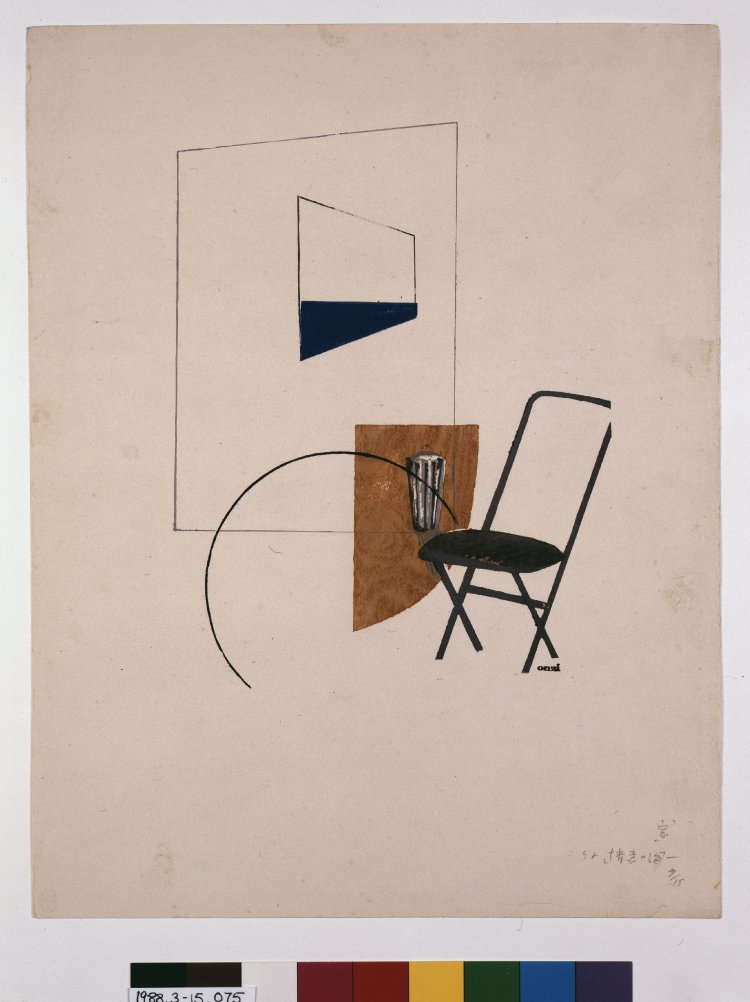
The Sea
海
1945
Color woodblock print

Ueno Zoo, from the series Recollections of Tokyo
1945
Color woodblock print
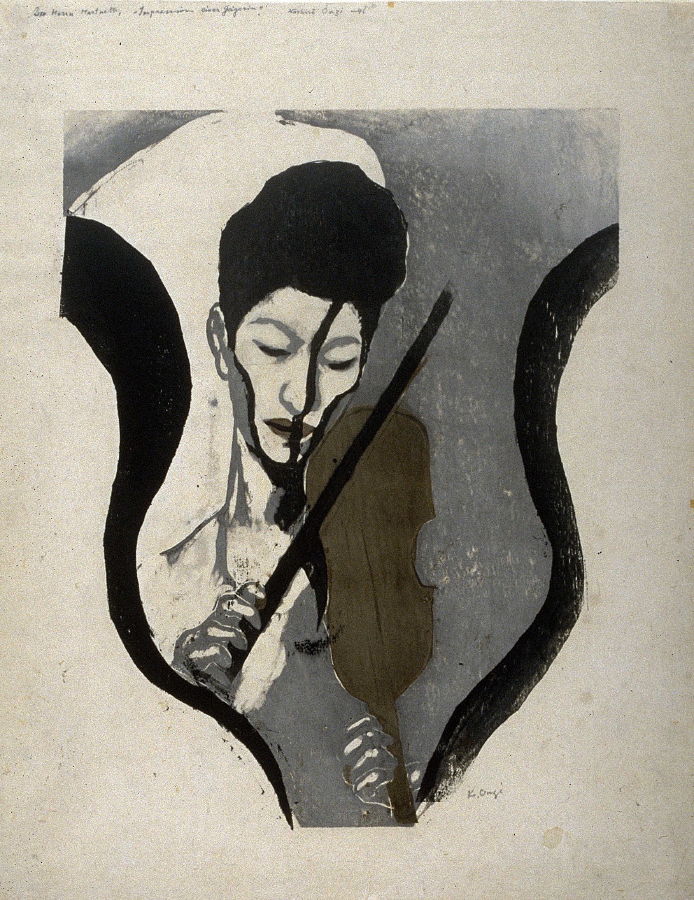
Impression of a Violinist
ヴァイオリニストの印象
1946
Color woodblock print