
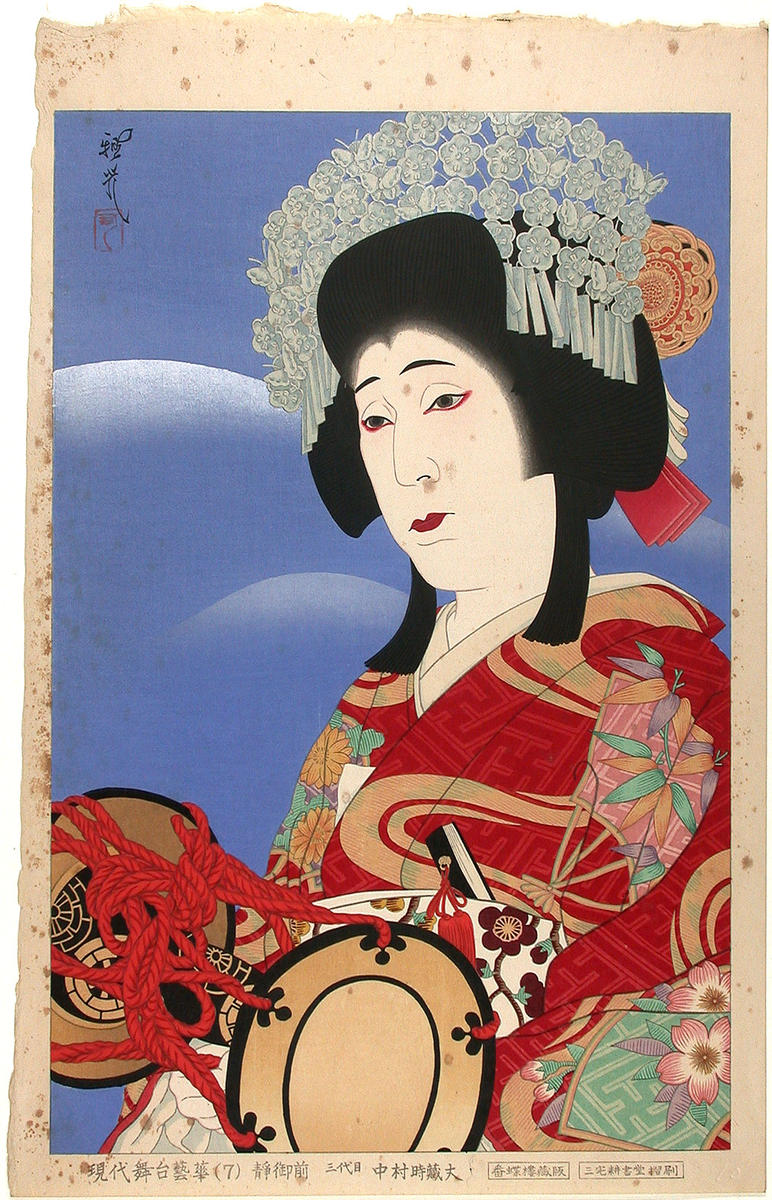
The actor Nakamura Utaemon VI playing the role of the shirabyôshi Hanako in the famous dance Musume Dôjôji
- Medium:
- Mokuhanga (Japanese woodblock)
- Image courtesy of
- Saru Gallery
Description
The second of Ota's portraits of Utaemon VI in Musume Dojoji captures a different moment in the dance's extended sequence -- perhaps the tenugui or kasa segments, where the shirabyoshi handles a dance prop drawn from the temple ceremony. The hikinuki costume-change tradition makes each phase of Musume Dojoji visually distinct, and Ota's pair of prints would have allowed collectors to follow Utaemon's transformation across the performance. The composition holds to the same yakusha-e isolation as the companion sheet, but the kimono pattern, sleeve position, and prop in hand mark this as a separate stage in the choreography. Ota's working practice of producing multiple prints from a single role reflects his approach to kabuki as a sequence of distinct pictorial moments rather than a single canonical pose. For Utaemon VI's Hanako specifically, the dance contained too many signature instants to compress into one image, and the second print preserves what the first could not.
More Prints by Ota Masamitsu


More Theater Prints


![Kabukiza [Kabuki Theater] by Sonoyama Harumi](https://www.artic.edu/iiif/2/10806d46-109a-d67f-30ac-d57e9b374873/full/843,/0/default.jpg)
![Inside Scene of Kabukiza [Kabuki theater] (One Hundred Views of Tokyo, Message to the 21st Century) by Obata Tsutomu](https://www.artic.edu/iiif/2/33905fb8-c304-71f5-6150-cb9260cf9efa/full/843,/0/default.jpg)
Featured in Collections
Curated cross-cuts that include this print.
Frequently Asked Questions
The actor Nakamura Utaemon VI playing the role of the shirabyôshi Hanako in the famous dance Musume Dôjôji was created by Ota Masamitsu (太田雅光).
The actor Nakamura Utaemon VI playing the role of the shirabyôshi Hanako in the famous dance Musume Dôjôji depicts theater.